
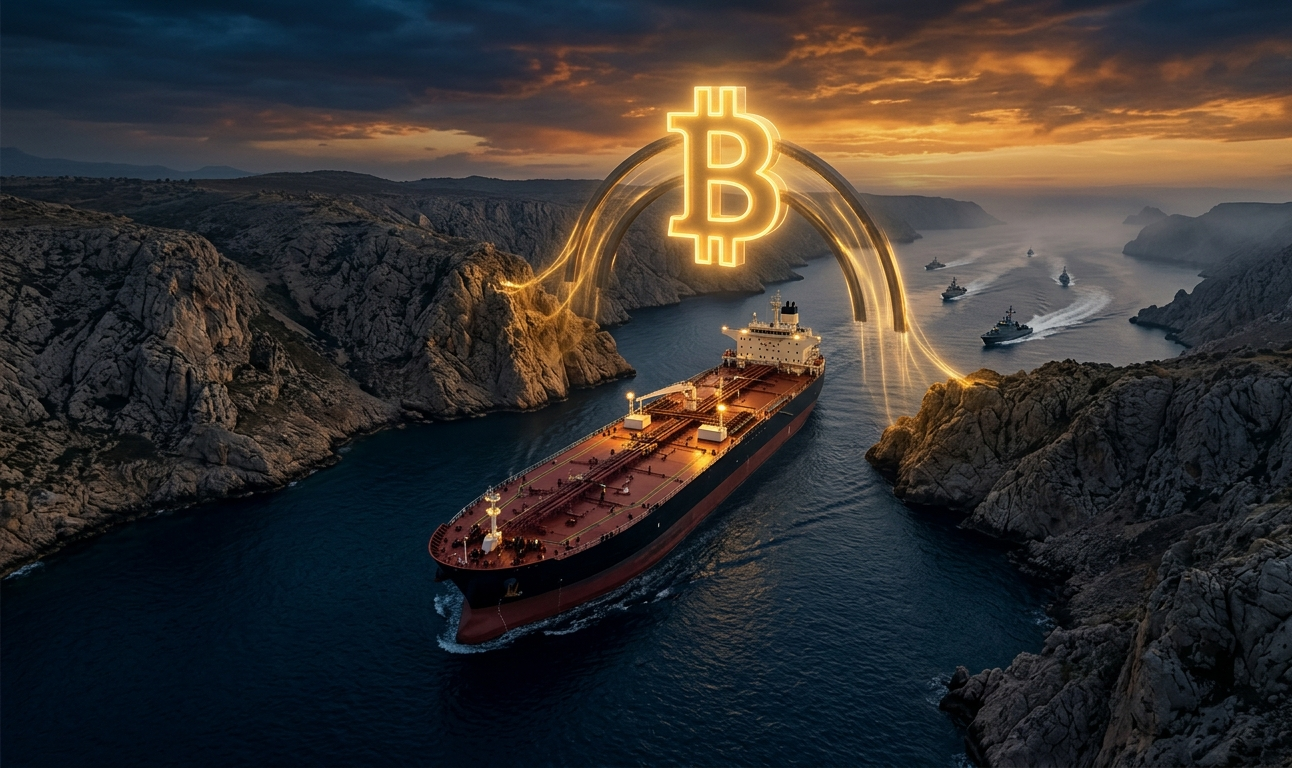
A waterway that carries roughly 20% of the world’s oil and liquefied natural gas supply has just become the site of a genuinely historic development for Bitcoin. Iran is demanding that oil tankers seeking passage through the Strait of Hormuz pay transit fees in cryptocurrency, including Bitcoin and dollar-pegged stablecoins, at a rate of approximately $1 per barrel of cargo. For a fully loaded Very Large Crude Carrier carrying two million barrels, that means a toll of up to $2 million per transit. The disclosure, first reported by the Financial Times and confirmed by Hamid Hosseini, a spokesperson for Iran’s Oil, Gas and Petrochemical Products Exporters’ Union, marks the first time a nation state has used crypto infrastructure as a sovereign revenue mechanism at a major global maritime chokepoint.
How the System Works
Under the proposed system, tankers must email cargo details to Iranian authorities, who will levy a toll of about $1 per barrel and instruct crews on how to settle the fee in digital assets such as Bitcoin. Empty tankers can pass freely, but fully laden vessels must comply with the reporting and crypto payment process before being cleared for passage.


Once the email arrives and Iran completes its assessment, vessels are given a few seconds to pay in Bitcoin. That design ensures transactions cannot be traced or seized under international sanctions, according to Iranian officials. Iran says the system is also intended to ensure weapons are not being sent through the Strait during the two-week ceasefire period.
Iran applies a five-tier nationality ranking system. Nations deemed friendlier receive lower rates, while vessels linked to the United States or Israel are denied transit entirely. Ship operators must submit vessel ownership records, flag registration, cargo manifests, destination ports, crew lists, and AIS tracking data to an unnamed IRGC-linked intermediary. Once payment clears, the IRGC issues a one-time secret permit code and route instructions directing ships along a path closer to the Iranian coast, often north of Larak Island. The vessel broadcasts the code on VHF radio, and an IRGC patrol boat escorts it through.
This Is Not a New Playbook
The Iranian regime and more specifically the Islamic Revolutionary Guard Corps has been increasingly using cryptocurrency over the last few years to facilitate cross-border commercial trade, especially in Iranian oil sales, according to data from blockchain analytics firm Chainalysis. Andrew Fierman, head of national security intelligence at Chainalysis, described the Hormuz toll system as highly unsurprising, noting that the IRGC had already built a complex and functioning crypto payment network for commercial trade long before it was applied to the strait.
As TRM Labs documented ahead of an OFAC designation in January 2026, the IRGC had already routed approximately $1 billion through offshore, exchange-branded stablecoin infrastructure, exploiting the same properties that attract lawful users: low transaction costs, high throughput, deep broker liquidity, and widespread regional adoption, all outside the U.S. correspondent banking system. The Hormuz toll system deploys that same architecture, transforming a pre-existing sanctions evasion rail into a real-time revenue collection mechanism for the Iranian state.
The Scale of the Revenue at Stake
At current traffic levels, public estimates suggest the toll system could generate up to $20 million per day from oil tankers alone, with $600 to $800 million per month possible if liquefied natural gas vessels are included. Before the war began in late February 2026, between 100 and 120 commercial vessels passed through the strait each day. As the conflict tightened, the IRGC effectively closed the strait to most commercial traffic, sending tanker transits down by 97%, according to S&P Global data. Even at a fraction of pre-war traffic levels, the crypto toll system represents a potentially significant revenue stream for a state operating under severe sanctions.
Iran’s National Security Committee approved a bill in early April 2026 to codify the fee structure into law. Payment is accepted in Chinese yuan routed through Kunlun Bank, or in dollar-pegged stablecoins such as USDT and USDC, bypassing the dollar-based financial system and U.S. sanctions. Bloomberg reported that at least two vessels had paid in yuan by April 1.
The White House and the Shipping Industry Push Back
The toll system has created an immediate diplomatic collision. The White House press secretary Karoline Leavitt confirmed that the fragile ceasefire between the U.S. and Iran depends on the Strait of Hormuz being opened for ships without limitation, including tolls. President Trump wants the strait opened immediately and without limitation, with the U.S. negotiating team led by Vice President JD Vance, Special Envoy Steve Witkoff, and Jared Kushner for the Islamabad talks.
Shipping companies are approaching the situation with extreme caution. Major operators including Maersk are taking a cautious approach while terms are clarified. One shipping executive with boats currently stuck in the Persian Gulf told CNBC: “We have no information about how we could transit the Strait of Hormuz during the ceasefire. The most important for us is the safety of our crew members, and if we were deciding to transit, we need absolute guarantees about the safety of our crew members.”
Tankers in the Gulf also received a radio broadcast warning that vessels attempting transit without Iranian approval would face military strikes. The IRGC attacked at least one non-compliant vessel, a Kuwaiti tanker, in what observers read as a signal to operators weighing the transit fee against the risk of refusal.
What It Means for Bitcoin and Crypto
The implications of Iran’s toll system for the broader crypto market go well beyond a single geopolitical story. This is the first documented case of a sovereign government using Bitcoin as a mandatory payment mechanism for access to a critical piece of global infrastructure. Whether or not the Hormuz situation resolves quickly, it demonstrates that Bitcoin is now functional and liquid enough to serve as a real-time settlement layer for billion-dollar trade flows, even under adversarial conditions where no traditional banking channel is available.
In the minutes after the FT report broke, prices on major cryptocurrencies surged. Bitcoin rose 5% to trade above $71,700, while Solana and Ethereum picked up 7% and 8% respectively. The market read the news as bullish for crypto adoption broadly, even if the specific use case involves sanctions evasion rather than mainstream commerce.
One analyst offered a sharp political observation: if Iran was thinking strategically, it might demand payment in USD1, the stablecoin launched by the Trump family-affiliated World Liberty Financial. Then the President of the United States would have a financial incentive to lift sanctions and allow Iran to charge whatever tolls it wanted. No such demand has been made, but the observation captures how deeply crypto has now embedded itself into the geopolitics of global energy trade.
The Strait of Hormuz has always been one of the most strategically critical waterways on earth. It is now also, officially, a Bitcoin payment corridor.