
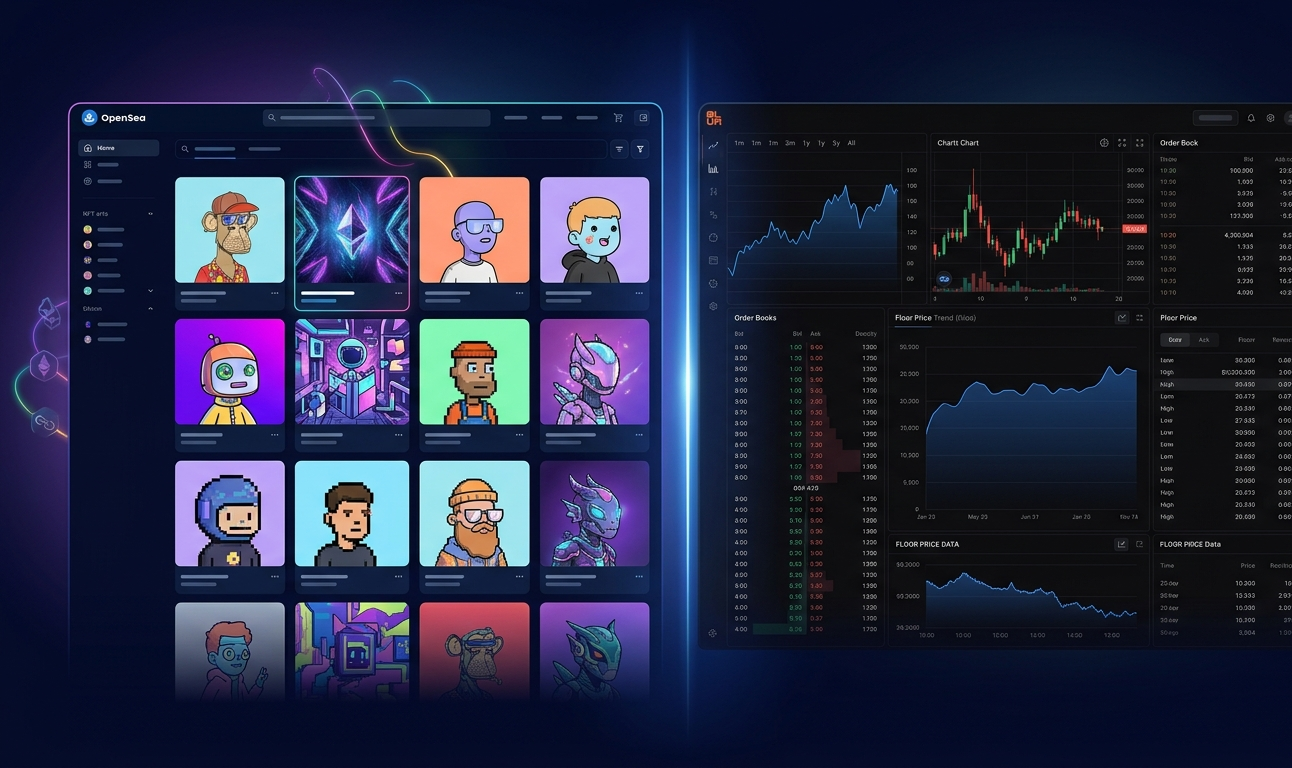
The NFT marketplace wars look very different in 2026 than they did when Blur launched in 2022 and nearly killed OpenSea with zero fees and token incentives. Both platforms are still standing, but both have transformed significantly. OpenSea completed a ground-up rebuild called OS2 in 2025, slashed its fees from 2.5% to 0.5%, expanded to 22 blockchains, and pivoted from a pure NFT marketplace into a multi-chain trading hub for tokens and digital assets. Blur remains the dominant venue for professional NFT traders, with zero marketplace fees, advanced order flow tools, and a token rewards system that has never fully stopped incentivising volume. The choice between them in 2026 is not simply a matter of fees. It depends entirely on what kind of user you are, what you plan to trade, and how much complexity you are willing to manage. This guide covers both platforms as they actually stand today.
The State of the NFT Market in 2026
Before comparing the platforms, it is worth understanding the market context both are operating in. NFT market capitalisation has fallen roughly 50% since mid-January 2026 to approximately $1.6 billion, and OpenSea’s monthly volumes have slipped below $500 million in recent months. The broader NFT market is significantly smaller in raw volume terms than it was at its 2021 and 2022 peak, when OpenSea alone processed $5 billion in a single month.
However, the total activity on both platforms includes far more than NFT trades in 2026. OpenSea processed over $2.6 billion in trading volume in October 2025, its highest in over three years, with more than 90% coming from regular cryptocurrency trading rather than NFTs. The platform currently holds about 51% of the NFT market share. The NFT marketplace category is quietly becoming a digital asset trading category, and OpenSea’s OS2 rebuild is the most visible expression of that shift.
OpenSea in 2026: The Full OS2 Rebuild
OpenSea in 2026 is not the same platform that Blur disrupted. In 2025 the platform launched OS2, described internally as the most significant evolution in OpenSea’s history. Trading volume surged to $2.6 billion in October 2025, the highest in over three years, and the platform now supports 22 blockchains with expansion beyond NFTs into fungible token trading, which accounted for $2.41 billion in DEX volume in October.
OS2 turns OpenSea into a complete digital asset hub. Marketplace fees were slashed from 2.5% to 0.5%, and swap fees were removed entirely at launch. Cross-chain functionality lets users buy assets on one blockchain using tokens from another. The system combines NFT trading and regular token trading in one interface with integrated liquidity aggregators for price discovery.
The SEC closed its investigation into OpenSea in February 2025 without enforcement action, removing the regulatory overhang that had weighed on the platform for over a year. The platform also acquired the mobile app Rally to rebuild its mobile experience. OpenSea’s planned SEA token, which was targeting a Q1 2026 launch, was ultimately delayed indefinitely in March 2026. CEO Devin Finzer cited challenging market conditions, and to soften the impact OpenSea introduced zero-percent token trading fees for 60 days starting March 31 and offered fee refunds to participants in the most recent rewards waves. The delay is a setback for users who accumulated XP toward the airdrop allocation, but the underlying OS2 platform continues operating regardless of the token timeline.
OpenSea Fees in 2026
The OS2 rebuild cut OpenSea’s standard marketplace fee from 2.5% to 0.5% on NFT trades. Token swap fees were eliminated during the launch period and remain zero in early 2026. Creator royalties are technically supported but enforcement is now optional, meaning creators may receive lower royalty payouts depending on the collection’s smart contract configuration.
OpenSea Strengths
OpenSea’s greatest assets in 2026 are breadth and accessibility. OpenSea supports multiple blockchains, offers the largest user base and the broadest collection coverage, and pioneered many features that competitors now replicate. It has more than 80 million NFTs across all major chains, a user-friendly interface with filters and rankings, no upfront minting fees for creators, and wallet support for MetaMask, Coinbase Wallet, Phantom, Ledger, and more.
For collectors and creators, OpenSea’s combination of broad discovery, cross-chain support, and the largest resale audience makes it the most practical single platform for mainstream NFT activity. OS2’s Voyages quest system rewards active users with XP that will factor into future SEA token allocation, giving long-term users an additional incentive to consolidate their activity on the platform.
OpenSea Weaknesses
Even at 0.5%, OpenSea’s marketplace fee is still higher than Blur’s zero. Royalty enforcement being optional creates tension with creator communities who feel the platform does not adequately protect their ongoing revenue. The SEA token delay has frustrated users who accumulated XP specifically in anticipation of the airdrop, and the timeline uncertainty makes the rewards programme harder to evaluate as a reason to use the platform.
Blur in 2026: Still the Pro Trader’s Terminal
Blur has not fundamentally changed its identity since launch. It remains a professional trading platform built around speed, data density, and zero marketplace fees, designed for users who trade at volume and need tools that OpenSea’s discovery-focused interface was never designed to provide.
Blur charges no marketplace fees on trades, meaning buyers and sellers avoid the typical platform commission entirely. The only cost is Ethereum gas. This is especially impactful for high-volume traders who save significantly over time. A trader with 100 ETH in monthly volume on a 2.5% fee platform pays 2.5 ETH in fees. On Blur, they pay zero.
Blur aggregates listings from other platforms including OpenSea and LooksRare, giving traders a single interface to access wider liquidity. Its tools transform NFT trading into a more professional, market-maker-style activity compared to the slower one-by-one listing and buying on traditional marketplaces. Blur rewards active traders with BLUR tokens through airdrops and reward programmes.
Blur’s Key Trading Tools
Blur’s interface is built around capabilities that casual collectors rarely need but professional traders rely on daily. Collection-wide bidding lets traders place bids across an entire floor simultaneously rather than on individual items, enabling large-scale liquidity provision. Floor sweep tools allow bulk purchases of multiple NFTs from the same collection in a single transaction. Real-time portfolio analytics give traders a live picture of their positions, unrealised gains, and collection floor movements without leaving the platform.
Blur is cited at over $50 million in monthly volume with approximately 11,000 monthly traders. It is widely described as offering 0% trading fees with gas still applicable and is best suited to active traders, fast flips, and liquidity routing.
Blur Weaknesses
Blur’s trader-first design is also its main limitation for a general audience. The interface is data-dense and assumes familiarity with NFT market mechanics that new users may not have. It operates primarily on Ethereum, lacking the multi-chain breadth that OS2 provides. Creator royalties on Blur are either optional or set at a minimum level, which has made the platform unpopular with artists and creators who depend on secondary sale revenue. The token incentive model, while effective at attracting volume, has historically encouraged wash trading activity that distorts genuine market signals.
Head-to-Head Comparison
| Feature | OpenSea (OS2) | Blur |
|---|---|---|
| Marketplace fee | 0.5% | 0% |
| Chain support | 22 blockchains | Primarily Ethereum |
| Creator royalties | Optional enforcement | Minimal or optional |
| Best for | Collectors, creators, beginners | Pro traders, flippers |
| Token | SEA (delayed) | BLUR (live) |
| NFT aggregation | Yes (via OS2) | Yes |
| Token/swap trading | Yes (OS2 feature) | No |
| Monthly active users | 382,000 | 38,300 |
| Mobile experience | Improved (Rally integration) | Limited |
Who Should Use Each Platform
OpenSea is the right choice for anyone who values breadth, discovery, and the ability to manage assets across multiple blockchains in one place. Collectors buying blue-chip NFTs, artists minting and selling their work, and users new to the space will all find OS2’s interface more approachable and its asset coverage more complete. If you want to buy a Solana NFT with ETH, cross-chain swap tokens, or browse long-tail collections that Blur simply does not index, OpenSea is where you go.
Blur is the right choice for anyone who trades at volume, needs professional-grade order flow tools, and wants to keep as much value as possible by eliminating marketplace fees entirely. If your primary activity is buying and selling Ethereum blue-chip NFTs at pace, running collection bids, or sweeping floors to build positions, Blur’s zero-fee structure and data tooling will serve you better than any other platform on the market.
The honest answer for most people in 2026 is both. Use OpenSea for discovery, creator purchases, and multi-chain activity. Use Blur for professional execution on Ethereum collections where fee savings and speed matter. The two platforms have converged enough in some areas, particularly around aggregation and analytics, that treating them as mutually exclusive misses the practical reality of how experienced NFT participants actually use the market.
Disclaimer: This article is for informational purposes only and does not constitute financial, investment, or legal advice. Cryptocurrency markets are highly volatile. Always conduct your own research before making any investment decisions.