Varntix has expanded its crypto earning products with fixed and flexible accounts, aiming to capture growing demand for passive income tools in digital assets. The company describes itself as a digital wealth platform built to help users earn fixed yields on crypto, with its latest update offering two different paths for investors who want structured returns rather than relying only on token price appreciation.
The launch comes as many crypto investors are reassessing how they use capital during volatile or sideways markets. While assets such as Dogecoin continue to draw attention from speculative traders, Varntix is positioning its accounts around predictability, liquidity and stablecoin payouts.


Fixed Accounts Offer Predefined Returns
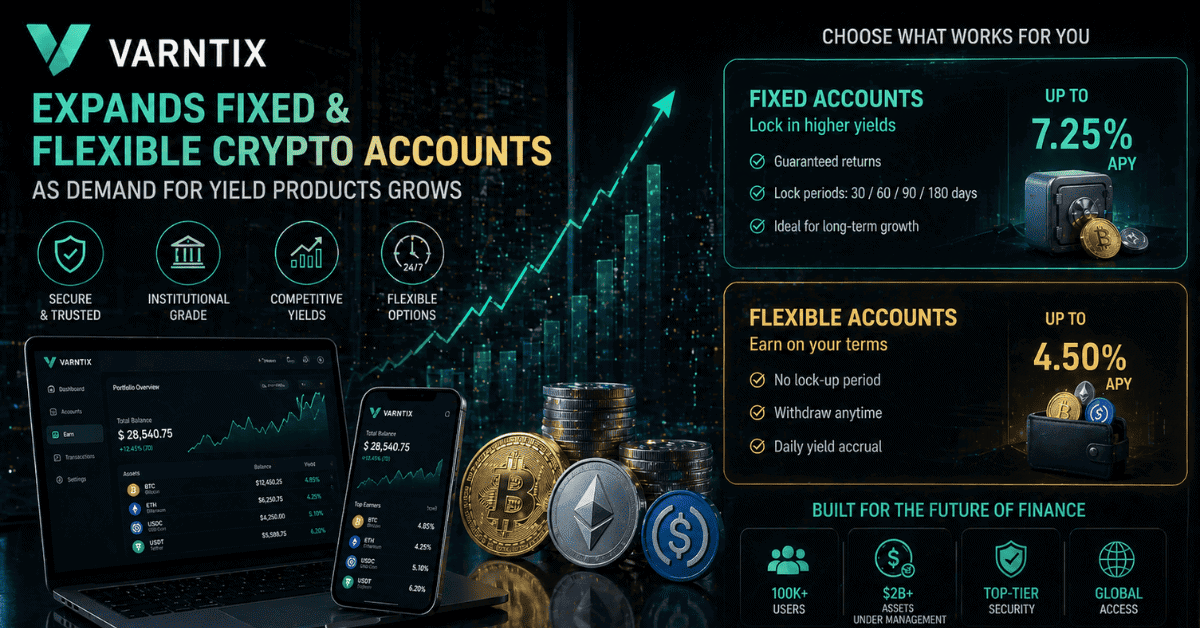
The core of the update is Varntix’s fixed account structure. According to the company, fixed accounts allow users to lock in predefined returns from the start, with rates reaching up to 24% APY depending on the selected term.
That is the major selling point for investors who want greater visibility over expected earnings. Instead of relying on staking rewards that can change, liquidity pool returns that fluctuate, or market gains that may never arrive, fixed accounts are designed to give users a defined return profile before they commit capital.
Varntix has also described earlier versions of its fixed-income model as running across terms of 6 to 24 months, with payouts made in stablecoins such as USDT and USDC. The company says this approach adapts traditional fixed-income ideas for blockchain-based execution.
Flexible Accounts Target Liquidity
The second part of the expansion is the addition of flexible accounts. These are designed for users who still want yield but do not want to commit fully to long-term lockups. Varntix says the flexible option gives investors more control over their capital while allowing them to continue earning returns.
That distinction matters because liquidity remains one of the biggest concerns in crypto yield products. High advertised returns can look attractive, but users often need to weigh those returns against withdrawal terms, counterparty exposure and the risk of being locked into a product during sudden market stress.
Earlier Varntix announcements described its flexible plans as offering lower but steadier returns, with ranges around 4% to 6.5% APY and shorter commitments.
Stablecoin Payouts Are Part of the Appeal
A key feature of Varntix’s pitch is that payouts are made in stablecoins. Stablecoins such as USDT and USDC are widely used in crypto markets because they are designed to track the value of the U.S. dollar, making them useful for settlement, liquidity management and income distribution.
For users, stablecoin payouts can make returns easier to understand compared with rewards paid in highly volatile tokens. A yield product that pays in a fluctuating asset may still expose users to price swings, even when the headline APY looks attractive.
That does not remove risk entirely. Stablecoin payouts depend on the platform’s operations, treasury strategy and ability to generate returns. It also requires users to consider the stability and liquidity of the specific stablecoins being used.
The Expansion Follows Reported $20 Million Demand
Varntix’s latest update follows a series of announcements around demand for its fixed-income crypto products. On April 23, the company said its high-yield fixed income product attracted more than $20 million in commitments within hours. It described that demand as a sign that investors are increasingly looking for structured, predictable returns rather than relying only on price-driven crypto strategies.
The company also said its model uses a Digital Asset Treasury approach that diversifies capital across multiple strategies. That framework is intended to reduce reliance on any single market condition, although the company has not provided full detail in the announcement about exact allocation methods, risk controls or counterparties.
Those details matter. In crypto, yield is never free. Investors should understand how returns are generated, what risks are involved, whether funds are locked, and what happens during periods of market stress.
Why Structured Crypto Income Is Getting Attention
The broader market backdrop helps explain why products like Varntix are gaining visibility. During strong bull markets, many investors are comfortable holding assets and waiting for price appreciation. During slower or more uncertain periods, the demand often shifts toward income, capital efficiency and clearer return expectations.
This is not unique to crypto. In traditional finance, investors have long balanced growth assets with income products such as bonds, money market funds or structured notes. Varntix is trying to bring a similar mindset into digital assets, with fixed and flexible accounts acting as alternatives to simple spot holding.
Still, crypto income products are not the same as bank deposits or government bonds. They can carry platform risk, liquidity risk, smart contract risk, treasury risk and regulatory uncertainty. High yields should always be evaluated carefully, especially when they are far above conventional fixed-income markets.
A Product Built for a More Mature Crypto Investor
Varntix’s expansion suggests that the crypto market is moving beyond a simple “buy and hold” mindset. More investors are looking for tools that help them earn, manage liquidity and plan around different market conditions.
That shift could benefit platforms that can clearly explain how returns are produced and how user funds are protected. For Varntix, the challenge will be proving that its fixed and flexible accounts can deliver not only attractive headline yields, but also transparency, reliability and strong risk management.
For now, the announcement gives Varntix a clearer position in the growing crypto income market. It is targeting users who still believe in digital assets, but want their capital to do more than wait for the next price rally.
This article is based on a press release issued by GlobeNewsWire.
Media Contact: admin@varntix.com
Disclaimer: This article is for informational purposes only and does not constitute financial, investment, or legal advice. Always conduct your own research before making any investment decisions.

This article is sponsored content. AltcoinReporter does not endorse investing in any project mentioned in sponsored articles. This content was not written by AltcoinReporter's editorial team, and AltcoinReporter takes no responsibility for its accuracy, claims, or quality. Readers should conduct thorough independent research before interacting with any featured projects. Nothing in this article constitutes financial, investment, or legal advice. Cryptocurrency investments carry significant risk of loss. Any investment decisions made based on this content are at the sole risk of the reader.