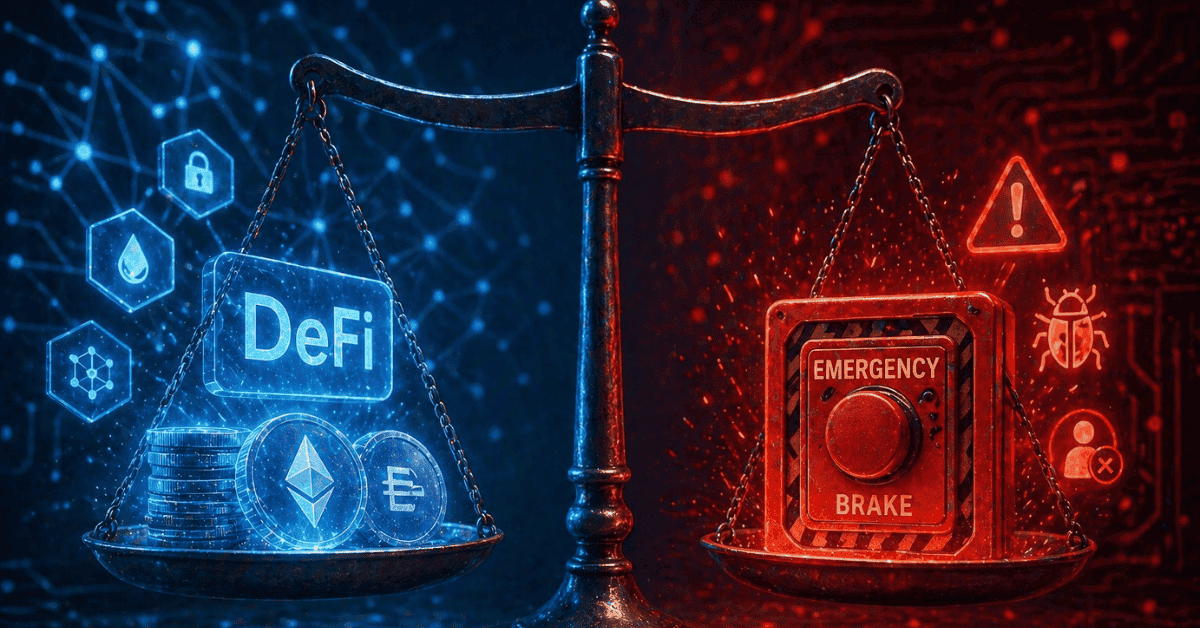
DeFi users hate centralized control, until a hacker is draining the pool.
That tension is back at the center of crypto after the recent KelpDAO exploit and its fallout across Aave. The incident revived one of DeFi’s oldest debates: should protocols have circuit breakers, emergency councils and admin controls that can freeze risky assets during a crisis?


The purist answer is no. DeFi is supposed to be open, neutral and unstoppable. The practical answer is harder. When hundreds of millions of dollars are at risk, users often want someone, or something, to act fast.
Crypto hates emergency buttons until the emergency arrives.
The KelpDAO Fallout Made the Debate Real Again
The latest debate is not theoretical.
On April 18, Aave governance contributors reported an incident involving rsETH and wrsETH after the KelpDAO exploit. Aave’s Protocol Guardian began freezing affected rsETH and wrsETH reserves across Aave V3 deployments, setting loan-to-value ratios to zero while disabling new supply and borrowing. Existing positions remained eligible for repayment and liquidation.
That is exactly the kind of emergency action DeFi users argue about. The freeze helped limit further damage, but it also showed that parts of the system still depend on privileged response mechanisms.
Galaxy Research described the broader KelpDAO exploit as a roughly $290 million incident tied to LayerZero infrastructure, saying it exposed risks across DeFi lending, bridging and multisig security. The report also said the attack created a wider tension in DeFi: the industry promises neutral infrastructure, but in major crises users often prefer whoever can act fastest.
Emergency Controls Can Protect Users
The strongest case for emergency brakes is simple: they can stop losses from spreading.
A lending protocol is not isolated. One bad asset can affect borrowers, lenders, liquidators, liquidity providers and other protocols connected to it. If an exploit creates bad collateral, fake assets or a sudden liquidity shock, waiting for normal governance can be too slow.
Aave’s emergency response shows why these tools exist. By freezing affected reserves and setting LTV to zero, the protocol limited new risk while keeping existing users able to repay or be liquidated under the rules. That is not a perfect solution, but it can prevent the situation from getting worse.
Circuit breakers can also give teams time to understand what happened. In a fast-moving exploit, the first few minutes matter. A temporary pause can stop an attacker from using the same weakness repeatedly while developers, risk managers and governance contributors assess the damage.
For users, that can be the difference between a painful incident and a total wipeout.
But Emergency Controls Make DeFi Look Less Decentralized
The problem is that emergency brakes come with a cost.
If a small group can freeze markets, change parameters or pause activity, users have to trust that group. That trust may be reasonable during a real exploit, but it weakens the claim that the protocol is fully decentralized.
This is the uncomfortable contradiction. DeFi wants to be credibly neutral, but credible neutrality becomes harder when someone can intervene.
Emergency councils and admin keys can also become attack targets. If an attacker compromises the people or keys with special powers, the safety system can become the vulnerability. Even without a hack, privileged controls can create governance risk, legal pressure and political disputes.
That is why some users prefer immutable protocols, even if they are less flexible. They would rather accept code risk than human discretion.
The Best Version Is Not Unlimited Admin Power
The real debate should not be “emergency brakes or no emergency brakes.” It should be what kind of brakes are acceptable.
A well-designed emergency system should be narrow, transparent and temporary. It should have clearly defined powers, public logs, multisig or governance oversight, time limits and post-incident review. It should not allow insiders to arbitrarily seize user funds or rewrite balances.
There is a big difference between pausing new borrowing against a compromised asset and giving an admin group broad control over all user deposits.
Protocols should also separate emergency response from long-term governance. A guardian can act quickly to contain damage, but permanent fixes should still move through governance whenever possible.
That compromise is messy, but DeFi itself is messy. The goal is not philosophical purity. The goal is making systems that users can survive.
Aave Shows the Trade-Off Clearly
Aave is one of the best examples because it is both highly decentralized in governance and highly pragmatic in risk management.
The protocol uses governance, risk service providers and guardian mechanisms because lending markets are complex. Asset listings, collateral parameters, liquidity conditions and oracle risk can all change quickly. A fully hands-off approach may sound cleaner, but it can be dangerous when markets break.
After the KelpDAO incident, Aave’s response included freezes across multiple deployments and a broader recovery discussion involving DeFi partners. CoinDesk reported that DeFi United proposed a coordinated plan to address the fallout, including support for affected Aave users after the KelpDAO exploit created 116,500 unbacked rsETH.
That response looked less like a fully autonomous machine and more like a financial network with emergency coordination. Some users will see that as a weakness. Others will see it as maturity.
DeFi Is Becoming More Like Financial Infrastructure
The bigger issue is that DeFi is no longer just an experiment for risk-tolerant users.
Large lending markets, liquid staking tokens, bridges, stablecoins and tokenized assets now connect many layers of crypto finance. When one part fails, the consequences can spread quickly.
Glassnode described the KelpDAO event as the largest confidence-driven liquidity event in Aave’s operational history, reporting that available liquidity on Aave V3 Ethereum Core fell from $9.77 billion to $5.75 billion within 29 hours after the incident, even though Aave’s contracts, oracles and liquidation engine functioned as specified.
That is a crucial point. Sometimes the protocol code works, but confidence breaks anyway.
Emergency systems are partly about code risk, but they are also about market psychology. If users believe nobody can respond during a crisis, they may rush to withdraw. If they believe there are credible safeguards, they may stay calmer. The challenge is making those safeguards credible without making them dangerously centralized.
The Bottom Line
DeFi needs to stop pretending this debate has an easy answer.
No emergency controls can make a protocol cleaner and more decentralized, but also more fragile during fast-moving attacks. Too many emergency controls can protect users, but also turn DeFi into something closer to traditional finance with extra steps.
The better path is limited emergency power with public accountability. Protocols should define exactly what can be paused, who can pause it, how long the pause lasts and how users are informed afterward.
The KelpDAO and Aave fallout shows why this matters. When hundreds of millions of dollars are at risk, ideology meets reality very quickly.
DeFi does not need panic buttons that can do anything. But it may need emergency brakes that can stop the car before it goes off the road.
Disclaimer: This article is for informational purposes only and does not constitute financial, investment, or legal advice. Always conduct your own research before making any investment decisions.