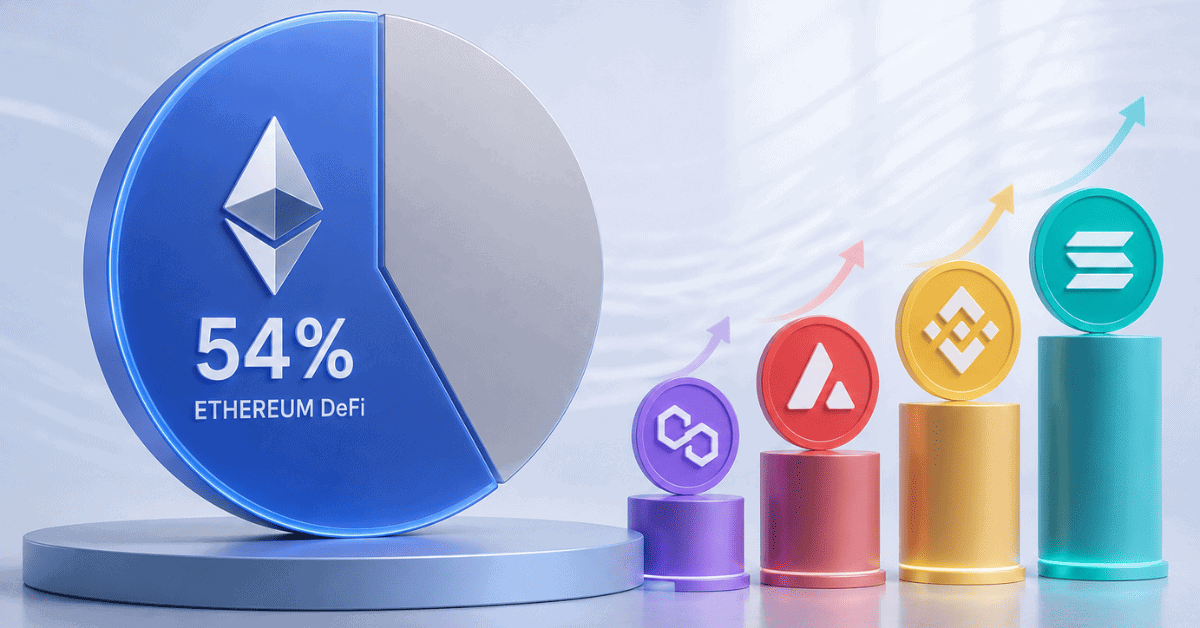
Ethereum DeFi dominance has fallen to roughly 54%, marking one of its weakest market-share readings in years.
The decline is based on total value locked, or TVL, across decentralized finance. Ethereum still leads DeFi by a wide margin, with about $45.4 billion locked in its ecosystem. But its share of the overall DeFi market has dropped from around 63.5% at the start of 2025 to roughly 54% now.


That is the important distinction. Ethereum is not losing DeFi. It is losing monopoly-like control over DeFi.
For years, Ethereum was the default home for on-chain finance. Lending, decentralized exchanges, stablecoins, yield protocols, liquid staking and governance all grew around Ethereum first. Now, liquidity is spreading across other ecosystems as users chase lower fees, faster execution and more specialized applications.
Why Ethereum’s Share Is Falling
Ethereum’s DeFi share is falling because crypto users are no longer loyal to one chain.
They go where fees are lower, rewards are better and trades execute faster. That has helped networks such as Solana, Base, BNB Chain, Arbitrum, Tron and Avalanche capture more activity in different parts of the market.
Solana has become especially strong in fast retail trading and meme coin activity. Base has grown as a major Ethereum layer-2 network with consumer apps and lower-cost DeFi. Tron remains dominant in stablecoin transfers, especially for USDT. BNB Chain continues to attract users who want cheaper trading and familiar exchange-linked infrastructure.
Ethereum still has the deepest DeFi history, but users now have more choices than ever.
This Is Not the Same as Ethereum Failing
The 54% figure sounds dramatic, but it needs context.
Ethereum remains the largest DeFi network by TVL. A $45 billion-plus DeFi base is still enormous. Many of the most important protocols, stablecoin flows and institutional experiments still depend on Ethereum or its broader ecosystem.
The problem is market share, not absolute relevance.
Ethereum can grow in dollar terms while its percentage of the total DeFi market falls. That happens when the broader DeFi market expands faster on other chains. In other words, Ethereum may still be strong, but competitors are growing faster from smaller bases.
That is very different from saying Ethereum is dead.
Layer-2 Growth Makes the Picture Messier
Ethereum’s own scaling strategy also complicates the data.
A lot of activity that used to happen directly on Ethereum mainnet now happens on layer-2 networks such as Base, Arbitrum and Optimism. These networks are part of Ethereum’s scaling roadmap, but they are often counted separately in DeFi TVL share comparisons.
That creates a strange optics problem.
If users move from Ethereum mainnet to Base, Ethereum mainnet dominance falls. But from a broader ecosystem perspective, that activity may still support Ethereum’s settlement and developer network.
This is why the “Ethereum falls to 54%” headline is partly true and partly incomplete. Ethereum mainnet is losing share, but Ethereum-aligned networks are also growing.
The real question is whether value continues to flow back to ETH itself.
Solana Is the Bigger Psychological Threat
Solana matters because it offers a simpler story.
Ethereum’s roadmap is modular. It depends on layer-2 networks, rollups, settlement, data availability upgrades and a more complex user experience. Solana’s pitch is easier to understand: one fast chain, low fees and lots of activity.
For retail traders, simplicity matters. If a user wants to swap meme coins or move between tokens quickly, Solana can feel smoother than navigating multiple Ethereum layer-2 networks.
That does not mean Solana is better for every DeFi use case. Ethereum still has deeper institutional trust and more battle-tested infrastructure. But Solana has become a serious competitor for user attention and trading volume.
Ethereum can no longer assume that DeFi users will stay by default.
What This Means for ETH
For ETH holders, the 54% dominance figure raises a key question: how much of DeFi’s growth will actually benefit ETH?
Ethereum’s investment case depends partly on network usage. If activity moves to other chains, ETH may lose some of the direct fee and liquidity advantages it once had. If activity moves to Ethereum layer-2 networks, the effect is more nuanced. ETH may still benefit through settlement, staking, security and ecosystem gravity, but the value capture is less obvious than when everything happened on mainnet.
That is one reason ETH has faced pressure in recent cycles. Investors still believe Ethereum is important, but they are asking harder questions about how the token captures value as the ecosystem spreads out.
The dominance decline makes that debate more urgent.
The Multi-Chain DeFi Era Is Here
The bigger story is that DeFi is becoming multi-chain by default.
Users no longer think of decentralized finance as one place. They think of it as a set of tools spread across ecosystems. They may lend on Ethereum, trade memes on Solana, move USDT on Tron, bridge to Base for apps and use Arbitrum for derivatives.
That is good for users because it creates competition. Chains have to fight for liquidity, developers and applications. Fees come down. User experience improves. Incentives get better.
But it also makes DeFi more fragmented. Liquidity spreads across chains, bridges become more important and risks multiply. A multi-chain world is more flexible, but also more complicated.
The Bottom Line
Ethereum DeFi dominance falling to 54% is a warning sign, but not a death sentence.
Ethereum is still the largest DeFi ecosystem by far, with about $45.4 billion in TVL. But its share has dropped sharply as rival chains and layer-2 networks attract more liquidity.
The old DeFi world was Ethereum first and everyone else second. The new DeFi world is more competitive, more fragmented and more multi-chain.
Ethereum still has the deepest moat. But moats need maintenance. If users keep chasing cheaper, faster and simpler alternatives, Ethereum will need to prove that its security, liquidity and institutional trust are still worth the complexity.
For now, Ethereum remains DeFi’s leader. It just no longer looks untouchable.
Disclaimer: This article is for informational purposes only and does not constitute financial, investment, or legal advice. Always conduct your own research before making any investment decisions.