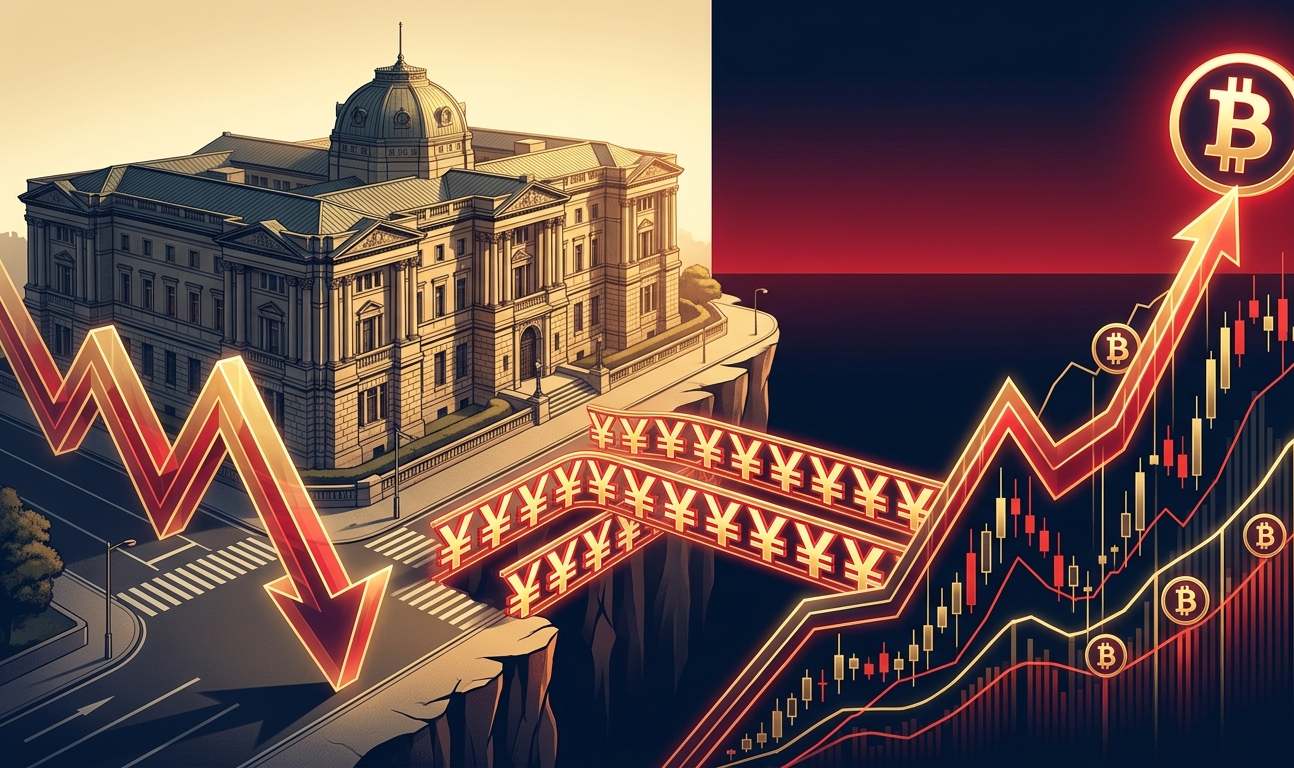
When Bitcoin broke through $74,000 on Monday, most of the attention went to Iran, Trump, and the short squeeze that wiped out $534 million in bearish positions. What received far less attention was a signal from Tokyo that may prove just as important for where Bitcoin goes next. Bank of Japan Governor Kazuo Ueda signalled on April 14 that the central bank is unlikely to raise interest rates at its April 28 policy meeting, pivoting to a more cautious stance amid uncertainty over how the ongoing Iran conflict is affecting Japan’s economy. Markets had been pricing in a 60 to 70% chance of a rate hike at that meeting just weeks ago, following hawkish comments from BOJ officials earlier in the year. That probability has now collapsed. For Bitcoin, this matters enormously, because the BOJ’s interest rate policy sits at the centre of one of the most powerful and destructive forces in global crypto markets: the yen carry trade.
Why the BOJ’s Rate Policy Moves Bitcoin
The mechanics are not immediately obvious but the historical record is unambiguous. The carry trade, where investors borrow cheaply in yen and deploy into higher-yielding assets including crypto, had become one of the largest sources of leveraged risk-asset exposure globally. A yen unwind tends to cause quick sell-offs in risk assets, with bitcoin and major cryptocurrencies the first to be hit.


The August 2024 episode remains the defining example. On August 5, 2024, the Bank of Japan’s unexpected interest rate hike triggered the unwinding of yen carry trades, causing Bitcoin to fall from $64,000 to $49,000 within 48 hours. That 24% crash in two days was not driven by anything happening inside crypto. No exchange failed, no protocol was hacked, no regulatory ruling came down. A central bank decision in Tokyo to raise rates by 0.25 percentage points was enough to drain billions in leveraged positioning from global risk assets virtually overnight.
The mechanics: when the BOJ raises rates, borrowing in yen becomes more expensive, yen-based carry trades unwind, institutions reduce exposure to risk assets, and liquidity tightens across global markets. Bitcoin, despite its decentralised nature, remains sensitive to these liquidity shocks. As yen-funded leverage unwinds, BTC often becomes collateral damage.
What Ueda Said and Why It Shifted the Market
Bitcoin climbed past $74,000 on Monday, and one reason is a decision made thousands of miles away in Tokyo. Bank of Japan Governor Kazuo Ueda signalled that the central bank is unlikely to raise interest rates at its April 28 policy meeting. The move eased pressure on risk assets like Bitcoin and other cryptocurrencies.
The BOJ had been expected to hike. Markets were pricing in a 60 to 70% chance of a rate increase just weeks ago, after Ueda and other officials made hawkish comments earlier in the year. But the ongoing conflict in the Middle East changed the calculation. Japan imports more than 90% of its oil through the Strait of Hormuz, which Iran has been blocking. That makes Japan’s economy especially exposed to the war.
The BOJ’s shift was validated immediately by Japan’s bond market. Japan’s 20-year bond auction on Tuesday drew its strongest demand since 2019, with a bid-to-cover ratio of 4.82 against a 12-month average of 3.27, confirming that institutional capital agrees the hiking cycle is pausing. Twenty-year yields, near their highest since 1997, fell nine basis points after the auction. When institutional buyers rush into long-dated Japanese government bonds, it is a direct signal that the market is pricing out near-term rate hike risk. That is exactly what happened.
The Yen Carry Trade and Crypto Positioning
A dovish BOJ keeps the yen weak, currently near 160 against the dollar. A weak yen keeps carry trade funding cheap. Cheap carry funding supports leveraged positions across risk assets, including the perpetual futures markets where bitcoin’s rally is being built. Data from last week showed $2.1 billion in new bitcoin open interest and $2.2 billion in ether open interest in 24 hours following the ceasefire, with coin-denominated OI confirming net new longs.
Some portion of that new positioning may be funded, directly or indirectly, by the same yen liquidity that Ueda just preserved. The connection between cheap Japanese money and Bitcoin’s perpetual futures open interest is not theoretical. It runs through the same institutional plumbing that connects Tokyo to New York to the 24-hour crypto derivatives markets that have driven the majority of Bitcoin’s price action throughout 2026.
The Iran War’s Hidden Connection to Japanese Monetary Policy
The reason the BOJ went dovish is itself linked to the same geopolitical conflict that has been driving Bitcoin’s price all year. Japan imports more than 90% of its oil through the Strait of Hormuz. The strait has been effectively closed since the Iran conflict began in late February, running at approximately 7% of normal traffic capacity. The oil supply disruption has created inflationary pressure globally, but the specific exposure of Japan’s economy to Hormuz-dependent energy means the BOJ cannot tighten into an oil shock without amplifying the damage to Japanese households and businesses.
If US-Iran talks lead to lower oil prices and reduced inflation pressure in Japan, the central bank will have even less incentive to hike, extending the period in which the yen-funded carry trade can bolster bitcoin. This creates a scenario where diplomatic progress on Iran is simultaneously bullish for Bitcoin through direct risk-on sentiment and additionally bullish through its effect on BOJ policy, which keeps the carry trade intact.
The Historical Pattern and What Comes Next
The historical record shows: in July 2024, the BOJ raised rates to 0.25% and Bitcoin fell by 26% in eight days. In January 2025, the BOJ raised rates to 0.50% and Bitcoin declined by 25% over 20 days. In January 2026, the BOJ raised rates to 0.75% and Bitcoin fell nearly 3% shortly after. Each episode was followed by recovery and new highs, but the short-term pain was real and consistent.
The January 2026 hike brought the BOJ’s benchmark rate to 0.75%, its highest level since 1995. Markets had been expecting a further hike to 1.0% at the April 28 meeting before Ueda’s dovish pivot. Japan’s benchmark rate sits at 0.75% as of March 2026. Markets were expecting a hike to 1.0% on April 28. That 0.25% move could drain tens of billions from global risk assets, because Japan is the world’s largest creditor nation with $3.7 trillion in net overseas assets. When yen strengthens, traders must sell those assets to repay loans.
That risk has now been removed from the April 28 meeting, at least. The BOJ’s next policy decision is scheduled for April 27 to 28, the same day that BNB Chain’s Osaka/Mendel hard fork is scheduled and just days before the CLARITY Act markup is targeted. If Ueda holds firm on his dovish signal, Bitcoin enters that period with one of its most reliable macro headwinds temporarily suspended. If something changes and the BOJ surprises markets with a hike anyway, the carry trade unwind risk returns in a market that is now more leveraged than it was at the start of the month.
For now, the message from Tokyo on April 14 is unambiguous. The BOJ is watching the same strait that Bitcoin traders are watching, and for the same reason. Until the Strait of Hormuz reopens and Japan’s energy supply normalises, the Bank of Japan’s rate hiking cycle remains on hold, and with it one of the most potent downside risks to Bitcoin’s recovery.