What began as a controversy over circular DeFi lending has escalated into one of the most explosive public disputes in crypto this year. Justin Sun, the founder of the Tron blockchain and World Liberty Financial’s largest known backer, published a lengthy statement on X on Sunday April 12 accusing the Trump family-backed DeFi project of hiding a secret blacklisting function inside the WLFI smart contract, one that he says gives the team unilateral power to freeze, restrict, or effectively confiscate any token holder’s assets without notice, cause, or recourse. He described himself as the first and largest victim of that function, pointing to the freezing of his own wallet in September 2025. Hours later, WLFI responded with four words that have since reverberated across crypto social media: “See you in court pal.” The dispute is no longer a governance complaint. It is now a public legal war between a $175 million investor and the politically connected project he backed, and the fallout is accelerating by the hour.
What Justin Sun Actually Alleged
Sun’s statement was not a vague expression of frustration. It was a detailed, structured accusation targeting three distinct aspects of WLFI’s conduct.


Sun accused the Trump family-backed DeFi project of building an undisclosed “backdoor blacklisting function” into the smart contract used to deploy WLFI tokens. The function, Sun wrote, gives the company “unilateral power to freeze, restrict, and effectively confiscate the property rights of any token holder, without notice, without cause, and without recourse.” Sun framed the design as the inverse of what investors were sold, calling it “a trap door marketed as an open door.”
On the governance question, Sun made more general criticisms of the project’s governance, including a vote on token lock-up periods in March 2026 in which over 76% of the voting tokens allegedly originated from barely 10 wallets. “Key information was withheld from voters, meaningful participation was restricted, and outcomes were predetermined,” Sun wrote on X.
The third strand of Sun’s accusation connected the backdoor allegation directly to the Dolomite borrowing story that broke earlier in the week. By April 9, 2026, WLFI had deposited 5 billion tokens as collateral and borrowed around $75 million in stablecoins. Over $40 million of those funds were sent to Coinbase Prime, a platform commonly used for institutional fiat conversion. The $40 million transfer to Coinbase Prime took place hours before Trump’s US-Iran ceasefire announcement. Sun’s framing positioned the backdoor, the circular borrowing, and the Coinbase Prime transfers as elements of a single pattern of conduct rather than isolated events.
The History Behind the Freeze
The September 2025 wallet freeze that sits at the centre of Sun’s complaint has a disputed history that both sides now present very differently.
WLFI froze 595 million of Sun’s unlocked tokens worth $107 million, citing a breach of his investor agreement. According to WLFI, the plan was to exit early using retail users’ locked tokens as liquidity. Sun would then use future token vestings to refill HTX user balances. WLFI says it obtained logs supporting this claim and froze his wallet on breach-of-agreement grounds.
Sun’s account is different. Nansen blockchain analytics data revealed that Sun’s wallet transfer occurred after a price decline, not before, countering some of the criticism levelled at him. Sun described the transfers as standard exchange deposit tests and insisted no buying or selling was involved.
His frozen WLFI stash, estimated by Bubblemaps at roughly 545 million tokens, has lost more than $80 million in value since the freeze, with the bulk of the decline tracking WLFI’s broader downtrend. Sun’s total exposure to the Trump-linked crypto ecosystem stands at approximately $175 million, including his WLFI investment and a $100 million commitment to the TRUMP memecoin. The freeze has been financially catastrophic for that portion of his portfolio.
WLFI’s Response and the Legal Threat
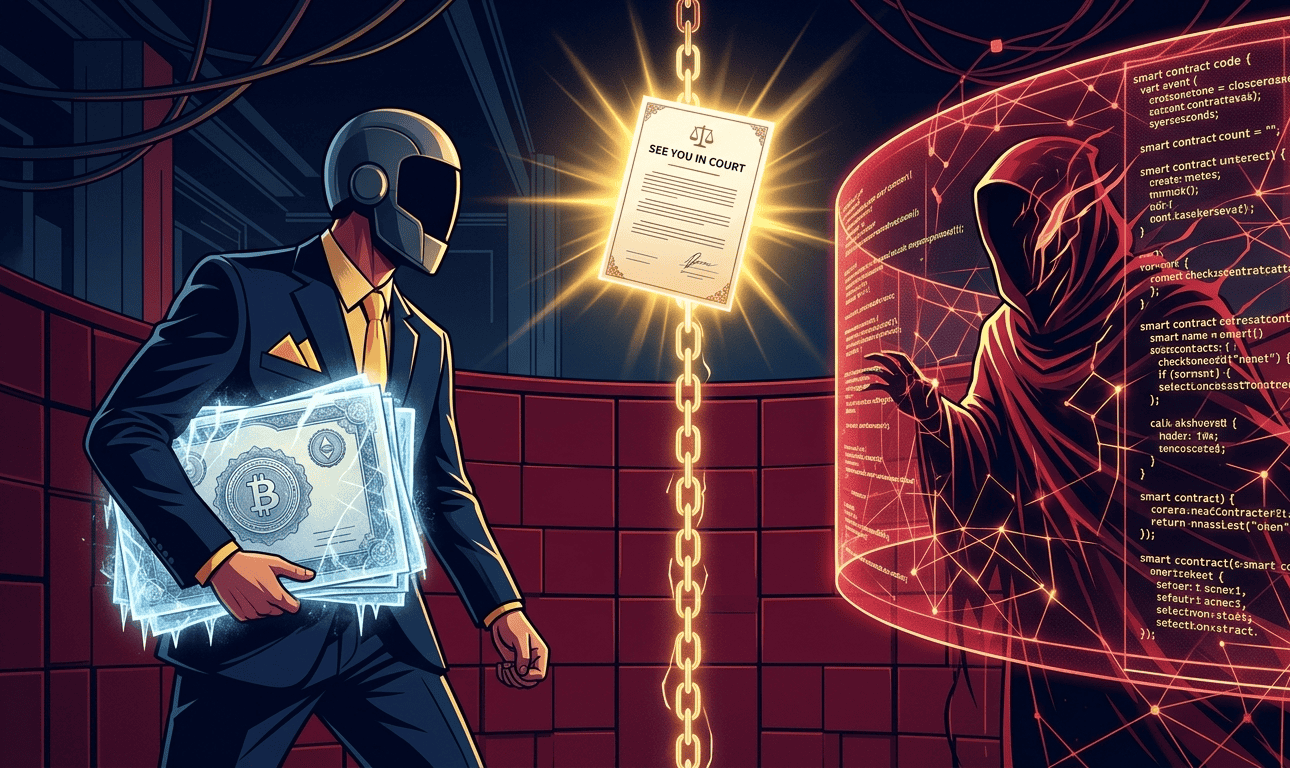
WLFI’s official account responded hours later, accusing Sun of “playing the victim while making baseless allegations to cover up his own misconduct” and signalling it may litigate, writing “See you in court pal.”
The official account declared: “Same playbook, different target. WLFI isn’t the first. We have the contracts. We have the evidence. We have the truth.”
Sun’s response to the legal threat sharpened the confrontation further. “Whoever is hiding behind this official account, step forward and identify yourself,” Sun wrote back to WLFI. “Every action taken by the WLFI team to secretly implant backdoor controls over user assets, to freeze investor funds without disclosure or due process, and to treat the crypto community as a personal ATM — someone must be held personally accountable for these actions.” The demand that WLFI team members identify themselves publicly, rather than sheltering behind an institutional account, raises questions about accountability that will become significantly more pressing if the dispute reaches a courtroom.
Why the Smart Contract Backdoor Allegation Matters
The specific legal and technical question at the heart of Sun’s allegation is whether a blacklisting function in a DeFi smart contract, even if disclosed in technical documentation, can be considered undisclosed for the purposes of investor agreements and securities regulation when retail token buyers had no reasonable way of knowing it existed or how it would be used.
This suggests a major crypto court battle is looming, which could test the legality of blacklist functions in smart contracts. The controversy has also brought unwanted attention to the project’s political ties, with Donald Trump serving as Chief Crypto Advocate.
Blacklisting functions exist in many centralised stablecoin contracts, including USDC and USDT, where they are disclosed and used for regulatory compliance. The argument against WLFI’s use of the same mechanism is different: WLFI is not a stablecoin, it is a governance token that was marketed as a decentralised finance platform. Using a centralised control mechanism on a governance token, and doing so without upfront disclosure to retail investors, is a materially different proposition, and one that regulators paying close attention to the Trump administration’s crypto dealings may find difficult to ignore.
The Token Is Now at All-Time Lows
The ongoing conflict has resulted in WLFI’s token hitting an all-time low. The coin’s price has collapsed 75% from its all-time high of $0.46, currently trading near $0.079, with a market capitalisation of approximately $2.5 billion and more than 144,000 token holders.
WLFI has recently paid off almost $10 million in outstanding loans and it is reported the team might include additional collateral in the near future. Chaos Labs has reported that WLFI is close to its 5.1 billion limit on collateral usage, with approximately 3 billion WLFI tokens used to borrow almost $40.7 million in stablecoins, with USD1 pool utilisation at 83.4% and USDC at 90.19%. The financial pressure on the project has not eased despite the partial loan repayment, and the addition of a public legal dispute with its largest former backer makes the outlook for a price recovery in the near term extremely difficult.
The contracts and supporting documentation have not been made public by any party. Those documents would probably become public records if legal proceedings proceed, and because both parties are signalling escalation, that time may not be far off. For the crypto industry broadly, a court case that forces the disclosure of internal WLFI smart contract mechanics and the evidence behind the September 2025 wallet freeze could set important precedents for how governance token blacklisting functions are disclosed, governed, and legally treated under US law.