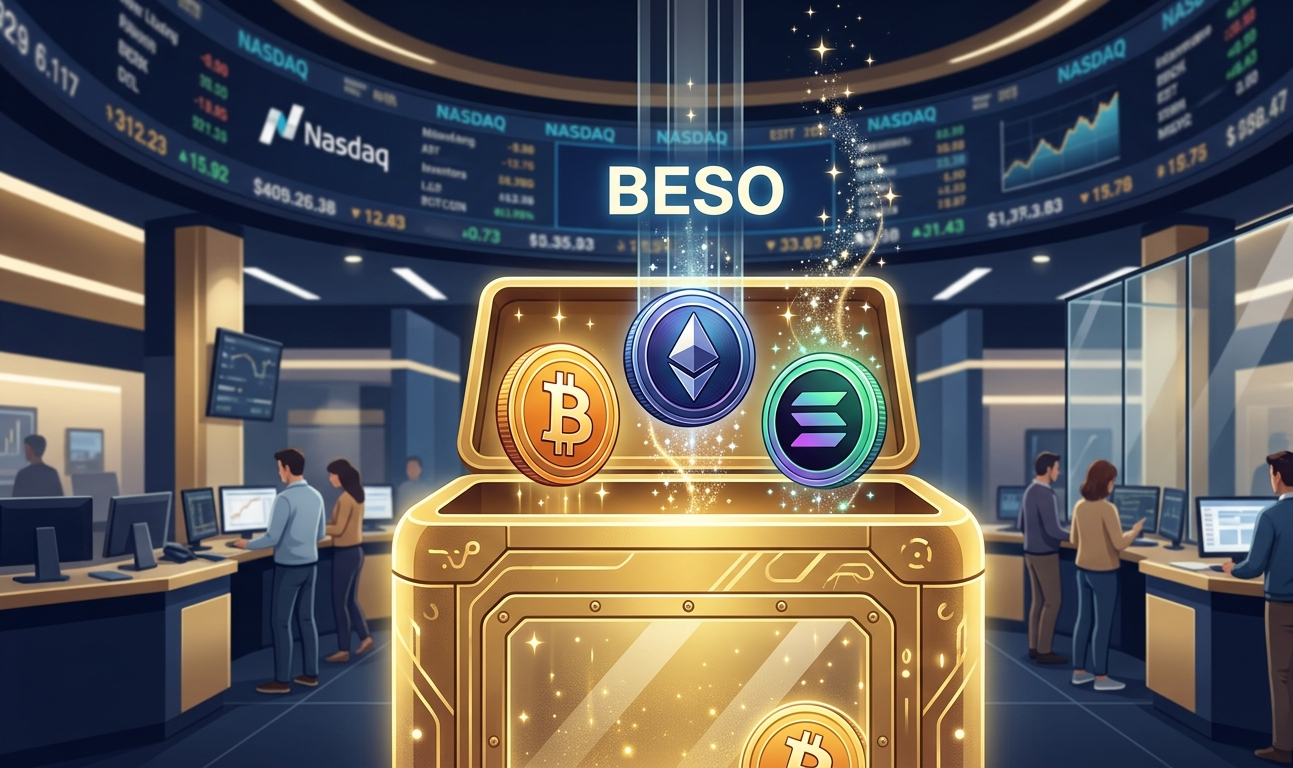
If you have been waiting for a single ETF that holds Bitcoin, Ethereum, and Solana together, it just arrived. Crypto trading firm GSR launched the GSR Crypto Core3 ETF on Nasdaq on Wednesday under the ticker BESO. It is the first actively managed multi-asset crypto ETF in the United States, and it comes with built-in staking rewards.
Until now, investors who wanted exposure to all three had to buy separate ETFs for each one. BESO puts them in a single fund with a 1% management fee, weekly rebalancing, and the ability to earn staking yields on the Ethereum and Solana portions of the portfolio.


Bloomberg ETF analyst James Seyffart called it the start of a trend. “I expect basket ETFs to be one of the fastest-growing categories in crypto ETFs over the next couple years,” he posted on X.
What Is the BESO ETF and How Does It Work?
BESO is pretty straightforward. The fund holds Bitcoin, Ethereum, and Solana. At least 80% of its assets go directly into these three cryptocurrencies or into exchange-traded products that track them. The rest can be held in cash or cash equivalents.
What makes BESO different from a passive index fund is that GSR’s team actively manages the weightings. Every week, they rebalance the portfolio based on what they call “research-driven signals.” So if Bitcoin is showing stronger momentum than Solana, they can shift more of the fund into BTC. If Ethereum’s on-chain activity is picking up, they can tilt toward ETH.
The staking piece is the other selling point. Ethereum and Solana both use proof-of-stake, which means holders can lock up their tokens to help run the network and earn rewards in return. BESO stakes a portion of its ETH and SOL holdings, passing those yields through to investors. That is something a plain Bitcoin ETF cannot offer because Bitcoin does not have staking.
GSR CEO Xin Song said the ETF reflects the firm’s “deep understanding of how this asset class is evolving.” GSR has been a major crypto market maker for over a decade, providing liquidity to exchanges and institutional traders. This is its first step into the ETF space.
Why Does a Multi-Asset Crypto ETF Matter?
The crypto ETF market has exploded since spot Bitcoin ETFs launched in January 2024. BlackRock’s IBIT alone holds over 800,000 BTC. Spot Ethereum ETFs followed. Solana ETFs arrived more recently with staking built in. But all of these are single-asset products. If you want all three, you need three separate funds, three separate positions, and three separate fees.
BESO simplifies that. One ticker. One fee. Three assets. Weekly rebalancing handled by professionals. And staking rewards on top.
For financial advisors building crypto allocations for their clients, this kind of product makes life a lot easier. Instead of explaining why they are recommending three different crypto ETFs, they can point to one fund that covers the three largest proof-of-work and proof-of-stake networks in the market.
Andy Baehr, GSR’s Managing Director of Asset Management, framed it simply: “Core3 answers the three questions every crypto investor faces: what to own, how to earn yield while you hold, and how to be positioned as markets evolve.”
How Does BESO Compare to Other Crypto ETFs?
The main competition is buying BlackRock’s IBIT (Bitcoin), BlackRock’s ETHA (Ethereum), and one of the newer Solana ETFs separately. That gives you full control over the allocation but costs more in total fees and requires you to manage three positions.
BESO charges 1% in management fees. That is higher than IBIT’s 0.25% or ETHA’s 0.25%, but you are paying for active management, weekly rebalancing, and the convenience of a single product. For investors who want a “set it and forget it” approach to crypto, that trade-off might be worth it.
The active management is a double-edged sword. If GSR’s team makes good calls on when to overweight Bitcoin versus Solana, the fund could outperform a simple equal-weight basket. If they get it wrong, it could underperform. That is the standard risk with any actively managed product.
Framework Digital Advisors serves as the fund’s official investment adviser, while GSR provides the crypto market expertise and trading infrastructure behind the scenes.
What Does This Mean for the Crypto ETF Market in 2026?
BESO is probably not the last multi-asset crypto ETF we will see this year. The success of single-asset Bitcoin and Ethereum ETFs proved there is massive demand for regulated crypto products. The next logical step is bundling them together.
Seyffart’s prediction that basket ETFs will be “one of the fastest-growing categories” makes sense. Other firms have already filed for similar products. As more tokens get approved for ETF wrappers and staking becomes standard, the product menu is going to keep expanding.
For everyday investors, that is good news. More products mean more competition, which means lower fees and better options over time. Two years ago, buying Bitcoin through a brokerage account was not even possible. Now you can buy a single ETF that holds Bitcoin, Ethereum, and Solana with staking yields and weekly rebalancing. The speed at which this market is maturing is hard to overstate.
Frequently Asked Questions
What is the BESO ETF ticker and where does it trade?
BESO trades on the Nasdaq exchange. It is the GSR Crypto Core3 ETF, launched on April 22, 2026. It holds Bitcoin, Ethereum, and Solana with a 1% management fee, weekly rebalancing, and staking yields on ETH and SOL.
Is BESO the first multi-asset crypto ETF in the US?
Yes. BESO is the first actively managed multi-asset crypto ETF in the United States to combine Bitcoin, Ethereum, and Solana exposure with staking capabilities in a single listed product.
How does BESO compare to buying separate Bitcoin and Ethereum ETFs?
BESO offers the convenience of holding all three assets in one fund with professional rebalancing. The 1% fee is higher than single-asset ETFs like BlackRock’s IBIT (0.25%), but includes active management and staking yields that individual Bitcoin ETFs cannot provide.