
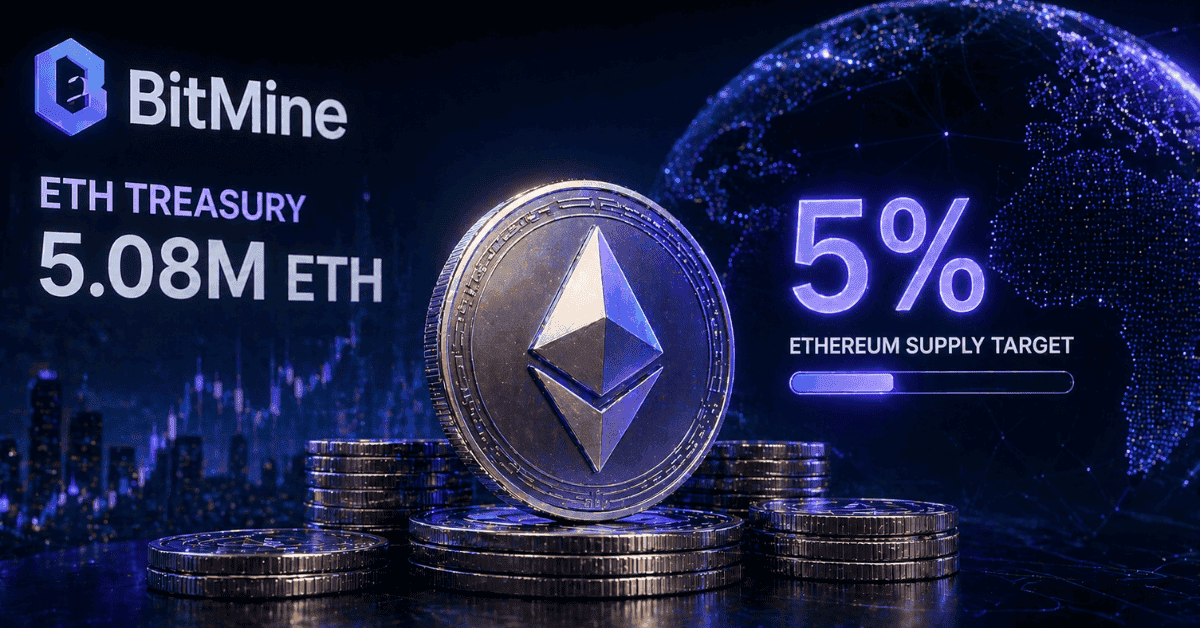
BitMine Immersion Technologies has pushed its Ethereum treasury to a new high, saying its holdings have reached 5.078 million ETH, worth about $13.3 billion including crypto and cash reserves.
The company now owns more than 4.21% of Ethereum’s total supply of about 120.7 million ETH, making BitMine one of the most aggressive public-company buyers of Ethereum in the market. BitMine says it is 84% of the way toward its “Alchemy of 5%” target, a plan to control 5% of the total ETH supply.


The latest milestone follows another large weekly purchase. Reports say BitMine added 101,901 ETH over the past week, pushing its holdings above the 5 million ETH mark and reinforcing its position as the clearest Ethereum equivalent to Strategy’s Bitcoin accumulation model.
BitMine Wants to Be the Strategy of Ethereum
A Corporate Treasury Built Around ETH
Strategy, formerly MicroStrategy, became famous for turning Bitcoin into the centerpiece of its corporate treasury. BitMine is trying to build a similar story around Ethereum.
The company is not simply holding a small ETH reserve as a diversification tool. It is making Ethereum the core of its balance sheet strategy, with Chairman Tom Lee framing ETH as a long-term institutional asset tied to tokenization, stablecoins and AI-driven finance.
That matters because Ethereum plays a different role from Bitcoin. Bitcoin is usually marketed as digital gold or a reserve asset. Ethereum is more closely tied to smart contracts, tokenized assets, DeFi, stablecoins and applications that generate on-chain activity.
BitMine’s bet is that ETH will become increasingly important as Wall Street moves more financial products onto public blockchains.
The 5% Target Is the Headline
Owning 5% of Ethereum’s total supply would be an extraordinary concentration for a public company.
At 5.078 million ETH, BitMine is already close. The company’s latest disclosure says it owns more than 4.21% of the total ETH coin supply, leaving it less than one percentage point away from the 5% goal.
That concentration can cut both ways. If Ethereum adoption grows and ETH appreciates, BitMine could become one of the biggest corporate beneficiaries of the trend. If ETH weakens sharply, the company’s balance sheet becomes highly exposed to a single volatile asset.
Why Ethereum Is Attracting Treasury Buyers
Stablecoins and Tokenization Are Key Drivers
Ethereum remains the main settlement layer for many stablecoins, tokenized assets and DeFi protocols. That gives ETH a different investment thesis from pure store-of-value assets.
When stablecoins move on Ethereum, when tokenized treasuries settle on-chain or when DeFi protocols execute transactions, ETH remains deeply connected to the network’s fee economy and security model. That is one reason institutional investors are paying closer attention.
BitMine’s public statements lean heavily into that theme. The company argues that Ethereum benefits from two large trends: Wall Street tokenizing assets on public blockchains and AI systems needing neutral, programmable settlement networks.
That is a bold thesis, but it reflects a real shift in how investors discuss Ethereum. ETH is increasingly being evaluated not only as a crypto asset, but also as infrastructure for financial markets.
Staking Could Turn ETH Into a Yielding Treasury Asset
Unlike Bitcoin, Ethereum can be staked. That gives companies holding large ETH balances a potential income stream if they participate in network validation or use staking infrastructure.
For a corporate treasury, that matters. A large ETH position can potentially generate staking yield, although staking also brings operational, liquidity and regulatory considerations.
BitMine’s ability to earn yield on part of its ETH stack could make the treasury strategy more attractive than simply holding an idle volatile asset. However, the company still faces ETH price risk, custody risk and public-market pressure if investors become nervous about its concentration.
The Market Will Watch Financing and Risk
ETH Purchases Need Capital
The central question is how BitMine continues funding its ETH accumulation. Large treasury strategies usually rely on capital markets, equity issuance, debt, preferred shares or other financing tools.
That model can work well when investor demand is strong and the underlying asset is rising. It becomes harder if the stock trades poorly, ETH falls or financing terms become less attractive.
That is why BitMine’s stock performance matters almost as much as ETH’s price. If investors continue rewarding the company for its Ethereum exposure, BitMine may have more room to keep buying. If the market starts treating the strategy as too risky, the pace of accumulation could slow.
Concentration Creates Volatility
BitMine’s ETH strategy is simple, but not low-risk. A company holding more than 4% of Ethereum’s total supply is directly exposed to the asset’s volatility.
If ETH rallies, BitMine’s balance sheet can expand quickly. If ETH drops, the company could face large unrealized losses and shareholder pressure. That is the same tradeoff that has defined Strategy’s Bitcoin model, but Ethereum adds its own variables, including staking economics, regulatory treatment and smart-contract ecosystem risk.
Investors should also watch liquidity. If a company becomes one of the largest holders of an asset, the market will eventually ask whether it can ever sell meaningfully without affecting price or sentiment.
What This Means for Ethereum
BitMine’s accumulation could strengthen the institutional narrative around ETH. A public company building a multibillion-dollar Ethereum treasury gives the asset a clearer corporate-balance-sheet story.
That may help Ethereum compete with Bitcoin in the institutional adoption conversation. Bitcoin has ETFs, Strategy and a strong store-of-value narrative. Ethereum has ETFs, staking, tokenization, stablecoins and now a growing corporate treasury champion in BitMine.
Still, one company’s buying does not guarantee Ethereum adoption. The real test is whether on-chain activity, tokenization, stablecoin settlement and institutional app development continue growing. BitMine is making a large bet that they will.
What Comes Next
The first thing to watch is whether BitMine reaches its 5% ETH supply target. At 4.21%, the company is already most of the way there, but each additional purchase becomes more visible as its holdings grow.
The second issue is financing. Investors will want to know how future ETH purchases are funded and whether the strategy remains shareholder-friendly.
The third signal is staking and treasury management. If BitMine can generate yield while managing custody and liquidity safely, its ETH treasury model may look more durable.
For now, BitMine has made itself impossible to ignore in the Ethereum market. A 5.08 million ETH treasury is not a side bet. It is a direct statement that the company believes Ethereum will become one of the core financial rails of the next market cycle.
Disclaimer: This article is for informational purposes only and does not constitute financial, investment, or legal advice. Always conduct your own research before making any investment decisions.