If you know what Michael Saylor’s Strategy does with Bitcoin, you already understand Bitmine. It is the same playbook applied to a different token. While Strategy spent $2.54 billion on Bitcoin last week, Bitmine Immersion Technologies quietly spent $230 million buying Ether. The company is doing for ETH what Saylor has done for BTC, and it is doing it while almost nobody is paying attention.
BitMine purchased 101,627 ETH last week, its biggest weekly haul since December 15, bringing total holdings to nearly 5 million tokens. The firm remains one of the few large digital asset treasuries still actively buying amid the recent volatility in crypto.


That 4.97 million ETH is worth approximately $11.4 billion at current prices. It represents about 4.1% of Ethereum’s total circulating supply. No other publicly traded company is even close to that level of Ether ownership.
Who Is Bitmine?
Bitmine Immersion Technologies trades on the New York Stock Exchange under the ticker BMNR. It started as a Bitcoin mining company before pivoting to become an Ethereum-focused treasury firm. Its chairman is Tom Lee, the veteran Wall Street strategist and co-founder of Fundstrat Global Advisors, who has become one of the most prominent institutional voices in crypto.
Total assets stand at $12.9 billion, with about 3.33 million ETH staked.
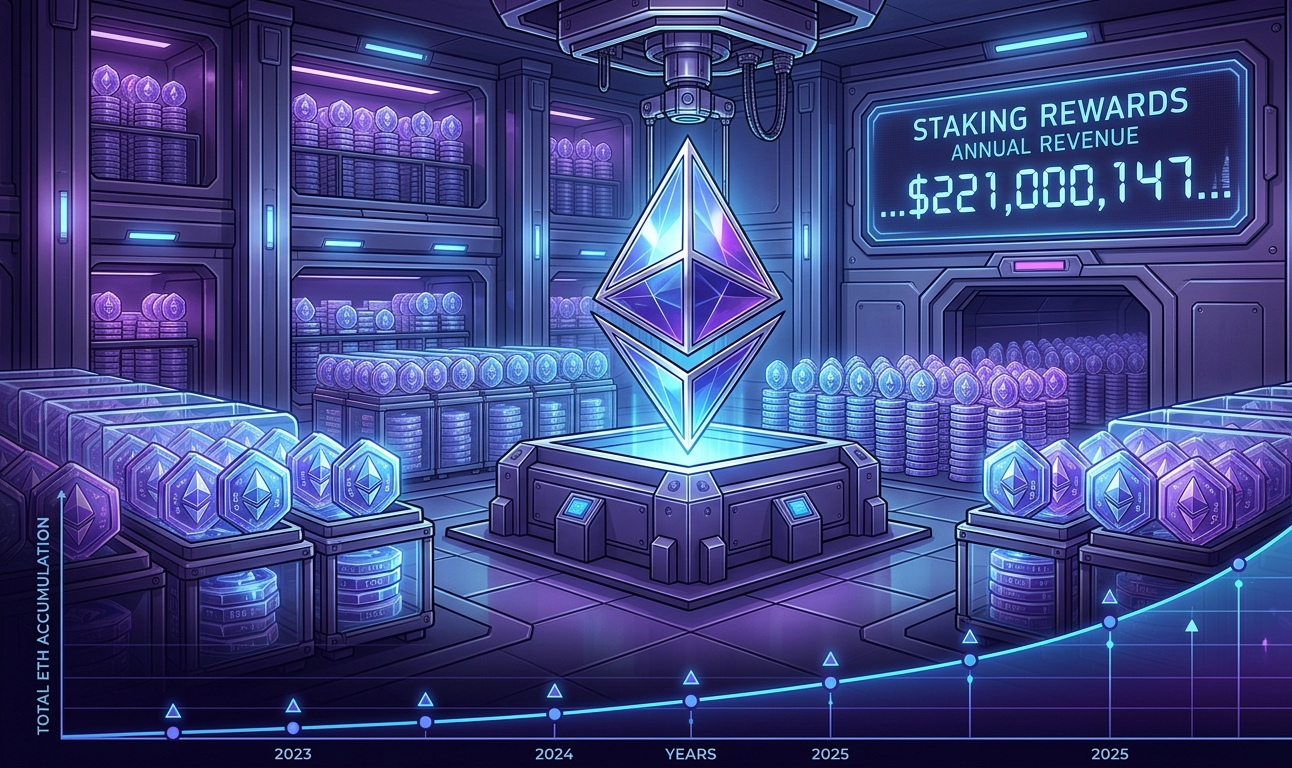
That staking detail is important. Two-thirds of Bitmine’s Ether is not just sitting in a wallet. It is locked into Ethereum’s proof-of-stake system, earning rewards for helping secure the network. The firm has staked more than 3.3 million ETH, generating roughly $221 million in annualised revenue.
This is where Bitmine’s model differs from Strategy’s. Strategy buys Bitcoin and holds it. There is no yield on Bitcoin sitting in a treasury. Bitmine buys Ether and stakes it, turning its treasury into a revenue-generating asset. The staking rewards effectively subsidise the cost of accumulation, which is why the company can keep buying even when the price is falling.
Why They Are Still Buying
Most digital asset treasury companies have slowed or stopped buying crypto in 2026. The Iran war, the oil shock, and the broader market volatility have scared off institutional buyers. Strategy is one of the exceptions on the Bitcoin side. Bitmine is the exception on the Ethereum side.
Lee said the firm sees signs that the recent drop in crypto prices is nearing an end. “Bitmine has maintained the increased pace of ETH buys in each of the past four weeks, as our base case ETH is in the final stages of the ‘mini-crypto winter,'” Lee said.
He added that Ether has risen sharply from its early February lows and has outperformed equities since the start of the Iran conflict on February 28, supported by demand tied to tokenisation and AI-related uses.
Lee’s thesis is straightforward. Ethereum is the settlement layer for stablecoins, tokenised assets, and an increasing amount of AI-related infrastructure. Those use cases are growing regardless of what happens with Iran or oil prices. If the “mini-winter” ends and risk appetite returns, ETH is undervalued relative to its network activity. He predicted at Paris Blockchain Week that Ether could climb above $60,000 over the coming years.
The Numbers in Context
Ethereum currently trades around $2,300, down more than 53% from its August 2025 all-time high of $4,946. That means Bitmine has been buying into significant weakness. Last week’s 101,627 ETH purchase was made at roughly $2,265 per token on average, well below both the all-time high and the network’s fundamental indicators.
Ethereum processed a record 200.4 million transactions in Q1 2026. Active addresses hit all-time highs. ETF inflows have been positive for multiple consecutive days. BlackRock launched a staked ETH ETF that pulled in $155 million on its first day. Charles Schwab announced it would begin offering direct spot ETH trading to its 39 million clients. The fundamental picture for Ethereum has never been stronger. The price has not caught up yet, and that is exactly the gap Bitmine is betting on.
Lee stated that the current crypto winter is “much closer to ending,” citing that while every major drawdown since 2015 coincided with an equity decline of at least 20%, the 2026 equity decline has been limited to 8%.
What Comes Next
Lee projected that once fully staked through the newly launched MAVAN validator network and partners, ETH staking rewards could reach about $330 million annually, based on a 2.88% yield assumption.
If Bitmine reaches 5 million ETH and stakes the majority of it, the company would be generating over $300 million a year in staking revenue alone. That recurring income stream, combined with any price appreciation in ETH, creates a compounding effect that Strategy’s Bitcoin-only model cannot replicate.
The risk is obvious. If Ethereum’s price continues to fall, Bitmine’s balance sheet takes the hit. The company reported a $3.8 billion quarterly loss in Q1 2026, driven entirely by the unrealised decline in ETH’s price. But Lee is betting that the price eventually catches up to the fundamentals. With nearly 5 million ETH in hand and $221 million in annual staking revenue to fund the wait, Bitmine has the resources to be patient.
For Ethereum holders, the message is simple: the largest corporate buyer of ETH in the world just made its biggest purchase of the year and said the bottom is near. That does not guarantee anything. But it does tell you where the smart institutional money is going while most of the market is still afraid.