
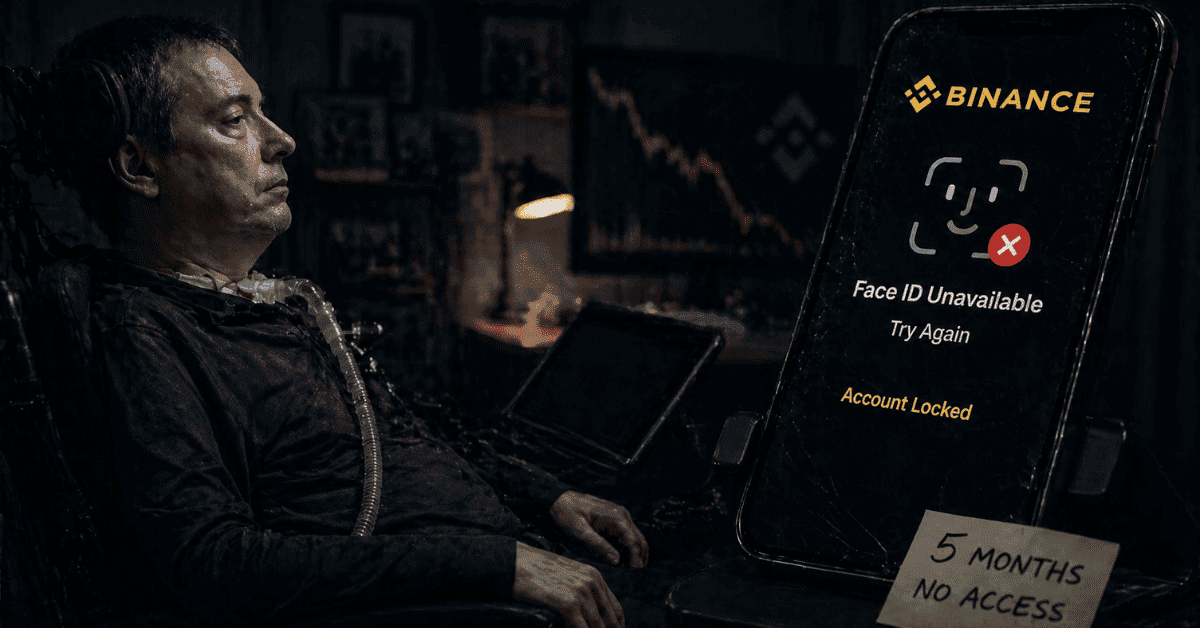
Binance is facing criticism after a former Argentine senator with amyotrophic lateral sclerosis, known as ALS, said the exchange’s facial verification system stopped recognizing him as the disease changed his appearance.
Esteban Bullrich, who served as Argentina’s Minister of Education from 2015 to 2017 and later as a senator, said he was locked out of his Binance account for five months. According to Protos, Bullrich claimed his crypto holdings were frozen during a period when Bitcoin fell from the $90,000 range into the $70,000s.


The case went viral after Bullrich publicly tagged Binance founder Changpeng Zhao and Binance CEO Richard Teng. Teng later apologized and said he was committed to fixing the accessibility gap for users facing similar challenges.
What Happened to Bullrich
Facial Verification Stopped Working
Bullrich revealed his ALS diagnosis in 2021. ALS is a progressive neurodegenerative disease that can weaken muscles, including facial muscles. That matters because biometric systems often compare a live face scan with older identity documents or previous verification images.
Bullrich said Binance’s Face ID system stopped recognizing him about five months ago. He also said Binance did not provide an accessible alternative that worked for his condition.
For a crypto user, that kind of lockout can be financially serious. If funds are held on an exchange and account access depends on facial verification, a failed biometric check can prevent trading, withdrawals and basic account management.
Binance Responded After the Post Went Viral
The public response appears to have made the difference. Binance Argentina said its team was reaching out directly and described the issue as an accessibility failure that needed to be corrected.
That response helped get attention on Bullrich’s case, but it also raised a harder question: why did it take a viral social media post for a disabled user to receive meaningful escalation?
In traditional finance, accessibility failures can prevent someone from managing savings, paying bills or protecting assets. In crypto, the stakes can be even sharper because asset prices can move quickly and exchange-held funds may be impossible to manage without access.
Why This Is Bigger Than One Account
Biometrics Can Fail When Bodies Change
Facial verification is common across crypto exchanges because platforms must reduce fraud, satisfy know-your-customer rules and protect accounts from takeover attempts. Binance’s own support material says face verification may be required for account access, trading, withdrawals, rewards and deposit-limit increases.
The security logic is understandable. Exchanges are frequent targets for identity theft, phishing and account-takeover scams. But biometric systems create a problem when they become mandatory and cannot be bypassed.
Faces change. Illness, disability, injury, aging, surgery, medication, facial paralysis and other conditions can all make a person look different from an older identity record. A system designed only around the “average” user can fail exactly when vulnerable users most need human support.
Mandatory Face ID Needs a Human Backup
Binance says facial verification is mandatory and cannot be removed or bypassed, describing it as essential for account protection. The problem exposed by Bullrich’s case is what happens when the correct user cannot pass the biometric test for legitimate medical reasons.
A strong security system should not depend on only one path. It should include accessible escalation, alternative verification, medical accommodation, trusted-contact procedures, notarized documents, live human review or other safeguards.
The goal is not to weaken security. It is to avoid turning security into exclusion.
Crypto Exchanges Need Better Accessibility Design
Accessibility Is Part of Consumer Protection
Crypto companies often talk about financial inclusion. But inclusion is not only about giving users access to tokens or low-cost transfers. It also means ensuring disabled users can safely access support, recover accounts and manage funds without needing public pressure.
For users with disabilities, bad account recovery processes can become a form of financial lockout. If the only working path is facial recognition, and facial recognition fails because of a medical condition, the platform has not built a truly accessible product.
This matters especially for centralized exchanges. Users who keep assets on an exchange are relying on that company’s support process. If access fails, they cannot simply use a seed phrase to recover funds elsewhere.
Automation Cannot Replace Judgment
Crypto platforms often automate identity checks because they operate globally and serve millions of customers. Binance reportedly crossed 300 million registered users in late 2025, which shows the scale of the support challenge.
But scale does not remove responsibility. Automated systems are useful for routine cases, while edge cases need trained human review. Disability-related verification failures are exactly the kind of cases where a platform should have a clear escalation path.
The damage from getting this wrong is not only reputational. It can expose users to market losses, stress, and potential legal or regulatory complaints.
What This Means for Binance
Binance’s response suggests the company understands the reputational risk. Teng’s apology was direct, and Binance Argentina acknowledged the accessibility problem publicly.
The harder task is building a process that prevents similar cases from lasting months. That likely means creating a dedicated accessibility review path for failed biometric verification, training support teams to recognize disability-related issues and giving users alternatives before they become desperate enough to post publicly.
Binance also needs to balance this with fraud prevention. Bad actors do try to bypass facial verification, sometimes by impersonating support staff or using AI-generated videos. That makes alternative verification harder, but not impossible.
A better system would protect users from scammers while still giving legitimate users a fair way to prove identity when biometrics fail.
What Comes Next
The first thing to watch is whether Binance publishes formal accessibility guidance for users who cannot complete facial verification because of illness, disability or changed appearance.
The second signal is whether other exchanges review their own biometric recovery systems. This is not only a Binance problem. Any platform that requires face scans for access, withdrawals or account recovery could face the same failure.
The third issue is regulatory attention. As crypto exchanges become more like mainstream financial institutions, accessibility and consumer-protection expectations will become harder to ignore.
Bullrich’s case shows that crypto security cannot be judged only by how well it blocks hackers. It must also be judged by whether real users, including disabled users, can still access their own money when automated systems fail.
Disclaimer: This article is for informational purposes only and does not constitute financial, investment, or legal advice. Always conduct your own research before making any investment decisions.