

Ethereum price analysis shows ETH stuck in a tense range as bulls defend the low $2,200 area while sellers continue to block a clean move toward $2,400.
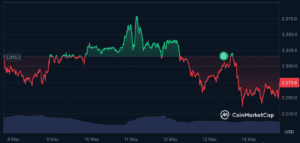
ETH is trading near $2,260, with CoinMarketCap data showing Ethereum down slightly over the last day and still ranked as the second-largest crypto asset by market value. The current setup is not a clean breakdown, but it is also not a strong breakout. Ethereum is holding above short-term support, while buyers still need to prove they can absorb sell pressure near the next major resistance area.


Why Ethereum Is Struggling Near $2,400
Ethereum’s biggest short-term problem is simple: buyers have not shown enough strength to clear the $2,400 area with confidence.
Several market trackers show ETH has been trying to recover from the low $2,200 range, but large sell orders near $2,400 have made the move harder. When traders talk about a sell wall, they mean a cluster of orders waiting above the current price. The price can still break through, but buyers need enough demand to absorb that supply.
That makes $2,400 more than a round number. It is the level that could decide whether ETH remains stuck in a sideways range or starts building a stronger recovery structure. If Ethereum clears it with volume, traders may look toward higher resistance. If it fails again, the market may return to testing the same support zones below.
For now, ETH looks trapped between patient buyers near support and sellers who are still comfortable defending the upper range.
Bulls Need to Protect the Low $2,200 Area
The low $2,200 area is the first major level ETH bulls need to defend.
Ethereum has been consolidating above roughly $2,220, while some technical updates point to weakness if ETH cannot reclaim the $2,280 to $2,300 area. That makes the middle of the range important because it separates a healthy rebound attempt from a market that is slowly losing momentum.
A break below the low $2,200 area would not automatically destroy Ethereum’s larger structure, but it would weaken short-term confidence. It could invite more sellers, trigger stop losses, and push traders to watch lower levels. A strong bounce from that zone, on the other hand, would show that buyers are still willing to step in before the chart turns more bearish.
This is why the current ETH setup needs balance. The market is not showing panic, but it is also not showing strong upside control. Bulls are defending support, while bears are still controlling the resistance zone above.
ETF Demand Is Still Not Strong Enough
Ethereum also needs stronger institutional demand if it wants to break higher.
Spot Ethereum ETFs gave ETH a regulated path into traditional portfolios, but demand has not been as powerful or consistent as Bitcoin ETF demand. That matters because ETF flows can help show whether larger investors are building exposure or stepping back.
Recent market analysis has pointed out that ETH does not need ETF inflows to match Bitcoin’s scale, but it does need enough steady demand to show that institutions are participating in the recovery. Weak or uneven ETF flows leave Ethereum more dependent on crypto-native traders, which can make price moves more fragile.
This is one reason ETH has struggled to turn support into a stronger breakout. Retail traders can push short-term moves, but a durable recovery usually needs broader demand. ETF buyers, whales, staking flows, and DeFi activity all matter when Ethereum is trying to move through a heavy resistance area.
Whale Activity Adds Pressure Near Resistance
Whale behavior is another reason the $2,400 area matters.
Large holders can shape short-term market structure because their orders create visible pressure in the order book. If whales place large sell orders near $2,400, smaller traders may hesitate to buy into that wall unless momentum becomes strong enough to challenge it.
Fresh technical coverage also noted that Ethereum faced bearish divergence near the $2,400 resistance zone, while whale wallets had accumulated roughly 360,000 ETH during the recent correction. That mix is important because it shows two different forces at work. Some large holders may be buying dips, while others may still be selling into strength near resistance.
That kind of mixed whale behavior can keep ETH range-bound. Accumulation near support can limit downside, but sell pressure near resistance can stop rallies from becoming clean breakouts. Until one side wins, Ethereum may continue moving inside a wide band.
Ethereum Still Has Strong Long-Term Themes
The short-term chart looks cautious, but Ethereum still has several long-term themes working in its favor.
The network remains the main base for DeFi, stablecoins, tokenization, Layer 2 settlement, and many institutional blockchain experiments. CoinMarketCap’s latest Ethereum update highlighted recent developments around clearer transaction signing and tokenized assets going live on Ethereum, both of which support the network’s utility beyond simple price speculation.
Those themes matter because Ethereum’s value is tied to real network use. If tokenized assets, stablecoins, and DeFi activity continue growing, ETH can benefit from deeper demand for settlement, fees, staking, and infrastructure.
The problem is timing. Strong long-term fundamentals do not always produce immediate price strength. ETH still needs buyers in the spot market, stronger ETF demand, and a clean technical breakout before traders will treat the current range as a confirmed recovery.
What Traders Should Watch Next
The first level to watch is still $2,400.
A clean break above that zone, especially with stronger volume, would suggest buyers are finally absorbing the sell wall. That could open the door to a stronger move toward the next resistance levels. If ETH fails again near $2,400, traders may treat the move as another rejection and look back toward the low $2,200 area.
The second level is the $2,220 to $2,250 support zone. Holding that area keeps Ethereum’s short-term structure alive. Losing it would make the chart weaker and could bring lower support levels into focus.
The third factor is ETF flow data. If Ethereum ETFs begin showing more consistent demand, ETH could have an easier time attacking resistance. If flows remain soft, Ethereum will need crypto-native demand to do more of the work.
The fourth factor is Bitcoin. ETH can build its own story, but Bitcoin still drives broad market risk appetite. If BTC remains under pressure after hot inflation data and ETF outflows, Ethereum may struggle even if its own setup improves.
Key Takeaway
Ethereum is not breaking down, but it is not breaking out either.
ETH remains caught between support in the low $2,200 area and resistance near $2,400. Bulls need stronger volume, steadier ETF demand, and a clean move through resistance before the market can treat this as a real recovery. Until then, Ethereum’s long-term themes remain strong, but the short-term chart still needs proof.
Disclaimer: This article is for informational purposes only and does not constitute financial, investment, or legal advice. Always conduct your own research before making any investment decisions.