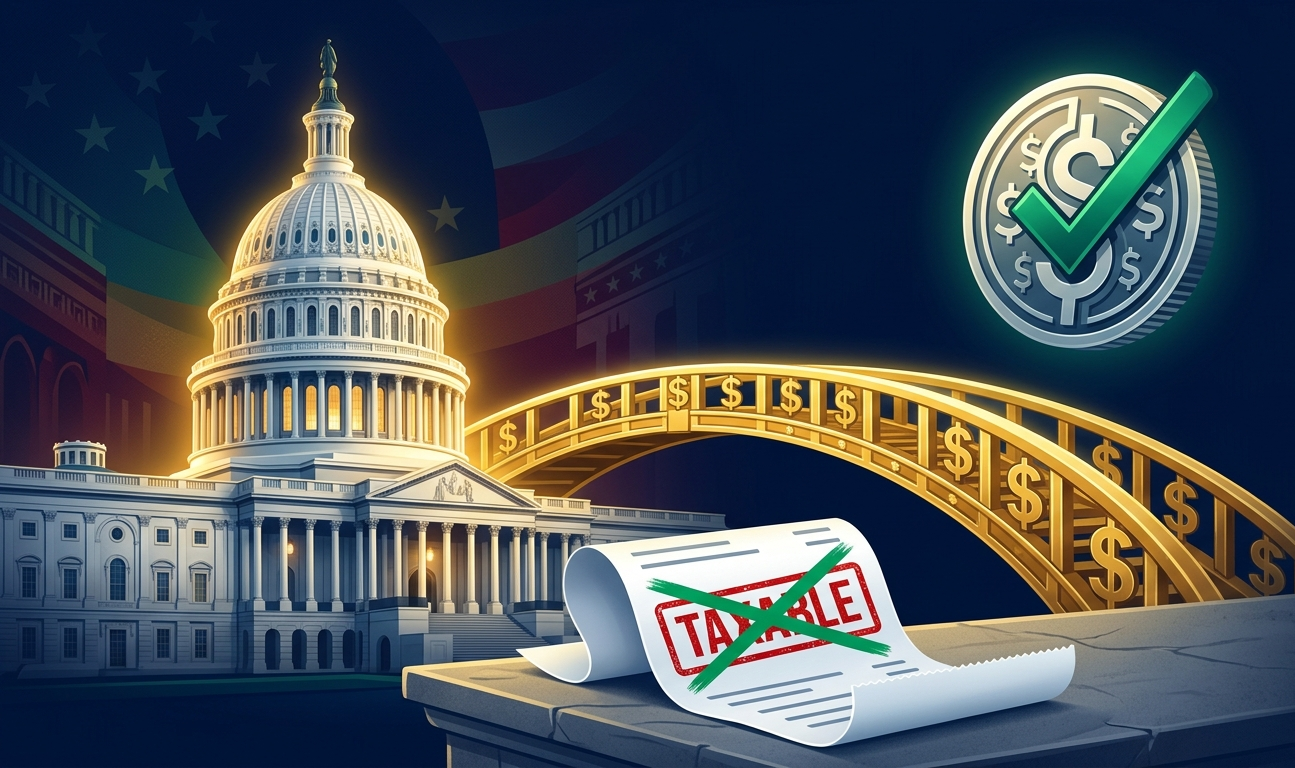
Under current US tax law, spending USDC or USDT to buy anything is treated by the IRS the same way as selling a stock. Every stablecoin transaction is a taxable disposal event, meaning anyone who pays for goods with crypto must calculate their cost basis, determine any gain or loss, and report it. The fact that USDC barely deviates from exactly one dollar is irrelevant to the IRS. The disposal is the event, and the event is taxable. A bipartisan bill circulating in the House of Representatives would change that entirely. The Digital Asset Protection, Accountability, Regulation, Innovation, Taxation, and Yields Act, known as the PARITY Act, would exempt everyday regulated stablecoin payments from capital gains tax, treating them the way foreign currency transactions are already treated under US tax law. The PARITY Act first appeared as a discussion draft in December 2025. Representatives Horsford and Miller relaunched the revised version in March 2026. It is today one of the most consequential pieces of crypto legislation that most people outside the industry have never heard of.
What the Bill Would Do
The core provision is straightforward. Under the new draft, gains on everyday payments made with regulated dollar-pegged stablecoins could be ignored for tax purposes. No gain or loss shall be recognised on the sale of a regulated payment stablecoin, provided the taxpayer’s basis stays above 99% of the redemption value. If the stablecoin holds close to $1, the transaction triggers no taxable event.


In practical terms, spending USDT or USDC on anything would no longer require tax reporting, provided the token meets the bill’s qualifying criteria. The administrative burden that currently makes stablecoin payments impractical for everyday commerce would be eliminated for compliant coins.
Not every stablecoin qualifies. To receive the tax relief, a stablecoin must meet the definition set out in the GENIUS Act. It must be pegged to the US dollar, issued by a permitted entity, and must consistently trade within 1% of one dollar for at least 95% of trading days over the prior 12 months. These criteria narrow the field to regulated, compliant issuers only. The bill does not extend any of this relief to volatile assets. Bitcoin, Ethereum, and similar cryptocurrencies remain outside the scope of these exemptions.
How the Bill Evolved
The December 2025 draft included a $200 de minimis threshold, meaning only stablecoin transactions below that value would be exempt. The updated draft drops the previous $200 de minimis threshold. The March revision removes the dollar cap entirely, replacing it with the 99% basis test, so any qualifying stablecoin transaction is exempt regardless of size, as long as the peg holds.
That is a significant expansion. The December version would have covered small retail purchases. The March revision would cover large business-to-business stablecoin payments as well, provided the token qualifies.
Staking and mining rewards would receive a five-year tax deferral option, a compromise between current IRS guidance and industry demands.
The bill also closes a loophole crypto traders have exploited for years. The bill would extend traditional wash-sale rules to digital assets like Bitcoin and other actively traded tokens, closing a long-standing loophole that allowed aggressive tax-loss harvesting in volatile crypto markets. Under current rules, an investor can sell Bitcoin at a loss, immediately buy it back, and claim the tax deduction. The PARITY Act would end that, aligning crypto with how stocks and bonds are already treated.
Why It Matters for Stablecoin Adoption
The stablecoin market now has a total supply exceeding $315 billion. USDT alone circulates at approximately $185 billion. Both are widely used in crypto trading but have struggled to gain traction as actual payment instruments in everyday commerce, partly because of this tax friction. If you were to buy your groceries with stablecoins every day, each one of those would be a taxable event. Removing that requirement could be huge for crypto and stablecoin adoption.
The timing connects directly to Tether’s launch of tether.wallet on April 14, which enables gasless stablecoin payments with username-based addresses. The infrastructure for frictionless stablecoin payments is arriving at the same moment the legislative framework to make those payments tax-free is advancing through Congress. If both succeed, the practical barriers to spending USDT in everyday commerce would be lower than at any point in the asset’s history.
What Comes Next
The draft legislation reflects bipartisan agreement on core policy objectives and provides the Treasury with targeted regulatory authority to prevent abuse while reducing unnecessary administrative burdens on taxpayers.
Representative Miller has stated he wants the bill before Congress for a vote before August 2026. The PARITY Act remains a discussion draft. It has not been formally introduced as legislation, has not been assigned to committee, and has not been voted on. The bipartisan sponsorship from a Republican and a Democrat on the House Ways and Means Committee is a meaningful signal, but it does not guarantee passage.
What is certain is that the problem the bill is trying to solve is real and widely acknowledged. The IRS treating every USDT payment as a stock sale is not a sustainable framework for a $315 billion asset class that the US government is simultaneously trying to position as a global dollar payment standard.