
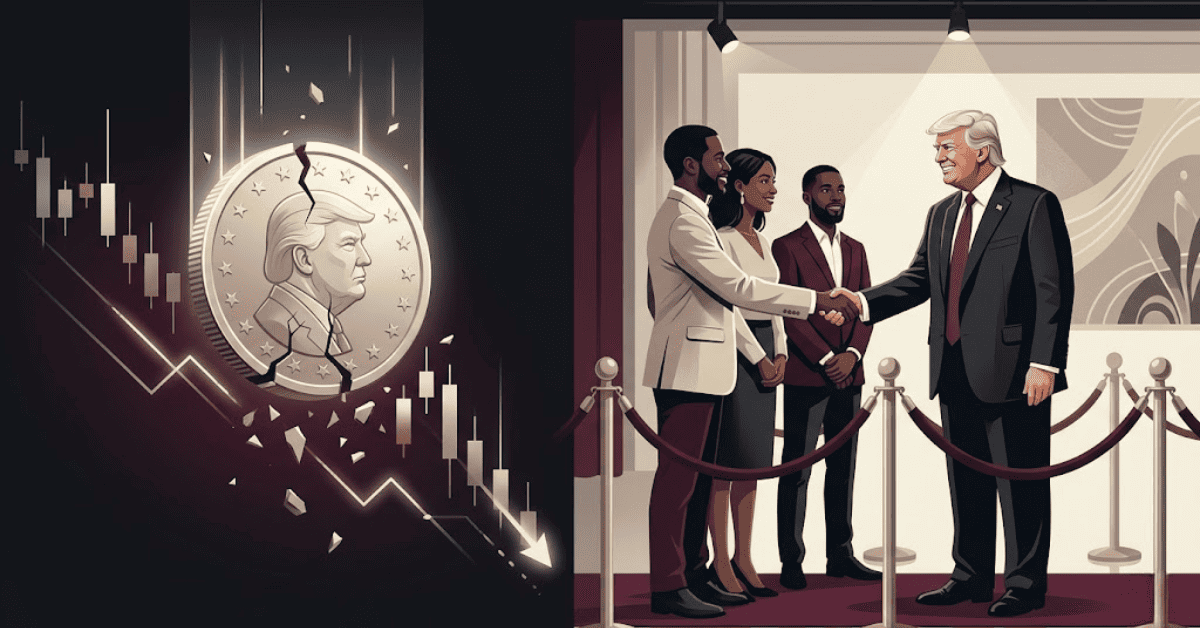
President Donald Trump hosted winners of his second annual $TRUMP meme coin contest at Mar-a-Lago on Saturday, even as the token tied to his brand traded roughly 96% below its all-time high.
The event brought together the largest holders of the $TRUMP token, with Reuters reporting that 297 qualifying winners were invited and the top 29 were eligible for a VIP reception. The contest was based on token holdings and purchases of Trump-branded merchandise, turning access to the event into a crypto-backed leaderboard race.


The timing made the gathering especially sensitive. The $TRUMP token, which surged after launching in January 2025, has since collapsed from a peak near $75 to below $3. When the contest closed earlier this month, the token was trading around $2.81, according to Reuters reporting republished by NDTV.
A Second Contest, But a Weaker Token
The Numbers Look Very Different This Time
This was not Trump’s first crypto-holder event, but the scale of investor enthusiasm appears to have cooled.
Reuters reported that the 297 qualifying winners held about $29 million worth of $TRUMP, citing crypto analytics firm Nansen. That is far below the roughly $148 million held by winners of the inaugural May 2025 contest.
MarketWatch also reported that $TRUMP had fallen 96% from its all-time high and about 80% since Trump’s first promotional event in May 2025. That kind of drawdown is severe even by meme coin standards, where prices often depend more on attention, celebrity branding and community momentum than on cash flows or protocol usage.
Access Became the Product
The contest shows how political meme coins can blur the line between speculation, fandom and access. For ordinary meme coins, the pitch is usually community, virality or the chance of a sharp price move. With $TRUMP, the pitch also included proximity to the sitting president through a private event at one of his clubs.
That makes the token unusual. Its value is not only connected to market sentiment around meme coins, but also to Trump’s public profile, political power and business network.
Why Ethics Watchdogs Are Paying Attention
Critics See a Conflict of Interest Problem
The event has drawn scrutiny because Trump is not just a public figure associated with a token. He is also the president, and the Trump family’s crypto ventures have become a major source of financial attention.
Reuters reported that Trump family crypto ventures have generated more than $1 billion, including hundreds of millions linked to meme coin sales in early 2025. The White House has denied that there is a conflict of interest, but ethics experts continue to question whether buyers are gaining a route to political influence by purchasing a president-linked crypto asset.
MarketWatch reported that Trump-affiliated entities control 80% of the token supply and have generated more than $324 million in trading fees for insiders, citing finance professor David Krause. That structure is one reason critics argue that insiders can benefit from trading activity even if retail holders suffer losses as the token price falls.
The Foreign Buyer Question Has Not Gone Away
The contest also raises questions about who is buying access. Reuters said billionaire Justin Sun was among the major participants in the broader Trump crypto ecosystem, while other reporting has highlighted concerns about foreign participation in Trump-linked crypto events.
For regulators and ethics lawyers, that is not a small detail. Crypto wallets can be pseudonymous, and token purchases can move through offshore exchanges or complex wallet structures. That makes transparency harder than with traditional political donations or event fundraising.
What the $TRUMP Collapse Says About Meme Coins
The $TRUMP token’s decline is also a reminder that celebrity-linked crypto assets can move violently in both directions. The launch captured enormous attention because it combined politics, meme culture and speculative trading. But once the initial frenzy faded, the token was left exposed to the same forces that hit many meme coins: thin fundamentals, changing attention cycles and heavy insider supply concerns.
That does not mean the token cannot rally again. Meme coins often move sharply on announcements, influencer attention or broader risk-on crypto markets. But the 96% drawdown shows the risk of buying tokens whose main value proposition is social momentum.
For retail traders, the lesson is straightforward. Access-based events can create short-term demand, but they do not guarantee lasting token value. A contest may attract whales, but it does not change the economics of a token with concentrated supply and limited utility.
What Comes Next
The next thing to watch is whether the event creates any meaningful rebound in $TRUMP trading activity or whether the token continues to drift near its lows. Traders will also be watching wallet behavior after the event, especially whether large holders reduce exposure once the access benefit has been used.
The bigger story may unfold in Washington. Lawmakers and ethics watchdogs are likely to keep examining Trump-linked crypto ventures, especially if token sales, trading fees or contest access become recurring features of his political and business brand.
For now, the Mar-a-Lago event captures the tension at the center of the $TRUMP trade. The brand is still powerful enough to bring major holders into the room, but the token chart tells a much colder story.
Disclaimer: This article is for informational purposes only and does not constitute financial, investment, or legal advice. Always conduct your own research before making any investment decisions.