
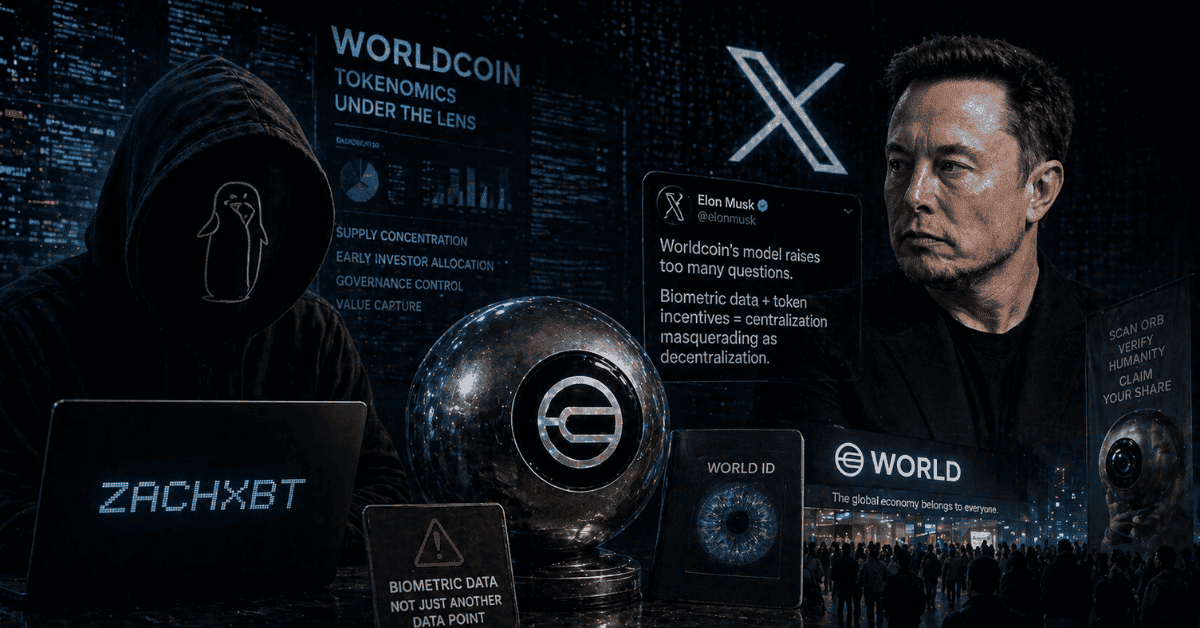
Worldcoin is facing renewed criticism after on-chain investigator ZachXBT accused the project of using predatory tokenomics and Elon Musk again amplified attacks on Sam Altman-linked ventures.
The latest dispute centers on WLD, Worldcoin’s native token, and the way it was launched with a low circulating supply compared with its much larger future unlock schedule. ZachXBT argued that the structure benefited insiders while leaving retail buyers exposed to heavy dilution as more supply entered the market.


The criticism has landed at a difficult moment for WLD. Market trackers show the token trading near $0.25 after reaching an all-time high around $11.74 to $11.82, depending on the data provider. That means WLD is down roughly 98% from its peak, a brutal drawdown even by altcoin standards.
Why ZachXBT Is Targeting Worldcoin
The Low-Float Tokenomics Debate
Low-float tokens can be highly controversial because only a small portion of total supply trades freely at launch. If demand is strong, the limited circulating supply can push prices up quickly. But as locked tokens later unlock for investors, teams, market makers or ecosystem incentives, existing holders can face major dilution.
ZachXBT’s criticism is that Worldcoin used this kind of structure while marketing itself as a global identity and financial inclusion project. He compared the model to other heavily criticized crypto launches where insiders had privileged access and retail traders carried much of the downside.
Worldcoin’s defenders may argue that token unlocks are disclosed and that long vesting schedules are common in venture-backed crypto projects. Critics counter that disclosure does not make the structure fair if ordinary buyers do not fully understand how much future supply may hit the market.
OTC Insider Sales Add to the Concern
The latest criticism also points to alleged over-the-counter sales by insiders. OTC deals can be legitimate, especially for large holders trying to avoid dumping tokens directly onto exchanges. But they can become controversial when the market believes insiders are reducing exposure while retail users continue buying.
That is why the timing matters. WLD’s price collapse has made tokenomics a central part of the Worldcoin debate. If investors believe insiders were able to exit or reduce positions while the broader market absorbed unlock pressure, confidence becomes harder to rebuild.
Worldcoin has long argued that its mission is to create a privacy-preserving proof-of-personhood network. But token performance and insider-sale allegations have shifted attention from the identity product to the financial incentives behind it.
Biometric Data Is the Bigger Ethical Flashpoint
Small Token Payments for Iris Scans
Worldcoin’s core product asks users to verify their humanity by scanning their irises through a device called an Orb. In return, users can receive a World ID and, in eligible regions, WLD tokens.
ZachXBT and other critics argue that this model disproportionately targets low-income users by offering small crypto payments in exchange for sensitive biometric data. That concern has followed Worldcoin since its early rollout, especially in emerging markets where token incentives can be more meaningful to participants.
The ethical question is not only whether users technically consent. It is whether they fully understand what biometric verification means, what data is stored, how it can be used and what risks exist if identity systems are compromised or misused.
Verified IDs Reportedly Appear in Black Markets
Another recurring concern is the reported sale of verified World IDs or Worldcoin-linked accounts through informal marketplaces. If verified accounts can be bought and sold, it weakens the project’s promise that World ID creates a reliable proof-of-personhood layer.
That creates a two-sided problem. On one side, black-market account sales raise privacy and security concerns for users who may be pressured or paid to give up verified identities. On the other side, they weaken the value of the identity system itself if platforms cannot trust that a verified account is controlled by the person who originally scanned.
For a project built around proving unique human identity, that is a serious challenge.
Regulators Have Already Pushed Back
Spain, Kenya and Other Jurisdictions Raised Concerns
Worldcoin’s biometric model has already drawn regulatory action in multiple countries. Spain’s data protection authority ordered Worldcoin to temporarily stop collecting and processing personal data in 2024, citing privacy risks and concerns around minors and consent. A later European data protection decision required changes around iris-scan data handling.
Kenya also suspended Worldcoin activity in 2023 over data-collection concerns before later dropping a criminal investigation and allowing the project to work toward resuming operations. Other jurisdictions have reviewed or restricted Worldcoin activity over biometric privacy, consumer protection and data-transfer questions.
This regulatory pattern matters because Worldcoin’s growth depends on onboarding verified users globally. If more countries restrict Orbs, limit token incentives or require stronger biometric safeguards, user growth could slow.
Privacy Is Now a Core Market Risk
For WLD investors, privacy regulation is not a side issue. It is a direct market risk.
Worldcoin’s token story depends partly on the success of its identity network. If regulators prevent the project from collecting biometric data in key markets, the network’s adoption case becomes weaker. If the project can satisfy regulators with stronger privacy guarantees, the opposite could happen.
That is why every privacy ruling, suspension and enforcement action now matters for WLD’s long-term outlook.
Elon Musk Keeps the Spotlight on Altman
Elon Musk’s renewed criticism of Sam Altman has added fuel to the debate. Musk’s comments were not limited to Worldcoin, but they gave ZachXBT’s Worldcoin thread a larger audience and tied the token controversy to broader public scrutiny of Altman-linked projects.
That matters because Worldcoin sits at the intersection of AI, crypto and identity. Its stated goal is to prove personhood in a world where artificial intelligence makes online identity harder to verify. But that same connection to AI has made the project politically and culturally sensitive.
Supporters see Worldcoin as infrastructure for a future where distinguishing humans from bots becomes essential. Critics see it as a risky biometric database tied to a collapsing token and powerful Silicon Valley backers.
What This Means for WLD Holders
WLD’s price decline shows how punishing tokenomics concerns can become once market sentiment turns. A project can have a large vision, strong backers and real technology, but if investors fear dilution, insider selling and regulatory restrictions, the token can struggle.
The next major issue is supply. If future unlocks continue increasing circulating supply while demand remains weak, WLD could face ongoing pressure. On the other hand, any credible reform to tokenomics, stronger transparency around OTC activity or major regulatory win could help stabilize sentiment.
For now, WLD remains a high-risk asset tied to one of crypto’s most controversial identity experiments.
What Comes Next
The first thing to watch is whether the Worldcoin team responds directly to ZachXBT’s tokenomics and insider-sale claims. A detailed response could clarify unlock schedules, OTC activity and how the project plans to protect public-market holders.
The second issue is regulatory action. Temporary restrictions could become permanent in some jurisdictions, while others may approve Worldcoin operations under stricter safeguards.
The third signal is whether Worldcoin changes its incentive model. If the project keeps offering small token payments for biometric verification, critics will continue arguing that the system targets vulnerable users. If it shifts toward a less incentive-driven model, growth may slow but reputational risk could improve.
Worldcoin’s problem is no longer just convincing people that proof of personhood matters. It must also convince users, investors and regulators that the token and biometric system are fair, safe and worthy of trust.
Disclaimer: This article is for informational purposes only and does not constitute financial, investment, or legal advice. Always conduct your own research before making any investment decisions.