
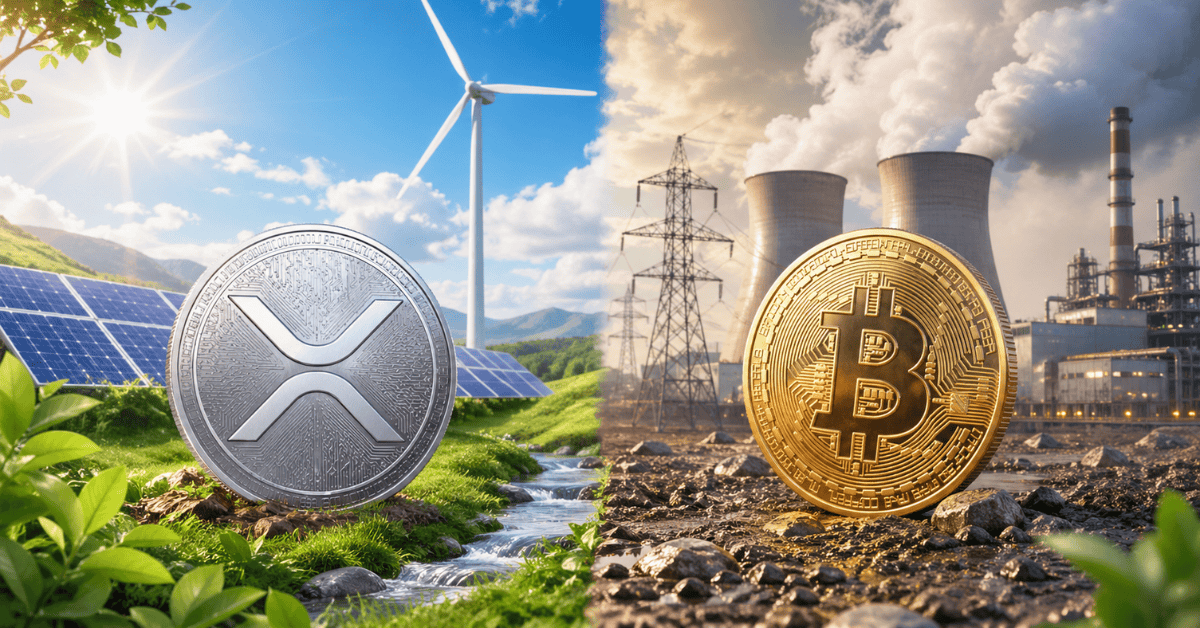
XRP is often described as one of the more environmentally friendly major cryptocurrencies. That claim is mostly fair, especially when XRP is compared with Bitcoin. The reason is simple: XRP does not use mining.
Bitcoin relies on proof-of-work, where miners run specialised machines to compete for new blocks and secure the network. That process consumes large amounts of electricity by design. XRP, by contrast, runs on the XRP Ledger, which uses a consensus process among validators instead of energy-intensive mining.


The XRP Ledger’s own documentation says the network requires no mining and uses “negligible energy.” XRPL Commons, which tracks sustainability data for the ledger, currently lists the XRP Ledger’s annual electricity consumption at roughly 457,000 kWh and annual emissions at about 63 tonnes of CO2 equivalent.
That is tiny compared with Bitcoin. Cambridge’s Bitcoin electricity tracker estimates Bitcoin’s annual electricity consumption in the hundreds of terawatt-hours range, while Cambridge’s 2025 mining research estimated Bitcoin’s annual electricity use at around 138 TWh, with 52.4% of mining energy coming from sustainable sources.
So, is XRP environmentally friendly? Compared with Bitcoin, yes. Compared with traditional payment networks or other low-energy blockchains, the answer depends on how the measurement is made.
Why Bitcoin Uses So Much Electricity
Bitcoin’s energy use comes from its security model.
In proof-of-work, miners spend electricity to protect the network from attack. The more valuable Bitcoin becomes, the more incentive miners have to deploy machines, search for cheap power and compete for block rewards. This links Bitcoin’s security to real-world energy consumption.
Supporters argue that this is a feature, not a flaw. They say Bitcoin’s energy demand gives the network neutrality, censorship resistance and independence from trusted operators. Critics argue that the same design makes Bitcoin environmentally costly, especially when mining relies on fossil fuels or strains local power grids.
Both points can be true at the same time. Bitcoin’s electricity use helps secure the network, but it also creates a footprint that regulators, investors and environmental analysts continue to scrutinise.
The most important thing is scale. Cambridge’s Bitcoin Electricity Consumption Index exists because Bitcoin mining is large enough to be compared with national electricity consumption. That does not automatically mean Bitcoin is “bad,” but it does mean Bitcoin’s environmental impact cannot be dismissed as trivial.
Why XRP Uses Far Less Energy
XRP takes a very different route.
The XRP Ledger does not require miners to solve computational puzzles. Instead, independent validators agree on the order and validity of transactions. Because validators are not competing through massive electricity expenditure, the network can operate with far lower power demand.
This is why XRP’s per-transaction energy use is often described as extremely small. XRPL educational material has previously cited XRP at around 0.0079 kWh per transaction, compared with much higher estimates for Bitcoin transactions. Other sustainability dashboards place XRPL’s consumption even lower depending on methodology and current network activity.
The exact number can vary by source, but the direction of the comparison does not. XRP uses a fraction of the electricity consumed by Bitcoin because XRP does not have mining.
That makes XRP attractive for payment-focused use cases, especially for businesses or institutions that care about ESG reporting. If a company wants fast settlement without a large electricity footprint, XRP has a much easier story to tell than Bitcoin.
The Per-Transaction Comparison Can Be Misleading
There is one important caveat: comparing Bitcoin and XRP by “energy per transaction” can oversimplify the issue.
Bitcoin’s electricity use does not rise neatly with each individual transaction. Miners consume power to secure the whole network, whether a block contains many transactions or fewer transactions. That means dividing total mining electricity by the number of on-chain transactions can produce dramatic figures, but it does not fully explain how the system works.
XRP is different because its validator model is not built around constant mining competition. Its electricity use is much more directly tied to running network infrastructure. That is why per-transaction comparisons usually make XRP look dramatically cleaner.
Still, the broader conclusion is valid. Whether measured annually, per transaction or by network architecture, XRP is vastly less energy intensive than Bitcoin.
Is XRP Carbon Neutral?
This is where the answer becomes more nuanced.
Ripple and XRP Ledger ecosystem groups have promoted carbon neutrality efforts, including carbon credits and sustainability partnerships. Ripple has also made corporate climate commitments, including a pledge to reach net zero by 2030.
However, investors should separate three things: Ripple the company, XRP the token and the XRP Ledger network. Ripple’s corporate sustainability targets do not automatically mean every use of XRP is perfectly carbon neutral. Carbon neutrality claims often depend on offsets, methodology and the quality of emissions accounting.
That does not erase XRP’s efficiency advantage. It just means “low energy” is a stronger claim than “zero impact.” XRP’s main environmental advantage is structural: it does not require proof-of-work mining.
Bitcoin Is Improving, But Still Energy Intensive
Bitcoin’s sustainability picture is also not static.
Cambridge research published in 2025 found that sustainable energy sources accounted for 52.4% of Bitcoin mining energy, with natural gas replacing coal as the largest single energy source in the surveyed data. That suggests the mining mix may be improving in some areas.
But Bitcoin still consumes far more electricity than XRP. Even if a growing share of mining uses renewable or lower-carbon energy, total consumption remains high. That matters because electricity demand has real-world consequences, including grid pressure, opportunity cost and local environmental effects.
For Bitcoin supporters, the question is whether that energy use is justified by Bitcoin’s role as a decentralised monetary network. For critics, the question is whether a crypto asset should consume that much power when lower-energy alternatives exist.
XRP lands on the other side of that debate. It sacrifices Bitcoin’s mining-based security model in favour of speed, efficiency and payment-focused settlement.
The Bottom Line
XRP is environmentally friendly compared with Bitcoin. Its consensus system avoids mining, uses far less electricity and produces a much smaller carbon footprint than proof-of-work networks.
That does not mean XRP has no environmental impact at all. Validators still run servers, infrastructure still consumes electricity and carbon-neutral claims should always be checked carefully. But among major crypto assets, XRP has a strong sustainability argument.
Bitcoin remains the more decentralised and battle-tested store-of-value network, but it carries a much heavier energy footprint. XRP is not trying to be digital gold in the same way. It is designed more for fast, low-cost settlement, and that design makes it dramatically more energy efficient.
For environmentally conscious crypto users, the comparison is clear. XRP is not perfect, but next to Bitcoin, it is much greener.
Disclaimer: This article is for informational purposes only and does not constitute financial, investment, or legal advice. Always conduct your own research before making any investment decisions.