Something happened this week that sounds boring on the surface but is actually a massive deal. Ondo Finance, JPMorgan, Mastercard, and Ripple successfully completed the first ever cross-border, cross-bank redemption of a tokenized US Treasury fund. And it settled in under five seconds.
If you’ve been hearing about “tokenization” and “real-world assets” for years and wondering when it would actually matter, this is the moment it starts getting real. Four of the biggest names in finance and blockchain just proved that tokenized government bonds can be redeemed across borders, across banks, and across continents in the time it takes to send a text message.


What Actually Happened?
Let’s walk through it step by step, because the details matter.
Ripple held a position in Ondo’s OUSG fund, which is a tokenized version of short-term US government Treasuries. Think of it like owning a government bond, but instead of paperwork sitting in a brokerage account, the asset lives as a token on the XRP Ledger blockchain.
When Ripple wanted to redeem that investment, Ondo processed the redemption on the XRP Ledger. That blockchain transaction cleared in under five seconds. But here’s the clever part. The system didn’t stop there.
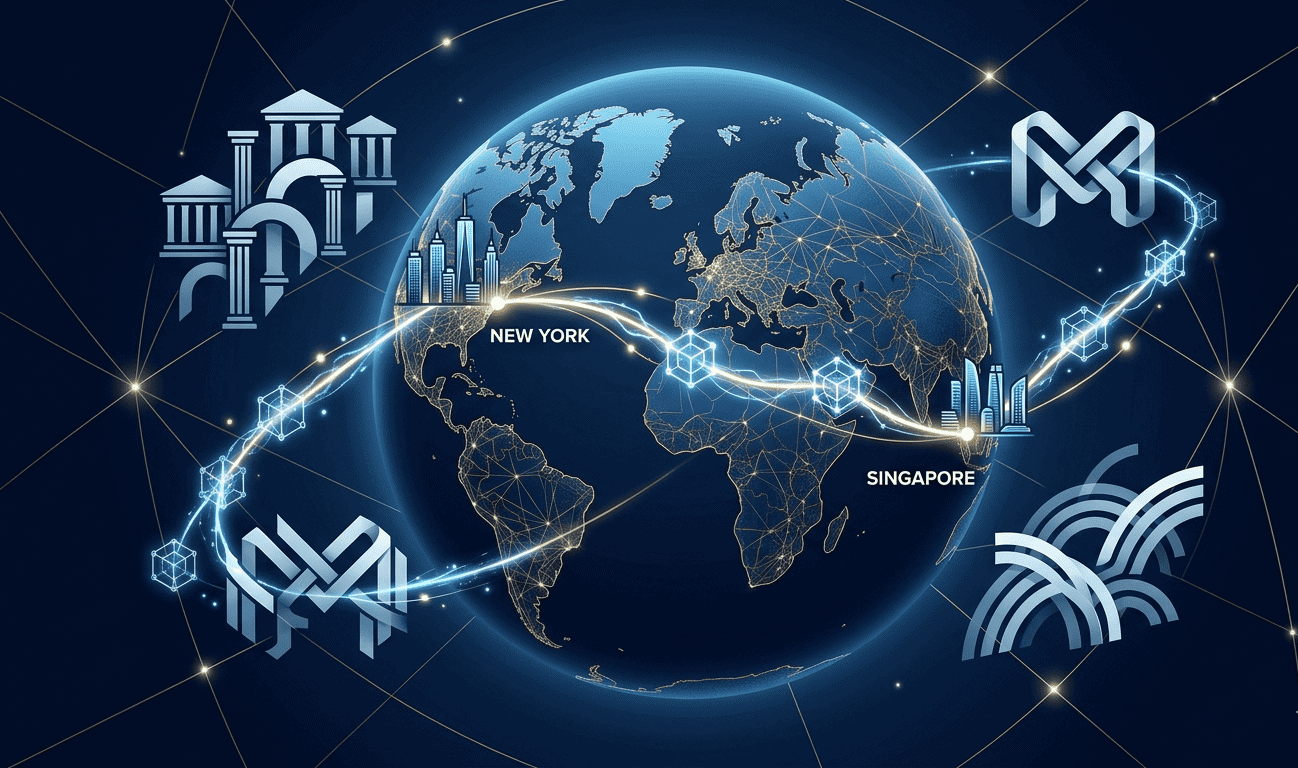
Mastercard’s Multi-Token Network automatically picked up the redemption instruction and routed it to JPMorgan’s blockchain platform, Kinexys. JPMorgan then debited Ondo’s blockchain deposit account and wired the equivalent US dollars to Ripple’s bank account in Singapore through its correspondent banking network.
The entire process, from token redemption on a public blockchain to actual dollars landing in a bank account on the other side of the world, happened in near real time. Outside of traditional banking hours. No manual wire transfers. No waiting one to three business days.
This is the first transaction of its kind between global financial institutions, combining a live public blockchain with traditional interbank settlement in a single seamless flow.
Why This Matters for Everyone
Here’s why you should care even if you’ve never bought a Treasury bond in your life.
Right now, the global financial system essentially shuts down every evening, every weekend, and every holiday. If you need to move money across borders, you’re at the mercy of banking hours, time zones, and a chain of intermediary banks that each take their cut and their time. A simple international wire transfer can take anywhere from one to five business days.
That system was built for a world where ledgers were physical books and transactions required humans to verify them. We don’t live in that world anymore.
What Ondo, JPMorgan, Mastercard, and Ripple just demonstrated is a framework for 24/7 global financial markets. Markets that never close. Settlement that happens in seconds instead of days. And the connecting tissue between the old world and the new is tokenization.
Ian De Bode, president of Ondo Finance, said the pilot lays the groundwork for global markets that never close. That’s not marketing fluff. That’s literally what the technology just did.
The Tokenization Market Is Exploding
This pilot didn’t happen in a vacuum. The tokenized real-world asset market has been growing at a staggering pace.
Tokenized US Treasuries alone have crossed the $15 billion mark. The broader RWA tokenization market surged over 250% from $5.4 billion at the start of 2025 to $19.3 billion by the end of Q1 2026. Some estimates put the current figure closer to $27 billion.
And the institutional heavyweights keep piling in. The Depository Trust and Clearing Corporation (DTCC) announced this week that it will launch its own tokenization service in October, with Treasury bills and bonds among the eligible assets. Nasdaq is preparing for tokenized stock and ETF trading. Boston Consulting Group projects the overall tokenization market could reach $16 trillion by 2030.
What’s interesting is that while the issuance side of tokenized assets has scaled rapidly over the past year, the redemption infrastructure had been lagging behind, still stuck on traditional wire systems and limited banking hours. This pilot directly addresses that gap by turning what used to be a multi-day process into a single integrated flow.
What’s the Catch?
As exciting as this is, there are legitimate hurdles ahead.
The International Monetary Fund warned in April 2026 that tokenization shifts risk to shared ledgers and smart contracts, making it harder to manage problems during periods of financial stress. Without clear legal frameworks around ownership and settlement finality, tokenized markets could remain fragmented rather than becoming mainstream.
Shark Tank investor Kevin O’Leary echoed that concern at Consensus Miami this week, saying that large amounts of institutional capital won’t move on-chain until US crypto market structure legislation passes. The CLARITY Act is currently working its way through the Senate, but it’s unclear exactly when it will be finalized.
So while the technology clearly works, the regulatory and legal infrastructure still needs to catch up before tokenized Treasuries become an everyday reality for institutional investors.
What This Means for Crypto
For the crypto industry, this is one of those stories that quietly validates everything the space has been building toward. A public blockchain (the XRP Ledger) just worked hand in hand with JPMorgan and Mastercard to settle a real financial instrument across borders. That’s not a testnet demo. That’s real money, real banks, real settlement.
The broader implication is that blockchain technology is finding its most powerful use case not in replacing traditional finance but in making it faster, cheaper, and available around the clock. Tokenization bridges both worlds, and this week’s pilot proves the bridge actually works.
Disclaimer: This article is for informational purposes only and does not constitute financial advice. Cryptocurrency investments carry significant risk. Always conduct your own research before making any investment decisions.