


The crypto market selloff deepened as Bitcoin moved near $78,000, with hot inflation, rising bond yields, and renewed ETF outflows pressuring risk assets across the board.
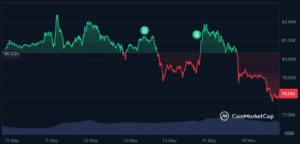
Bitcoin is currently trading around $78,202, with an intraday low near $77,711, after failing to hold the $80,000 area. The broader crypto market also weakened sharply, with CoinMarketCap showing the total market cap near $2.59 trillion, down about 2.95% over the last day. That daily drop is roughly in line with a market value loss near $100 billion from recent levels.


This is not a single-cause move. Crypto is reacting to several pressures at once. Inflation is staying hotter than markets wanted, Treasury yields are rising, Bitcoin ETF flows have turned weaker, and traders are reducing exposure to assets that depend on easy liquidity.
Inflation Pressure Hits Risk Appetite
U.S. consumer prices rose faster than expected in April, with CPI up 0.6% month over month and 3.8% year over year. Core CPI also rose 0.4%, keeping pressure on the Federal Reserve to stay cautious on rate cuts.
That matters for Bitcoin because crypto often trades like a liquidity-sensitive asset during macro stress. When inflation looks sticky, traders expect the Fed to keep rates higher for longer. Higher rates make cash and bonds more attractive, while riskier assets such as Bitcoin, Ethereum, Solana, and XRP can lose momentum.
Bitcoin can still benefit from long-term institutional demand, but short-term traders care about liquidity. If the market believes rate cuts are delayed, leveraged positions become more fragile and altcoins usually feel the pressure first.
Rising Yields Make Bitcoin’s Job Harder
The 10-year Treasury yield climbed toward 4.6%, while the 30-year yield moved near 5.12%, its highest level in about a year. Higher yields pushed investors away from risk assets after a week of strong stock-market performance.
For crypto, that creates a difficult setup. Bitcoin does not pay yield. When bond yields rise, investors can earn more from safer assets, which makes speculative assets less attractive in the short term.
This does not mean Bitcoin’s long-term case disappears. It means the near-term market has to compete with a stronger yield environment. If Treasury yields stay elevated, Bitcoin may struggle to rebuild momentum above $80,000, and altcoins may remain under heavier selling pressure.
The same pressure can show up quickly across crypto because many traders use leverage. When yields rise and Bitcoin drops, leveraged long positions can unwind fast, adding more selling to an already weak tape.
ETF Outflows Remove a Key Support
Bitcoin ETF demand has been one of the market’s biggest support pillars, but recent outflows have weakened that support.
Spot Bitcoin ETFs saw large withdrawals earlier this week, including about $233.25 million in net outflows on May 12 and about $635.23 million on May 14, the largest single-day outflow since mid-February.
ETF flows matter because they show whether institutional demand is absorbing market supply. When inflows are strong, they can help support Bitcoin even when retail traders are cautious. When outflows appear during a macro selloff, Bitcoin loses one of its strongest buffers.
That is why the current move feels heavier than a normal intraday dip. Bitcoin is not only facing technical resistance near $80,000. It is also dealing with a weaker institutional flow picture at the same time as inflation and yields pressure broader markets.
Bitcoin Near $78,000 Becomes the Market’s Main Test
The $78,000 area is now the key short-term battleground for Bitcoin.
BTC has already touched an intraday low near $77,711, which means traders are watching whether buyers defend the high-$77,000 to low-$78,000 range. A quick recovery back above $79,000 to $80,000 would suggest the selloff is still controlled. A deeper break could bring more defensive positioning across the market.
Bitcoin’s dominance has stayed elevated during the weakness, which shows that traders are still treating BTC as the safest part of crypto compared with smaller assets. Recent market coverage also pointed to broader crypto weakness while Bitcoin dominance remained strong.
That is usually not a great sign for altcoins. When Bitcoin drops and dominance stays firm, smaller tokens often fall faster because traders move away from higher-risk positions first.
Altcoins Feel the Selloff Faster
Altcoins are usually hit harder when Bitcoin loses important levels during macro pressure.
That is happening again as traders reduce exposure to tokens with weaker liquidity, smaller market caps, or more speculative narratives. The total crypto market cap is now near $2.59 trillion, and the 24-hour market decline shows that selling has spread beyond Bitcoin.
Ethereum, Solana, XRP, BNB, and other large altcoins can stabilize if Bitcoin holds the $78,000 area. But if BTC breaks lower, altcoins may face another round of selling because they depend heavily on confidence in the wider market.
This is also where ETF outflows matter beyond Bitcoin. When institutional Bitcoin demand weakens, it changes the mood across the whole crypto market. Traders become less willing to chase altcoin rallies, and short-term capital moves toward stablecoins or cash.
What Traders Should Watch Next
The next few sessions will likely decide whether this is a controlled pullback or a deeper crypto market selloff.
The first signal is Bitcoin’s reaction around $78,000. A strong bounce would show that buyers still view this range as attractive. A weak bounce or a clean break below the intraday low would make the chart look more fragile.
The second signal is Treasury yields. If yields cool, Bitcoin may get room to recover. If yields keep rising, risk assets may stay under pressure.
The third signal is ETF flow data. A return to inflows would help calm the market. Continued outflows would make it harder for Bitcoin to reclaim $80,000.
The fourth signal is inflation commentary from the Fed. Hot inflation keeps rate-cut hopes under pressure, and crypto is unlikely to ignore that while yields remain elevated.
FAQ
Why is the crypto market falling today?
Crypto is falling because hot inflation, rising Treasury yields, weaker Bitcoin ETF flows, and broader risk-off sentiment are pressuring Bitcoin and altcoins at the same time.
How much value did crypto lose?
CoinMarketCap shows the total crypto market cap near $2.59 trillion, down about 2.95% over the last day. That scale of decline is roughly in line with about $100 billion in market value lost from recent levels.
Why do ETF outflows matter for Bitcoin?
ETF outflows matter because they show weaker institutional demand. When spot Bitcoin ETFs are losing money during a macro selloff, BTC has less flow support to absorb selling pressure.
Disclaimer: This article is for informational purposes only and does not constitute financial, investment, or legal advice. Always conduct your own research before making any investment decisions.