Bitcoin slipped below $79,000 as markets reacted to a sensitive Federal Reserve transition, with Jerome Powell temporarily staying on as chair pro tempore until Kevin Warsh is sworn in as the next Fed chair.
The Federal Reserve said Powell’s formal term as chair concluded on May 15, 2026, but the Board named him chair pro tempore while Warsh’s swearing-in remains pending. The Fed described the move as a temporary bridge during the transition, not a new full term for Powell.


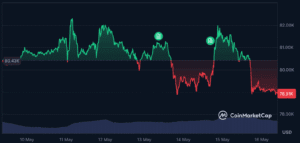
Bitcoin was trading around $78,957, with an intraday low near $78,686, according to current market data. That puts BTC back under the $79,000 level after a week where traders were already watching Treasury yields, inflation concerns, and the Fed’s policy direction.
What Happened at the Federal Reserve?
Powell’s term as Fed chair ended on May 15, but he has not fully left the central bank’s leadership structure yet.
The Fed Board named him chair pro tempore, which means he temporarily leads the central bank until Warsh officially takes over. Warsh has already been confirmed as the next chair, but the final swearing-in process has not been completed.
That detail matters because the market is not only reacting to a person. It is reacting to uncertainty around the handover. Investors want to know how quickly Warsh takes the role, how policy communication changes, and whether the Fed becomes more open to rate cuts or stays cautious on inflation.
For Bitcoin, this kind of uncertainty can matter quickly. BTC often trades like a high-risk macro asset when markets are focused on rates, yields, and liquidity. When the Fed outlook becomes less clear, traders can reduce risk before waiting for the next signal.
Why Bitcoin Fell Below $79,000
Bitcoin’s drop below $79,000 came as Treasury yields rose and inflation worries returned to the front of the market.
Fresh market coverage showed BTC falling as low as $78,600, with traders watching rising U.S. yields, energy prices, and the possibility that the Fed may not cut rates as quickly as risk assets would like.
This is the key issue for crypto. Bitcoin tends to perform better when liquidity is improving, rate-cut expectations are strong, and investors feel comfortable taking risk. It can struggle when yields rise because safer assets become more attractive and leveraged traders become more cautious.
The Fed transition adds another layer. Warsh is expected to take over from Powell, but markets still need to hear how he will guide policy. Until that becomes clearer, Bitcoin may remain sensitive to every inflation print, bond move, and Fed comment.
Why Powell’s Temporary Role Matters
Powell staying temporarily does not mean the Fed is changing direction overnight.
The Fed framed the move as a standard temporary step during a leadership transition. Reuters also reported that Powell was named chair pro tempore until Warsh is sworn in, with the timing of Warsh’s official start still pending.
The issue is that markets dislike open-ended uncertainty. Some officials also raised concerns about the temporary arrangement. Barron’s reported that Governor Stephen Miran opposed the designation and Vice Chair for Supervision Michelle Bowman abstained, with both raising concerns about the structure of Powell’s temporary role.
That does not create a crisis by itself. But it does create noise around the central bank at a time when crypto traders already care deeply about rate cuts, inflation, and liquidity.
For Bitcoin, the market wants a cleaner answer. Who is leading the Fed, how quickly does the transition finish, and will the next chair lean more dovish or more hawkish?
Why Warsh’s Policy Direction Is Important for Crypto
Kevin Warsh’s arrival matters because a new Fed chair can change how markets think about future rates.
Crypto traders are not only watching today’s policy. They are trying to price what the Fed may do over the next several meetings. If Warsh is seen as more willing to cut rates, Bitcoin could benefit from stronger liquidity expectations. If he is seen as more focused on inflation control, BTC may face more pressure.
That does not mean Warsh alone controls Bitcoin’s price. Bitcoin also depends on ETF demand, exchange liquidity, miner behavior, institutional flows, and broader market risk appetite. But the Fed still has a major influence because interest rates shape how much risk investors are willing to take.
Right now, the market is dealing with both a leadership change and a price chart that has lost the $79,000 area. That combination makes traders more careful.
What Bitcoin Traders Should Watch Next
The first level to watch is whether Bitcoin can reclaim $79,000 to $80,000.
A move back above that range would show buyers are still defending the broader trend. If BTC fails to recover and keeps trading below $79,000, traders may start watching lower support zones and reducing risk in altcoins.
The second thing to watch is Treasury yields. If yields keep rising, Bitcoin may struggle to build momentum because investors may prefer safer yield-bearing assets. If yields cool, BTC could get room to stabilize.
The third thing is the Fed handover itself. Markets will want clarity on when Warsh is sworn in and how he frames inflation, growth, and interest rates in his first public signals as chair.
The fourth factor is ETF demand. Bitcoin spot ETF flows have become one of the clearest ways to track institutional appetite. Strong inflows can help absorb selling pressure, while outflows can make macro-driven drops sharper.
What This Means for Altcoins
Altcoins usually become more vulnerable when Bitcoin loses key levels during macro uncertainty.
If BTC stays below $79,000 and volatility rises, traders may reduce exposure to smaller tokens first. That can pressure Ethereum, Solana, XRP, meme coins, and newer altcoins even if their individual stories have not changed.
This is why Fed transitions matter beyond Bitcoin. A weaker BTC market often tightens liquidity across crypto. When traders become cautious, they tend to move toward cash, stablecoins, or only the largest assets.
If Bitcoin quickly recovers the $79,000 to $80,000 range, altcoins may stabilize. If BTC keeps weakening, the broader crypto market could remain defensive until the Fed transition becomes clearer.
What Happens Next?
The next few days are important because markets need clarity from both price action and policy signals.
If Warsh is sworn in quickly and gives a steady message, some of the transition uncertainty may fade. If the handover drags on or creates more political noise, risk assets may stay under pressure.
Bitcoin also needs to show whether the move below $79,000 is only a short-term dip or the start of a deeper pullback. A fast recovery would suggest buyers are still active near the current range. A continued slide would make the market more cautious, especially if yields keep rising.
For now, the story is not only that Powell’s formal chair term ended. The bigger story is that Bitcoin is trying to price a Fed leadership change at the same time as macro conditions become less friendly for risk assets.
Disclaimer: This article is for informational purposes only and does not constitute financial, investment, or legal advice. Always conduct your own research before making any investment decisions.