
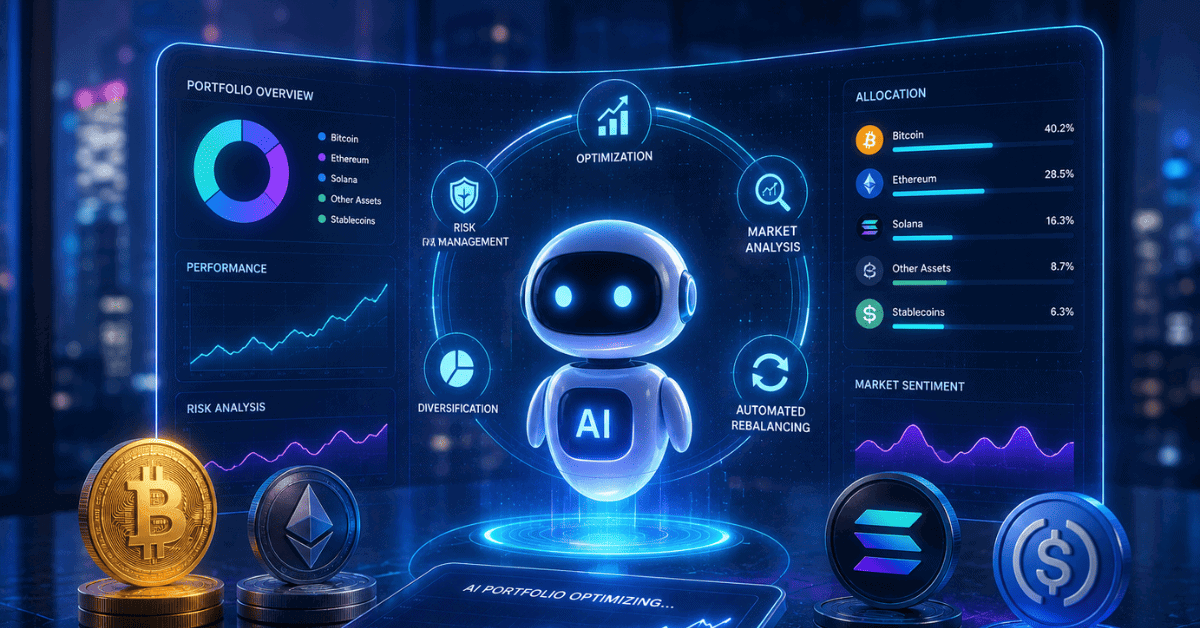
AI crypto portfolio management is becoming a serious talking point after CoinGecko found that 14.5% of surveyed crypto participants would let an AI agent manage their entire portfolio.
That is roughly 1 in 7 respondents willing to hand over 100% of their crypto holdings to an automated system. Even more striking, 87.1% said they would let AI agents manage at least 10% of their portfolio, showing that crypto users are cautious about AI, but still curious enough to test it with real money.


The result captures something very specific about crypto culture. Users may distrust centralized platforms, worry about wallet access, and understand that automation can go wrong. But many are still willing to experiment if they think the upside is big enough.
Why Crypto Users Are Open to AI Agents
Crypto has always attracted early adopters. The same audience that learned to use self-custody wallets, decentralized exchanges, bridges and yield protocols is naturally more open to letting software make financial decisions.
AI agents fit into that mindset.
In theory, an AI trading or portfolio agent can monitor markets around the clock, react faster than a human, rebalance positions, track sentiment, and execute predefined strategies without panic or greed. For a market that never closes, that promise is easy to understand.
CoinGecko’s survey also found that around half of participants believe AI agents will be better than humans at crypto trading and investing most of the time. That is not overwhelming trust, but it is enough to show that AI is moving from novelty to financial tool in the minds of many crypto users.
The Trust Problem Has Not Gone Away
The funny part is that crypto users are not blindly trusting AI.
CoinGecko found that 37.5% of respondents do not trust AI agents with wallet access, while 34.5% said they do trust them and 27.9% were neutral. That split is important because portfolio management is not just about choosing assets. It can also require permission to move funds, sign transactions, interact with DeFi protocols, or access exchange accounts.
That is where the risk becomes real.
An AI agent that only gives suggestions is one thing. An AI agent with permission to trade, bridge assets, approve smart contracts or manage private keys is another. In crypto, a bad decision does not always mean a small underperformance. It can mean a drained wallet, a malicious contract approval, or a liquidation triggered by poor risk settings.
Why 14.5% Is a Big Number
At first glance, 14.5% may sound small. It is not.
For any financial technology, getting 1 in 7 users to say they would hand over their entire portfolio is a major sign of risk appetite. In traditional finance, most investors would hesitate before giving full control to an automated system, especially one using relatively new AI models.
Crypto users appear more willing to take that leap because they are already used to high volatility and experimental tools. Many have traded meme coins, used unaudited protocols, farmed new tokens, or followed anonymous market calls. Against that backdrop, an AI portfolio manager may feel like just another high-risk, high-reward product.
That does not make it safe. It makes it very crypto.
AI Could Help, But It Can Also Amplify Mistakes
AI agents could eventually make crypto portfolios more efficient. They may help users avoid emotional trades, monitor risk, identify suspicious wallet activity, and automate boring tasks such as rebalancing or tax-aware tracking.
But AI can also scale mistakes quickly.
A flawed model can misread market conditions. A trading bot can overfit to past data. An agent can follow a bad signal. A wallet-connected system can become a security target. If thousands of users rely on similar AI strategies, those agents could even crowd into the same trades, making selloffs sharper when conditions turn.
The deeper issue is accountability. If an AI agent loses money, who is responsible? The user, the developer, the protocol, the exchange, or the model provider? Crypto has not fully answered that question.
The Next Phase of Crypto Automation
The CoinGecko survey suggests the market may be ready for a new wave of AI-driven crypto tools, but users will likely demand more guardrails.
The safest products may start with limited permissions: alerts, portfolio analysis, risk scoring, suggested trades, or small allocation caps. More advanced users may experiment with agents that can trade directly, but only within strict limits.
That is where the industry could move next. Not full autonomy from day one, but controlled automation with clear permissions, spending limits, emergency stops and transparent logs.
A Very Crypto Kind of Trust
The most interesting takeaway is not that crypto users fully trust AI. They clearly do not.
The real takeaway is that many are willing to give AI a small piece of the portfolio anyway, and a surprisingly large minority would hand over everything. That mix of skepticism and risk appetite is exactly why crypto moves so fast.
AI crypto portfolio management is still early, and it carries serious security, execution and accountability risks. But if CoinGecko’s survey is any guide, the market is not waiting for perfect trust before experimenting.
In crypto, “I do not fully trust this” and “I might try it anyway” can both be true at the same time.
Disclaimer: This article is for informational purposes only and does not constitute financial, investment, or legal advice. Always conduct your own research before making any investment decisions.