Users began reporting the problem shortly after 01:00 GMT on Tuesday. Searching for Telegram in Apple’s App Store returned nothing. Official listings produced 404 errors. The absence held across every tested region, worldwide and simultaneously, for one of the most widely used messaging platforms on earth.
Existing installations kept working. Android and the Mac App Store were unaffected. But new downloads and reinstalls on iPhone and iPad were blocked entirely, and for several hours nobody knew why.


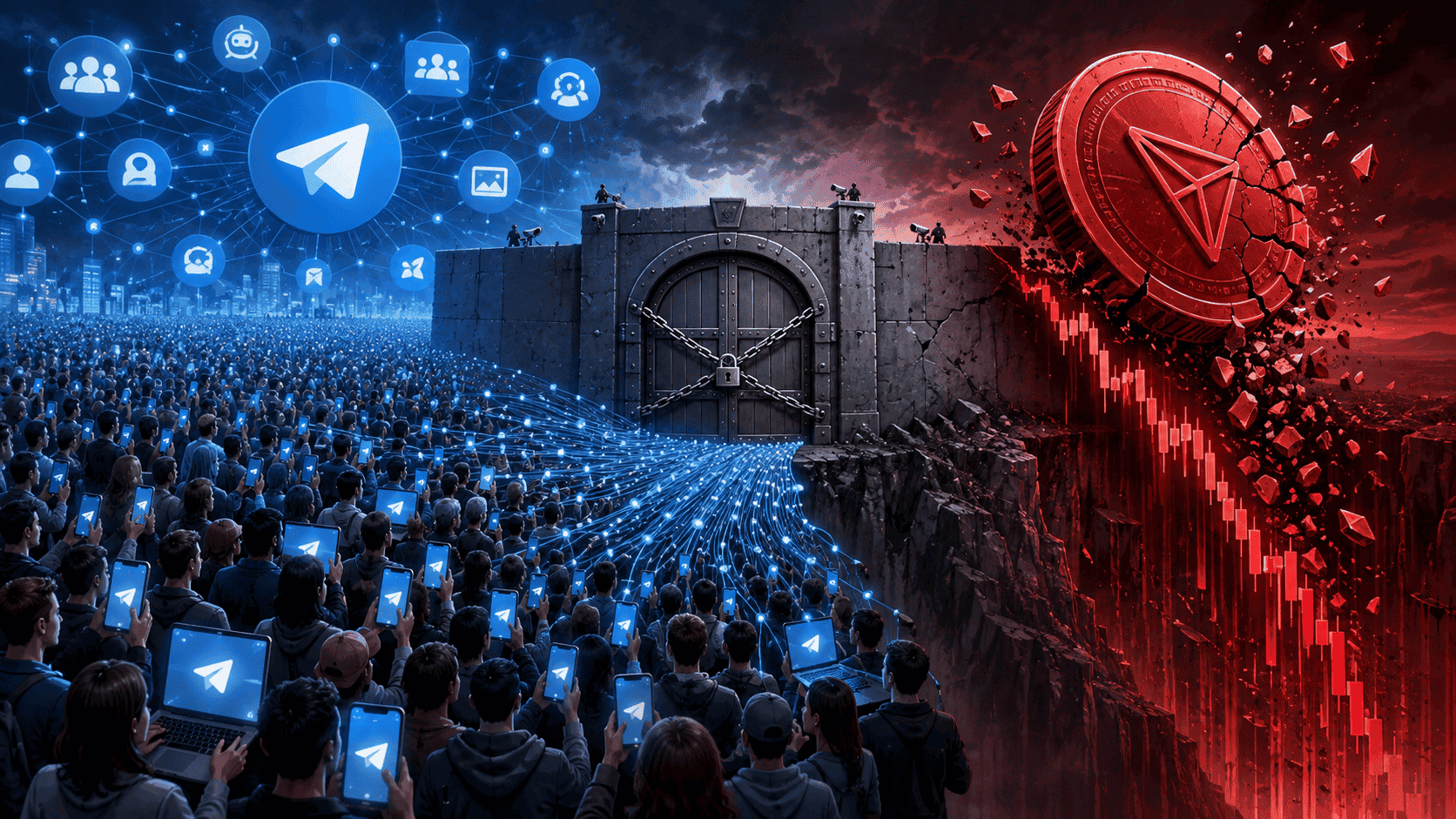
GRAM, the token formerly known as Toncoin and now the centrepiece of Telegram’s crypto ambitions, fell roughly 8% to a three-month low of $1.29.
The app was restored the same day. Apple subsequently confirmed the removal followed a review that identified content violating its guidelines prohibiting child sexual abuse material, and said the app was reinstated after the developer promptly removed the content and banned the user who posted it. Telegram confirmed the restoration. Apple did not respond to requests for comment outside business hours.
The whole episode lasted hours. What it revealed about GRAM’s structural position lasts considerably longer.
The Dependency the Token Cannot Escape
Three weeks ago, Pavel Durov announced that Telegram would embed a native, non-custodial GRAM wallet directly into every version of its app this summer, describing it as the largest rollout of a non-custodial crypto wallet in human history. The claim was arithmetically defensible: putting a self-custody wallet in front of more than a billion monthly active users would instantly dwarf every existing crypto wallet by an order of magnitude.
That entire thesis rests on distribution. GRAM’s investment case is not really about the underlying blockchain’s technical merits; it is about Telegram’s reach. The token is a bet that a messaging platform with a billion users can convert some fraction of them into crypto users through sheer proximity.
Tuesday demonstrated how fragile that channel is. A single platform operator, acting unilaterally and without warning, removed the distribution mechanism for the world’s most ambitious consumer crypto rollout. Not because of anything crypto-related, and not because of any regulatory action against GRAM. The token fell 8% because of a content moderation decision at a company with no involvement in it whatsoever.
Every crypto project that depends on app store distribution carries this exposure. GRAM simply carries it more visibly than most, because its value proposition is distribution.
This Has Happened Before, Repeatedly
The precedent cuts both ways, which is why the market reaction was sharp but not catastrophic.
In 2018, Apple briefly pulled Telegram and its experimental Telegram X app over concerns about inappropriate content circulating in some channels. Durov said at the time that Apple had alerted the company, prompting Telegram to introduce additional protections before the apps were restored days later.
Other removals have proved permanent. In 2024, Telegram was pulled from the Chinese App Store alongside WhatsApp, Threads and Signal after Apple received an order from the country’s internet regulator. That removal remains in effect. In 2023, Telegram was temporarily banned in Brazil for failing to provide authorities with information about groups accused of promoting violence in schools.
The pattern is that removals can be temporary, and they can also happen again at any time, to any app, without warning. That is the genuinely useful takeaway for anyone holding a token whose value depends on app store presence.
The Pressure Building Around Durov
The timing landed amid an unusually heavy period of legal pressure on Telegram and its founder, which is partly why the initial absence prompted so much speculation.
Last week, Australia’s telecommunications regulator initiated civil proceedings against Telegram over allegations it failed to detect and remove pro-terror material from the platform. Over the weekend, Russia’s Federal Security Service announced that Durov had been charged with aiding terrorism and placed on an international wanted list. Durov, who has lived outside Russia since 2014, said he was put on the list for refusing demands for mass surveillance and censorship on Telegram. Russia first blocked Telegram in 2018, lifted the restrictions two years later, then banned the service again in February 2026.
None of that appears connected to Tuesday’s removal, based on Apple’s stated reason. But the accumulation matters for GRAM holders in a broader sense. Telegram’s regulatory position is contested in multiple jurisdictions simultaneously, and the token’s value is tethered to a platform facing sustained legal challenge across several continents.
What It Means for Holders
The immediate damage was limited and largely reversed, but the episode surfaces three things worth weighing.
The first is concentration risk of an unusual kind. Most crypto assets face protocol risk, regulatory risk and market risk. GRAM additionally faces platform risk, where a third party with no stake in the token can materially affect its distribution overnight. That is not a flaw in the token’s design so much as an inherent cost of building a crypto asset on top of someone else’s consumer product.
The second is that the wallet rollout timeline now carries an extra variable. Durov’s announcement gave no firm date beyond summer, released no technical documentation, and did not detail the key management scheme for a billion non-technical users. Add app store availability to the list of things that must hold for that plan to execute as promised.
The third is more about market psychology. GRAM fell 8% on a story that resolved within hours, hitting a three-month low in the process. That suggests holders are already nervous, and that the token trades with limited conviction beneath it. GRAM remains far below its May highs, and a token that gaps down on a temporary listing outage is one where the marginal holder is watching for reasons to leave.
Telegram is back on the App Store. The wallet rollout remains on the table. But Tuesday was a useful demonstration that the largest consumer crypto distribution plan ever attempted runs through a gate someone else controls, and that gate can close without notice.
FAQ
What happened to Telegram on the App Store?
Telegram disappeared from Apple’s App Store worldwide early on August 4, 2026, with searches returning no results across every tested region and official listings producing 404 errors. Existing installations continued working, and Android and the Mac App Store were unaffected. Apple later confirmed the removal followed a review identifying content that violated guidelines prohibiting child sexual abuse material, and said the app was restored after Telegram removed the content and banned the user responsible. Telegram confirmed the app was reinstated the same day.
Why did GRAM fall?
GRAM dropped roughly 8% to a three-month low of $1.29 because the token’s value proposition depends heavily on Telegram’s distribution reach. Pavel Durov announced weeks ago that Telegram would embed a native non-custodial GRAM wallet into every version of its app this summer, targeting its billion-plus monthly active users. A worldwide App Store removal, even a temporary one, directly threatens that distribution channel, which is the core of the investment thesis.
Has this happened before?
Yes, several times. Apple briefly removed Telegram and Telegram X in 2018 over inappropriate content, restoring them after safeguards were added. Telegram was pulled from the Chinese App Store in 2024 alongside WhatsApp, Threads and Signal after an order from China’s internet regulator, and that removal remains in effect. Brazil temporarily banned the service in 2023. Removals can be temporary, but they can also be permanent and can occur without warning.
Disclaimer: This article is for informational purposes only and does not constitute financial advice. Cryptocurrency investments carry significant risk. Always conduct your own research before making any investment decisions.