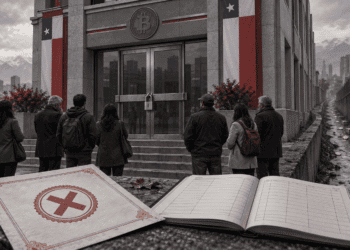

Most crypto regulation works by restricting who can do what. Licences, registration requirements, asset eligibility rules, investor caps. Brazil’s central bank has chosen a different lever: time.
Under Resolution BCB No. 584/2026, published on August 7, Brazilian exchanges and virtual asset service providers will be required to delay certain customer transfers by up to 24 hours. The rule takes effect on 1 January 2027 and applies when a customer deposits reais or crypto with an exchange and then seeks to send funds abroad or to a wallet they control.


The threshold is the equivalent of $10,000, reached either through a single transaction or through the combined value of a customer’s transfers on the same day. Smaller transfers may also face delays if an exchange flags them as risky under its own risk-management policies.
The central bank has been explicit that this is not a freeze. Nothing is confiscated and nothing is permanently blocked. The delay simply creates a window during which compliance teams can examine a transaction before the funds move beyond reach. A trader moving $15,000 in bitcoin to a self-custody wallet held outside Brazil would wait up to a full day. So would a company settling a large invoice with a foreign crypto firm.
Why Speed Is the Target
The reasoning behind the rule is specific, and it explains why a delay rather than a restriction.
The central bank cited the growing use of virtual assets, including stablecoins, to move money obtained through financial scams quickly out of reach. That speed is the core of the problem. In traditional banking, fraud proceeds move through systems with settlement windows, correspondent banks and reversal mechanisms. Investigators have time. In crypto, funds can leave a regulated exchange, cross a border and land in a self-custodial wallet within minutes, after which recovery becomes extraordinarily difficult.
Nearly every major crypto theft demonstrates this. The Coldcard exploit that has dominated headlines this month saw more than $100 million swept from thousands of addresses across a handful of 41-minute windows. North Korean actors accounted for close to $600 million in the first half of 2026 alone, and the laundering typically completes long before enforcement can respond.
A 24-hour hold does not stop a determined criminal. It does mean that a scam victim who realises what has happened, or an exchange whose monitoring flags an anomaly, has a realistic chance of intervening before the money is gone. That is a modest but genuine change to the economics of fraud.
The Model Is Asian, Not Western
One detail worth noting is where Brazil looked for precedent, because it reveals a philosophical choice.
The central bank has pointed to Singapore and South Korea, where regulators can delay or reject suspect digital payments, as the templates for the new rule. That is a different approach from the EU and US frameworks, which focus primarily on information-sharing requirements such as travel rules obliging firms to pass customer data alongside transfers.
The distinction matters. Information-sharing regimes assume that visibility enables enforcement after the fact. Delay-based regimes assume that some transactions should simply not complete at the speed the technology permits. Brazil has chosen the second, deciding that the answer to instant settlement is to make certain settlements not instant.
The rule extends an architecture Brazil has been building for years. A 2023 framework required exchanges and service providers to register with the central bank. Resolution BCB 521, covering virtual asset services and international transactions involving digital assets, took effect in February 2026. Resolution 584 extends that oversight specifically to the movement of funds across national boundaries, an area where supervision has historically lagged.
The Industry Won More Time
The implementation timeline tells its own story about how this was negotiated.
The central bank’s original June draft targeted an October 2026 start date, according to Brazilian financial outlet Rio Times. The version formally announced on August 7 pushed implementation back a full year to January 2027, granting the industry a considerably longer runway than the draft offered after firms pressed for more preparation time.
That concession reflects a real compliance burden. Exchanges will need to upgrade monitoring systems to identify transfers above the threshold and, critically, to track a customer’s total daily transfer volume rather than examining each transaction in isolation. Aggregating across a rolling day, across multiple assets, and applying holds selectively is a meaningful engineering task, not a configuration change.
Some details also remain unresolved in public reporting. It is not fully clear whether retail and institutional users will face identical treatment, or how much latitude exchanges will have in interpreting the risk flags that can trigger delays on sub-threshold transfers. Those choices will determine how disruptive the rule feels in practice.
What It Means
For users in Brazil, the practical effect is narrow but real. Transactions under $10,000 remain unaffected, preserving the speed of ordinary retail payments and remittances, which represent the vast majority of activity. Anyone moving larger sums out of local platforms will need to plan around a potential day’s wait.
For exchanges, slower outbound settlement affects operations and liquidity management, since platforms must queue and review qualifying transactions rather than processing them on demand. Expect updated withdrawal notices distinguishing domestic movements from transfers leaving the country.
The broader significance is that Brazil is the second major jurisdiction in a week to tighten controls on crypto leaving its regulated perimeter. Russia’s digital asset law, signed on August 4 and effective September 1, bars withdrawals from domestic digital depositories to personal wallets after a transition period. The two countries have almost nothing in common politically, and their stated motivations differ, with Brazil citing fraud and Russia constructing a supervised domestic market. But both arrived at the same instinct: that the ability to move crypto instantly out of a regulated system to a wallet nobody controls is a gap worth closing.
That instinct is likely to spread. Self-custody remains legal in both countries, and neither has banned it. What is being restricted is the frictionless bridge between the regulated financial system and personal custody. For an industry whose founding proposition was permissionless value transfer, the emerging regulatory consensus is that permission is not required, but patience increasingly is.
FAQ
What does Brazil’s new rule require?
Under Resolution BCB No. 584/2026, published August 7 and effective 1 January 2027, Brazilian exchanges and virtual asset service providers must delay certain customer transfers by up to 24 hours. It applies when a customer deposits reais or crypto with an exchange and then seeks to send funds to a foreign virtual asset firm or a self-custody wallet. The threshold is $10,000 equivalent, reached through a single transaction or combined transfers on the same day. Smaller transfers may also be delayed if flagged as risky.
Is this a freeze on crypto transfers?
No. The central bank has stressed the measure is a temporary hold, not an asset freeze or permanent block. Nothing is confiscated and transfers are not prohibited. The delay creates a window for compliance teams to review transactions before funds move beyond recovery, addressing the speed at which fraud proceeds can currently leave regulated platforms. Transactions under $10,000 are not automatically subject to the requirement.
Why did the start date move to 2027?
The central bank’s original June draft targeted October 2026. Following industry requests for more preparation time, the final version published August 7 pushed implementation back a full year. Exchanges face a substantial technical burden: they must identify transfers above the threshold and track each customer’s cumulative daily transfer volume rather than assessing transactions individually, which requires significant monitoring system upgrades.
Disclaimer: This article is for informational purposes only and does not constitute financial or legal advice. Cryptocurrency investments carry significant risk. Always conduct your own research before making any investment decisions.