Lose your private key today and the money is gone. Not frozen, not recoverable through an appeal process, gone. It is the single most unforgiving property of self-custody and the reason millions of people have never tried it.
Monad has published a proposal to change that.


The Ethereum-compatible blockchain released a Monad Improvement Proposal on 24 August titled “Flexible and Upgradeable Account Authentication,” authored by researchers Kushal Babel and Jan Camenisch. It would separate a wallet’s permanent address from the credentials used to control it, letting users replace, add or retire keys while the address stays the same.
“Accounts can change their keys without changing their address,” Monad said in a post announcing the proposal. “This lets accounts upgrade to quantum-resistant schemes.”
The network holds roughly $939 million in total value locked across its DeFi applications according to DefiLlama, with about $732 million in stablecoins and $329 million in decentralised exchange volume over 24 hours. Its MON token traded near $0.031, up about 2% on Tuesday and more than 40% over the past week.
How the current model traps users
In most Ethereum-compatible wallets, an externally owned account is bound tightly to one private key. That binding creates two separate problems.
The first is loss. If the key disappears, no mechanism exists to prove ownership by any other means, and the assets sit permanently unreachable at an address nobody can sign for.
The second is upgrade friction. Adopting stronger security typically means generating a new address and transferring everything across. That costs gas, breaks integrations, invalidates anything referencing the old address, and creates a window where the transfer itself can go wrong.
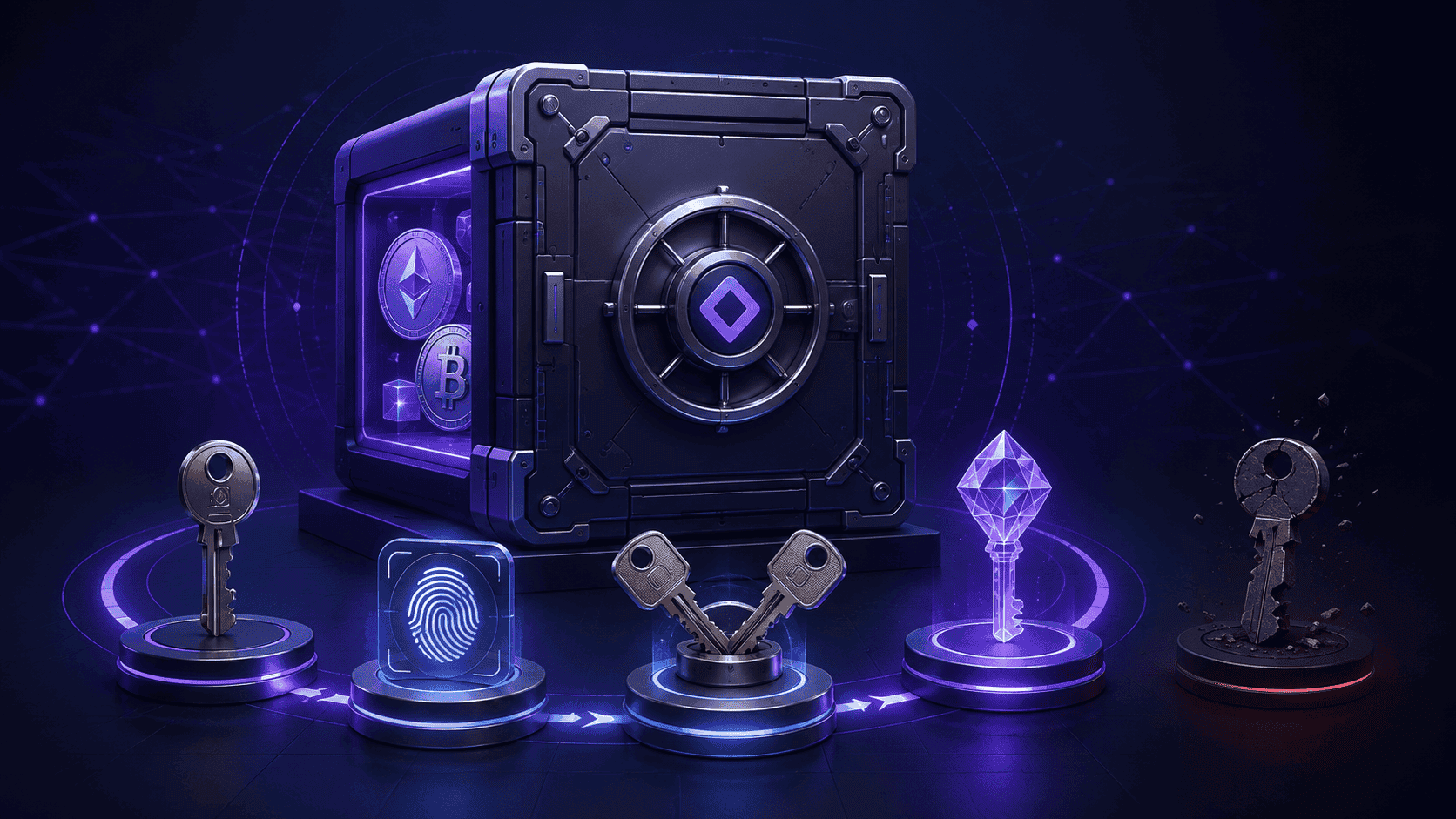
Monad’s proposal replaces the single-key binding with what the draft calls an authentication configuration. The account stores a set of authenticators plus rules governing which ones can approve transactions, and that configuration can be updated over time while the address remains fixed.
What the configuration allows
The practical range is wider than key recovery alone.
An account could permit either a traditional crypto key or a passkey stored on a phone or laptop to approve transactions. A separate recovery rule could require two trusted guardians acting together to install a replacement key if the primary one is lost. An existing single-signer account could be converted into a multisignature setup without moving a single token.
The proposal supports ECDSA on secp256k1, the standard Ethereum uses today, alongside ECDSA on P-256, WebAuthn-based P-256 passkeys, Ed25519, and ML-DSA, a post-quantum signature scheme.
That last entry is the one with the longest time horizon attached to it.
The quantum problem this is designed for
Quantum computers threaten crypto because sufficiently powerful machines could break the digital signatures used to prove ownership of coins. No such machine exists yet, and estimates of when one might vary by decades.
The industry is nonetheless preparing. Bitcoin developers are exploring quantum-resistant signature schemes while arguing over how to protect older coins whose public keys are already exposed on-chain, a debate that produced Michael Saylor’s 110-point opposition to BIP-110 in July and Binance founder Changpeng Zhao’s suggestion that Satoshi Nakamoto’s dormant coins might need freezing. Ethereum has made post-quantum security a formal research priority spanning wallets, staking and smart contracts, with Vitalik Buterin’s Lean Ethereum roadmap targeting post-quantum signatures by 2029.
Monad is approaching the same problem from a different layer. Rather than changing the protocol’s signature scheme wholesale, it would let individual accounts swap in quantum-resistant cryptography themselves, at their own pace, without relocating assets.
The distinction matters for how migration would actually happen. Bitcoin’s version of this problem is complicated by the fact that coins in old address formats cannot be upgraded without their owners moving them, and some of those owners are unreachable. An architecture where accounts can rotate credentials in place sidesteps the abandoned-wallet problem entirely.
Recoverability cuts both ways
Every mechanism that lets someone regain access to an account is also a mechanism that could let the wrong person in.
The Coldcard exploit this month illustrated what happens when key generation fails: attackers reconstructed seeds offline for wallets that had never been connected to anything, draining more than $100 million across thousands of addresses. Recoverability would not have helped there, because the attacker had the keys.
But it demonstrates the general principle that the security of a wallet ultimately reduces to who can produce a valid signature. Adding guardians, passkeys and rotation rules expands that set. A recovery configuration requiring two trusted parties is only as secure as the process for choosing and verifying them, and social engineering against multisignature signers has been the single most productive attack vector in crypto this year, accounting for roughly $600 million in North Korea-linked losses in the first half of 2026 alone.
Monad’s draft does not yet address these trade-offs in detail, which brings up the most important caveat.
This is a draft, not a shipping feature
The proposal is an early draft. Its authors have not written a detailed implementation specification, developers have not announced an activation date, and the change does not require anyone to upgrade.
Existing accounts would continue operating normally under the current model. Nothing about the proposal forces migration.
Monad launched its mainnet in late 2025 after raising $19 million in 2023 and a further $225 million in a Paradigm-led round in 2024, and was among the most anticipated launches of that year. It remains compatible with Ethereum applications.
The concept is not novel in isolation. Account abstraction has been discussed on Ethereum for years, and Solana has implemented partial versions. What distinguishes Monad’s version is the explicit combination of key rotation, recovery and post-quantum readiness in a single account-level design, published as a formal proposal rather than a research direction.
Whether it ships in anything resembling its current form is unknown. But the problem it targets, that self-custody currently offers no path back from a single mistake, is the one that has kept the technology confined to people willing to accept that risk.
FAQ
What is Monad proposing?
Separating a wallet’s permanent address from the credentials that control it, so users can replace, add or retire keys without changing the address or moving assets.
What could this enable?
Account recovery through trusted guardians, passkey support on phones and laptops, conversion to multisignature, and upgrades to post-quantum signature schemes including ML-DSA.
Does it fix the quantum threat?
It provides a migration path rather than a fix. Accounts could adopt quantum-resistant cryptography in place, avoiding the problem Bitcoin faces where old coins cannot be upgraded unless their owners move them.
Disclaimer: This article is for informational purposes only and does not constitute financial advice. Cryptocurrency investments carry significant risk. Always conduct your own research before making any investment decisions.