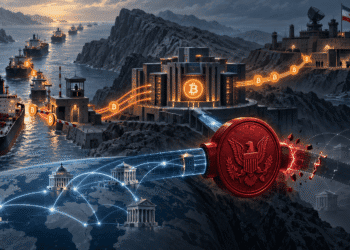
This might be the strangest crypto story of the year. Scammers are impersonating Iranian military officials, contacting cargo ships stranded near the Strait of Hormuz, and demanding Bitcoin or USDT in exchange for safe passage through one of the most dangerous waterways on earth. At least one ship appears to have paid. It was fired on anyway.
Shipowners are receiving fraudulent messages from scammers posing as Iranian authorities and demanding Bitcoin or USDT payments for safe passage through the Strait of Hormuz, according to Greek risk management firm Marisks.


The strait has been effectively closed since late February, when the US and Israel began military operations against Iran. Roughly 20,000 oil tankers and freighters are currently stuck in the Gulf with nowhere to go. The captains of those ships are desperate, isolated, and running out of options. That makes them perfect targets.
How the Scam Works
The messages are designed to look official. They reference Iranian security services, ask for vessel documentation, and use formal language that sounds like it could come from a government authority. The goal is to convince a ship’s captain or owner that they can buy their way through the blockade with crypto.
“After providing the documents and assessing your eligibility by the Iranian Security Services, we will be able to determine the fee to be paid in cryptocurrency (BTC or USDT). Only then will your vessel be able to transit the strait unimpeded at the pre-agreed time,” said the fraudulent message cited by Marisks.
The reason the scammers ask for crypto specifically is obvious. Bitcoin and USDT transactions are harder to reverse than wire transfers, and they do not require the sender to go through a bank that might flag the payment as suspicious. For someone sitting on a ship in the middle of the Gulf with limited communication and mounting pressure from cargo owners, the promise of a clear path through the strait can override the usual red flags.
At Least One Ship Fell for It
Marisks said it believed at least one ship fell victim to the scam and was fired upon while trying to pass through the strait over the weekend.
Think about that for a moment. A ship’s crew paid crypto to someone they believed was an Iranian official, attempted to transit the strait based on that “clearance,” and was met with gunfire. The payment bought nothing. The crew was put in danger. And the scammers walked away with the crypto.
On April 18, when Iran briefly reopened the strait for passage subject to inspections, at least two vessels, including a tanker, reported coming under fire from Iranian patrol boats and were forced to turn back. Marisks said one of those vessels appeared to have fallen victim to the fraud before attempting to transit.
Why This Scam Is So Effective
What makes this scam particularly dangerous is that it is not entirely fiction. Iran has actually floated the idea of charging crypto tolls for passage through the strait. The Financial Times reported on April 8 that Tehran is seeking up to $2 million per tanker in fees, with payments allowed in cryptocurrency, including Bitcoin.
That real proposal gives the fake messages a layer of credibility. If you are a shipping captain who has heard that Iran is accepting crypto for passage, and you receive an official-looking message asking for exactly that, the line between real and fake becomes blurry. The scammers are riding on the back of a genuine policy proposal to make their fraud more convincing.
TRM Labs told Decrypt that no on-chain data indicating crypto was being used for Hormuz transit fees has been seen. In this case, the lack of on-chain evidence has not made the threat any less real for stranded vessels.
So Iran talks about crypto tolls. Scammers copy the playbook. Ships pay. And nobody can tell whether the payment went to a government official or a criminal in a basement somewhere. That ambiguity is what makes the whole thing work.
The Sanctions Problem
Even if a ship captain paid what they thought was a legitimate Iranian toll rather than a scam, they would still have a problem. “Whether the recipient is genuinely Iranian or not, the intent to transact with a sanctioned regime is present,” said Xue Yin Peh, head of investigative strategy at on-chain intelligence firm Chainalysis.
Under US sanctions, sending crypto to an Iranian entity, even unknowingly, can trigger legal liability. OFAC does not care whether you thought you were paying a legitimate fee or a scam. The act of sending Bitcoin to a wallet associated with a sanctioned party is the violation. That puts shipping companies in an impossible position: they cannot transit the strait without clearance, they cannot tell real clearance from fake, and attempting to pay either way could land them in legal trouble.
Shipping companies should run blockchain intelligence checks on any wallet before transferring funds and consult sanctions experts before acting on any payment demand.
What This Says About Crypto in 2026
A year ago, the idea that cargo ships would be paying Bitcoin ransoms to transit a military blockade would have sounded like the plot of a bad thriller. Today it is a Reuters headline. The Hormuz scam is a reminder that crypto does not exist in a vacuum. It goes wherever money goes, and right now money is going to some very dark places.
For the 20,000 vessels stuck in the Gulf and the crews aboard them, the danger is not theoretical. Every fake message that lands in a captain’s inbox adds another layer of risk to an already terrifying situation. And somewhere out there, scammers are counting their Bitcoin and waiting for the next desperate ship to take the bait.