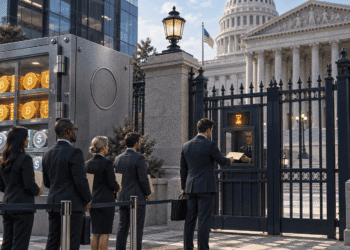

The Senate returns from recess on May 11. The Memorial Day recess starts May 21. That gives the Senate Banking Committee roughly eight working days to mark up the CLARITY Act, the bill that would finally tell the crypto industry which agency regulates what. If it does not happen by May 21, multiple senators say the next chance is 2030.
The SEC just scheduled a public roundtable on the CLARITY Act for this month. That is the regulator’s way of saying “we are ready to implement this whenever Congress passes it.” Ripple CEO Brad Garlinghouse says the bill will pass by the end of May. Polymarket gives it 46% odds. The gap between optimism and reality has never been wider.


What Is the CLARITY Act and Why Does It Matter?
Right now, nobody in America knows whether most crypto tokens are securities (regulated by the SEC) or commodities (regulated by the CFTC). That confusion has been going on since 2017. Companies have moved overseas because of it. Billions in institutional capital has sat on the sidelines waiting for an answer. And enforcement has substituted for actual rules.
The CLARITY Act fixes this. It draws a clear line between the SEC and CFTC. Most blockchain-native tokens would be treated as digital commodities. Securities would stay with the SEC. DeFi developers would get safe harbour protections. Stablecoins already have their own law (the GENIUS Act, signed July 2025). The CLARITY Act fills in the rest.
The House passed it in July 2025 with a massive 294-134 bipartisan vote. The Senate has not taken a single formal vote on it. It has been stuck at the committee level since January.
Why Has It Taken So Long?
Three fights held it up, one after another.
The first was stablecoin yield. Banks lobbied hard to ban crypto companies from paying interest on stablecoin balances. The White House’s Council of Economic Advisers published a report finding that a full yield ban would cost consumers $800 million per year. That report gave Senators the cover to compromise. Both sides say this issue is now “99% resolved.”
The second was Trump family crypto ethics. Senator Tillis threatened to kill the bill unless it included language restricting White House officials from promoting crypto. Trump’s family ventures exceed $1 billion. That fight consumed weeks of negotiation. Tillis has since confirmed he will support a markup, but the ethics language is still being finalised.
The third is brand new. On May 1, Tillis raised a fresh concern: law enforcement groups oppose the DeFi developer liability provision. They say it would protect people who build platforms used for money laundering. This issue was not publicly flagged until this week. It adds another complication to an already compressed timeline.
What Needs to Happen in 8 Days?
A lot. Here is the full checklist before the bill reaches Trump’s desk:
The Senate Banking Committee needs to schedule and complete a markup. Chairman Tim Scott says he has Tillis and additional Republican votes secured, but Senator John Kennedy is still a holdout. Scott wants 13 out of 13 Republicans. He does not have them yet.
After the markup, the bill goes to the Senate floor for a 60-vote cloture vote. Democrats will demand the ethics provisions and DeFi changes. Without bipartisan support, the 60-vote threshold is not reachable with Republicans alone.
Then the Senate version needs to be reconciled with the House version that passed in July 2025, and with the Senate Agriculture Committee’s own version that passed in January.
Then Trump signs it.
Brad Garlinghouse thinks all of that can happen by the end of May. “When people are at their peak of frustration, that’s when they finally compromise, and it gets done. I think we’re there,” he said at XRP Las Vegas on April 30.
Most people do not share his optimism. Galaxy Research puts the odds at 50-50. TD Cowen says one-in-three. Polymarket prices it at 46%, down from 82% in February.
Why 2030 If It Fails?
This is the part that scares the industry. Senator Cynthia Lummis warned at the Bitcoin 2026 Conference that the current political alignment is rare and fragile. You need a crypto-friendly White House, a Republican Senate majority, a cooperative SEC chair, and enough bipartisan support in both chambers to pass complex legislation. All of those conditions exist right now. None of them are guaranteed after the November midterms.
If Republicans lose the Senate, the next Banking Committee chairman might not be pro-crypto. If Trump loses influence or leaves office, the next president might reverse course. If the current SEC chair is replaced, the regulatory stance could flip again. Each of those changes means starting the entire legislative process from scratch.
Senator Bernie Moreno said it more directly: “If it doesn’t pass now, it’s not happening anytime soon.” Lummis posted on X: “This is our last chance to pass the Clarity Act until at least 2030.”
A new Congress in 2027 would need to rewrite the bill, hold new committee hearings, negotiate new compromises, and navigate a potentially hostile regulatory environment. That takes years. The crypto industry spent over $100 million on lobbying and campaign donations to get to this point. If May 21 passes without a markup, all of that investment is at risk.
What Should Crypto Investors Watch?
May 11 is when the Senate returns. Watch for Chairman Tim Scott to announce a markup date. If he schedules one for the week of May 11 to 15, the bill is alive. If he does not, the window starts closing fast.
May 21 is the Memorial Day recess deadline. If the Banking Committee has not voted by then, the bill enters a legislative black hole of competing priorities, midterm politics, and summer recesses.
The SEC roundtable this month is a positive signal. European asset managers met with the SEC’s Crypto Task Force on May 1 to discuss CLARITY Act implementation. When offshore firms are planning for a law that has not passed yet, that tells you the professionals think it is more likely than not.
But professionals have been wrong before. And eight working days is not a lot of time to resolve ethics language, DeFi liability concerns, Senator Kennedy’s holdout, and a 60-vote floor threshold, all while the Iran war and the budget fight compete for the same Senate calendar.
The crypto industry has never been closer to the finish line. It has also never been this close to running out of time.
Disclaimer: This article is for informational purposes only and does not constitute financial, investment, or legal advice. Always conduct your own research before making any investment decisions.