Prediction markets got so spicy that the Senate had to tell itself: please do not gamble on secrets.
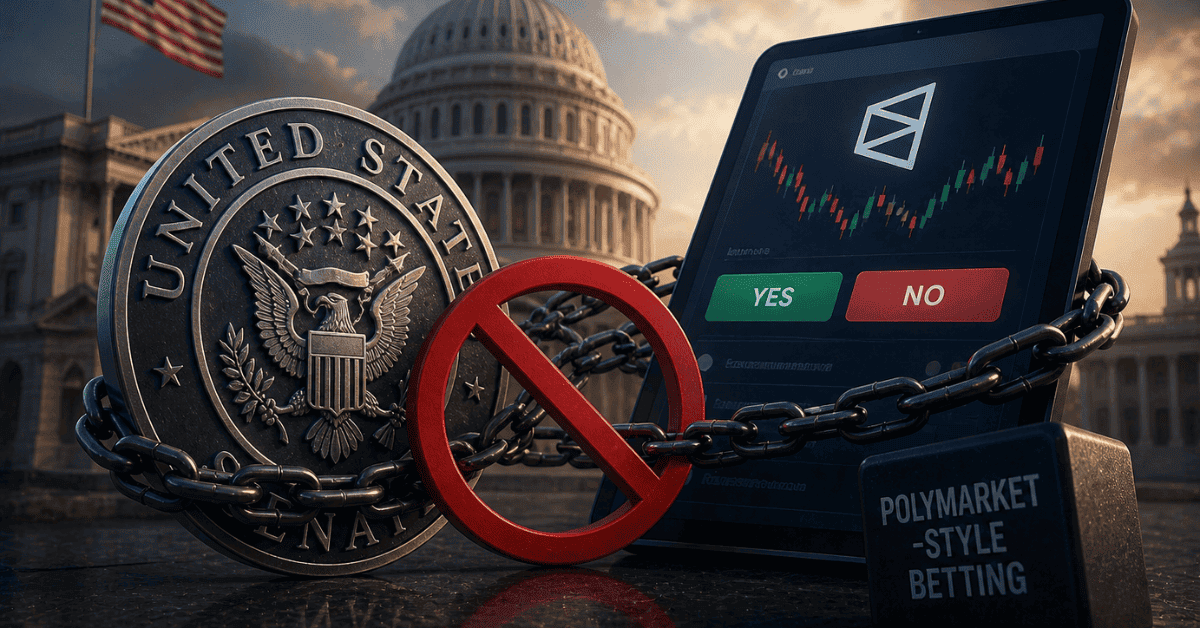
The U.S. Senate approved a bipartisan resolution banning senators, officers and staff from participating in prediction markets, including platforms such as Kalshi and Polymarket. The rule was adopted by unanimous consent on April 30, meaning no senator objected, and it took effect immediately.


That is a remarkable moment for a market category that used to feel niche. Prediction markets let users trade contracts tied to future events, including elections, policy decisions, economic data, sports, weather and geopolitical outcomes. Now the Senate has decided that its own members and staff should not be allowed to participate.
Crypto prediction markets became so real that politicians had to ban themselves from playing.
The Concern Is Insider Political Information
The ethical issue is obvious.
Senators and their staff often know things before the public does. They may have access to private briefings, legislative timelines, national security information, committee negotiations or internal political strategy. If they trade on prediction markets, they could potentially profit from information ordinary users do not have.
That risk becomes especially uncomfortable when the markets involve elections, wars, economic crises or policy decisions.
Senate Minority Leader Chuck Schumer framed it bluntly on the Senate floor, warning that Congress should not become a casino where members gamble on wars, economic crises or elections. Resolution sponsor Sen. Bernie Moreno, a Republican from Ohio, said senators have no business engaging in speculative activities like prediction markets while receiving a taxpayer-funded paycheck.
The funny part is that Congress basically had to write a rule saying: do not monetize insider political information by betting on the outcomes you may influence.
Why This Hits Polymarket and Kalshi
The rule is broader than one company, but the public examples are obvious.
Kalshi is a regulated U.S. prediction market platform, while Polymarket became one of crypto’s most recognizable event-betting venues, especially during high-profile political and geopolitical cycles. Both are part of a wider boom in markets that let traders express views on real-world outcomes.
Business Insider reported that the Senate rule applies to prediction markets like Kalshi and Polymarket, and that the resolution also urged the House, executive branch and judicial branch to adopt similar restrictions.
That matters because the concern is not only about senators. The same logic applies to many people inside government. A congressional aide, agency official or judicial staffer could also possess sensitive information that might move a prediction market.
If the Senate is the first branch to restrict itself, it may not be the last.
Prediction Markets Are Becoming Financial Infrastructure
The deeper story is that prediction markets are no longer just internet gambling with better charts.
They are increasingly being treated as information markets. Traders use them to price the probability of elections, court rulings, regulatory approvals, wars, macroeconomic outcomes and corporate events. Media outlets quote them. Crypto traders monitor them. Political observers use them as real-time sentiment gauges.
That makes insider access more dangerous.
If a senator knows a vote is about to collapse, or a staffer knows a bill’s markup has been delayed, that information could matter. If a lawmaker has confidential briefings on foreign policy or national security, the risk becomes even more serious.
This is why the Senate’s move is bigger than an ethics tweak. It is an acknowledgment that prediction markets now matter enough to create conflicts of interest.
The Industry Is Already Under Pressure
Prediction markets were already facing political scrutiny before the Senate banned itself.
Business Insider reported that recent insider-trading incidents have intensified criticism of the sector, including cases involving political candidates betting on their own elections and a U.S. Army soldier accused of using classified information to profit on Polymarket. The report noted that Kalshi and Polymarket have both taken steps to detect or restrict improper trading, but critics argue that enforcement does not solve the broader problem.
That is the uncomfortable position for the industry. Prediction markets can be useful because they aggregate information. But the better they become at pricing real-world events, the more attractive they become to people with nonpublic information.
The market’s strength creates the political problem.
This Is Not the Same as a Public Ban
The Senate rule does not ban ordinary users from prediction markets.
It applies to senators, officers and Senate staff. Regular traders can still use legal platforms where available, subject to existing laws, platform rules and jurisdictional restrictions.
But the symbolic impact is still important. When lawmakers ban themselves from an activity, it tells the public that the activity creates special ethical risk. It also gives critics of prediction markets a stronger argument for broader limits.
Some lawmakers are already pushing for tougher restrictions. Business Insider noted that the Senate resolution urged other branches of government to follow, while other legislation seeks to restrict prediction markets more broadly.
The key question is whether this stays as a congressional ethics rule or becomes part of a larger regulatory push.
The Crypto Angle Is About Trust
For crypto, the story matters because prediction markets are one of the sector’s most visible real-world use cases.
Polymarket showed that blockchain-based markets can attract mainstream attention, especially when they track political and global events. The promise is simple: open markets can produce live probability estimates that are sometimes faster and more flexible than polls or expert commentary.
But trust is fragile.
If users believe markets are being moved by insiders, classified information or political operators, the entire product becomes harder to defend. That is especially true when markets involve wars, elections or crises where public officials may have both influence and private knowledge.
Prediction markets can be powerful, but only if users believe the game is not rigged.
The Bottom Line
The U.S. Senate’s prediction-market ban is funny, but it is also serious.
Lawmakers effectively admitted that these markets have become meaningful enough that public officials should not be allowed to trade on them. That is a strange kind of validation. Prediction markets became so real that politicians had to ban themselves from playing.
The next debate will be bigger. Should only lawmakers and staff be restricted, or should prediction markets face broader limits around politics, war and public policy? Should platforms police insider trading themselves, or should regulators impose stricter rules?
For now, one thing is clear: Congress knows prediction markets are not a toy anymore.
Disclaimer: This article is for informational purposes only and does not constitute financial, investment, or legal advice. Always conduct your own research before making any investment decisions.