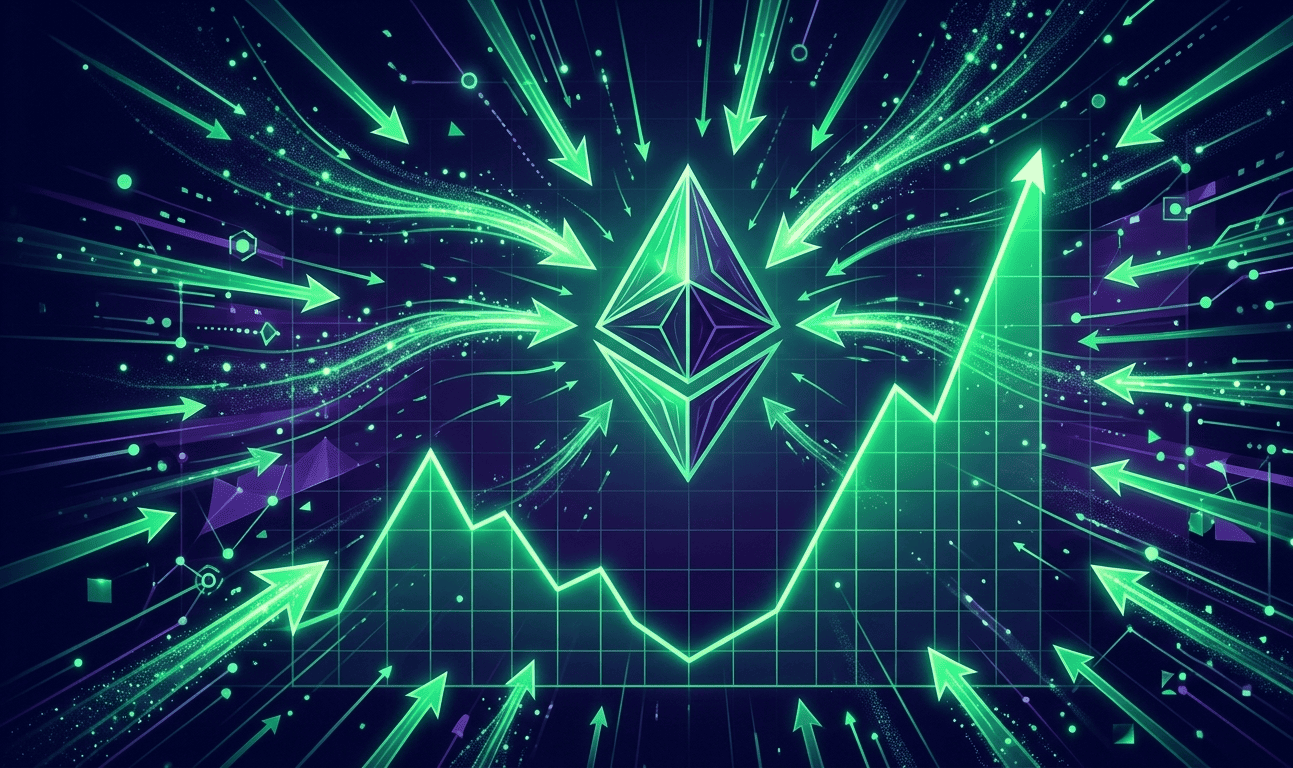
For months, Ethereum had a frustrating problem. The network was getting busier, but the price was not responding. That dynamic is now shifting. Ethereum processed a record 200.4 million transactions on its base layer in the first quarter of 2026, a 43% jump from the previous quarter and the first time it has ever crossed 200 million in a single quarter. At the same time, ETH is now rallying toward $2,400 as spot Ethereum ETFs have posted inflows for six consecutive days, their longest positive streak of 2026. The fundamentals and the capital flows are finally pointing in the same direction.
The Network Has Never Been This Busy
Ethereum processed a record 200.4 million base-layer transactions in the first quarter of 2026, capping a multi-year U-shaped recovery in network activity. The recovery began in mid-2025, with each successive quarter seeing higher activity than the last. Q1 2026 activity jumped 43% from Q4 2025’s 145 million, marking a clear U-shaped growth from the 2023 bottom.


To put this in context, Ethereum’s quarterly transaction count bottomed at around 90 million in late 2023 during the depths of the bear market. It has now more than doubled from that low. Active addresses reached 12.6 million per DeFiLlama data, hitting all-time highs in some weekly metrics. The network added approximately 284,000 new users in Q1 2026, an 82% quarter-over-quarter increase.
Most of the traffic lives on Layer 2s, which are separate networks built on top of Ethereum that process transactions cheaply and then batch them down to the main chain for final settlement. Base and Arbitrum are the two largest, where users interact with them for lower fees, and the activity shows up on Ethereum’s base layer as settlement and bridging.
The ETF Flows Have Flipped
The bigger story today is not the transaction data from Q1. It is what is happening right now with capital flows. US-listed spot Ether exchange-traded funds have outpaced their Bitcoin counterparts for six consecutive days, marking the longest inflow streak for Ethereum ETFs this year.
Ethereum ETFs attracted $7.7 million in daily inflows and $187 million on a weekly basis, their strongest performance of the year. Network activity rose 41% week over week to roughly 3.6 million daily transactions. Wallets holding at least 100,000 ETH grew from 54 to 57, a pattern that has historically preceded price increases.
This is a meaningful shift. For most of 2026, Ethereum ETFs were bleeding capital while Bitcoin ETFs dominated flows. The rotation started in mid-April and has now extended for nearly a full week. When ETH ETFs are attracting inflows at the same time that Bitcoin ETFs are mixed, it signals that institutional capital is broadening its crypto exposure rather than treating Bitcoin as the only safe bet.
Why the Price Is Moving Now
ETH opened Friday at $2,348.49, its highest opening price since March 18. It is up roughly 7% on the week, outperforming Bitcoin over the same period. The broader market rally driven by Iran’s reopening of the Strait of Hormuz is lifting everything, but Ethereum is capturing more than its share.
Several things have converged at once. The record network activity provides a fundamental floor beneath the price that did not exist during the 2023 downturn. The ETF inflow streak shows institutional money rotating in. BlackRock launched its ETHB staked ETH ETF this month, pulling $155 million on day one and confirming that institutional demand for yield-generating ETH products remains strong. Charles Schwab announced it will begin offering direct spot ETH trading to its retail clients in the coming weeks, opening Ethereum up to millions of brokerage accounts that previously had no easy access to it.
And the Glamsterdam upgrade, Ethereum’s next major hard fork expected around June, is starting to enter the market’s pricing. FXEmpire analyst Ibrahim Ajibade highlighted Glamsterdam as a potential catalyst for a move toward $2,800 in Q2, noting that upgrades have historically preceded multi-month rallies.
What the Bears Still See
It would be dishonest to write this article without acknowledging the gap that still exists. ETH is trading around $2,350. Its all-time high was $4,954 in August 2025. That is a 52% drawdown. Bitcoin, by comparison, is down about 40% from its October 2025 peak. ETH has underperformed BTC for most of the past year.
Much of the growth is driven by Layer 2 and stablecoin settlement, which boosts L1 transaction counts but, after the Dencun upgrade, does not translate cleanly into higher fees, token burn, or holder value.
This is the structural challenge that Ethereum bulls need to address. More activity does not automatically mean more value for ETH holders if that activity is happening on Layer 2s where fees are fractions of a cent. The Glamsterdam upgrade is partly designed to address this by improving mainnet throughput, but the full economic impact on fee revenue and ETH burn rates remains an open question.
CryptoAnu noted that ETH still faces resistance around $2,400 and that the ETH/BTC ratio must reclaim 0.035 on a weekly basis to confirm a genuine altcoin rotation.
What to Watch
The $2,400 level is the immediate test. Ethereum has approached it several times this month and been turned back each time. A clean daily close above it would be the first since March and would open the path toward $2,600 and potentially higher. The six-day ETF inflow streak needs to extend into next week to confirm that the rotation is structural rather than a short-term trade. And the Strait of Hormuz ceasefire needs to hold past April 22, because the risk-on environment driving the entire market depends on it.
For the first time in months, Ethereum’s story is simple: the network is busier than ever, the money is flowing in, and the price is following. Whether it lasts depends on whether any of those three things breaks first.