
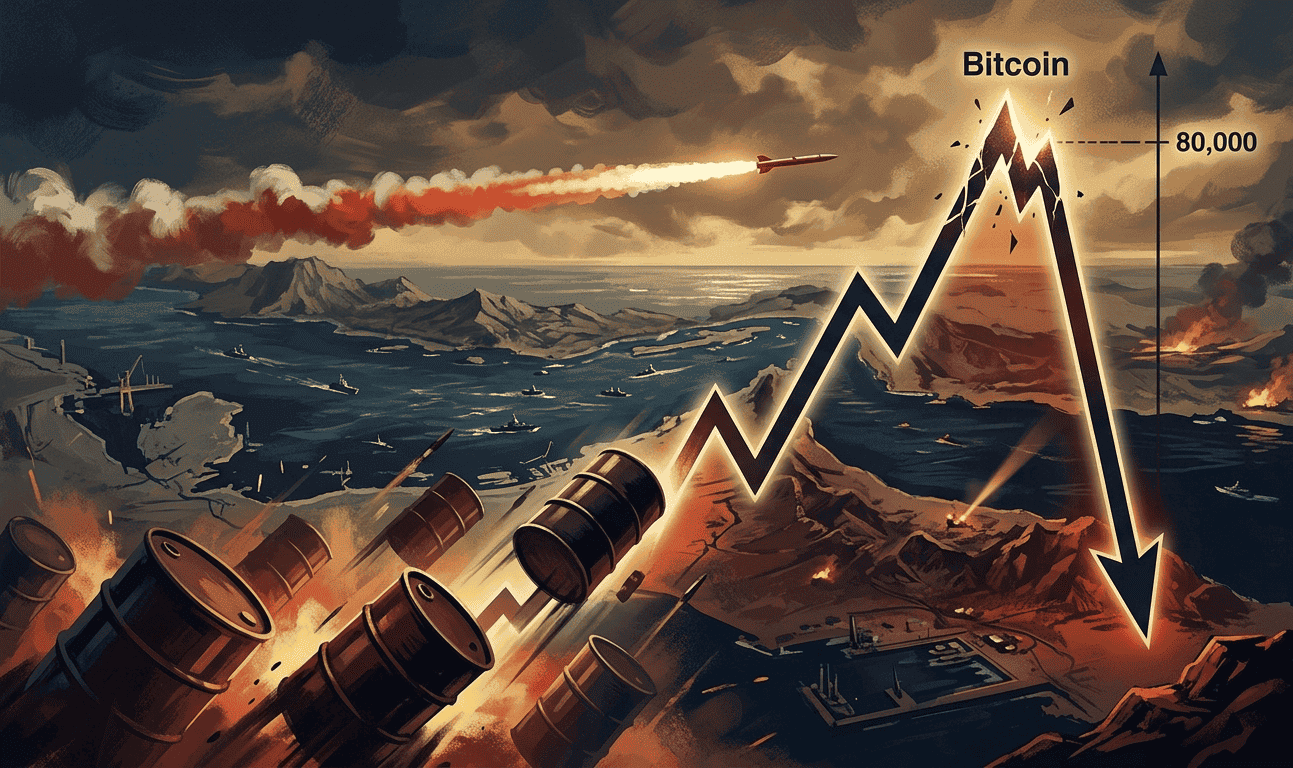
Bitcoin finally broke $80,000. Then Iran said it shot at an American warship. And in less than ten minutes, the party was over.
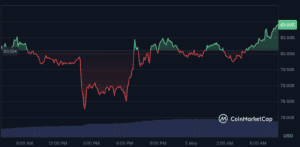
Bitcoin hit $80,594 early Monday morning, its highest price since January 31. Traders were celebrating. Shorts were getting liquidated. The breakout everyone had been waiting for was finally happening.


Then Iran’s Fars news agency, which is linked to the Revolutionary Guard, claimed two missiles had struck a US Navy vessel near Jask Island at the southern entrance to the Strait of Hormuz. Oil spiked 5% to $113 per barrel. Bitcoin dropped $1,500 in minutes. The celebration turned into a scramble for the exit.
The US denied it. Central Command said no American ship was hit. Oil pulled back. But Bitcoin did not recover. It settled around $79,000 and stayed there. The $80,000 breakout lasted less than an hour.
What Actually Happened Near Jask Island?
The story came in waves, each one contradicting the last.
First, Fars reported that a US warship had ignored warnings from the Revolutionary Guard to leave Iranian waters near Jask. Two missiles were fired and the vessel was “forced to turn back,” according to Iran’s account. Al Jazeera picked up the story from Iran’s state TV.
Minutes later, US Central Command denied the report. A senior US official told Axios that no American vessel had been struck. The Pentagon confirmed all ships were accounted for and operational.
But here is what makes it complicated. The incident happened on the same day Trump announced “Project Freedom,” a new military operation to escort stranded ships through the Strait of Hormuz. The Pentagon deployed 15,000 personnel, over 100 aircraft, warships, and drones to support the mission. Iran had warned that any US entry into the Strait would trigger a military response.
So did Iran actually fire at a US ship? Or did it fire warning shots near one? Or did it fire at nothing and use the story as propaganda to scare the US away from Project Freedom? Nobody outside of the two militaries knows for sure. What we do know is that both sides are now operating warships in the same narrow waterway, and somebody fired something at somebody.
Why Did Bitcoin React So Fast?
Because crypto never sleeps and traders never stop watching headlines.
The missile report hit during Asian trading hours on Monday morning. Crypto was the only major market open. Stocks were closed. Bond markets were closed. The entire weight of the global reaction landed on Bitcoin, oil futures, and forex.
Liquidations hit $450 million in 24 hours, with over $70 million in longs wiped out in the single hour after the missile report. Bitcoin had just squeezed $301 million in shorts on the way up to $80,594. Within minutes, those gains reversed and the longs started getting squeezed instead.
This is what trading Bitcoin during a war looks like. You can be right about the direction, right about the fundamentals, right about the institutional flows, and still lose money in ten minutes because a news agency in Tehran publishes a claim that nobody can verify.
What Does This Mean for the $80,000 Breakout?
The good news: Bitcoin briefly traded above $80,000. That means the level is breakable. The sellers sitting at $79,200 to $80,000 were overwhelmed, at least momentarily. The resistance is not a wall anymore. It is a door that opened briefly and can open again.
The bad news: the breakout was killed by something that had nothing to do with crypto. No amount of ETF inflows, whale accumulation, or supply squeezes can protect against a missile headline. As long as the Iran war continues, every rally above $80,000 faces the risk of being reversed by a single report from a state news agency.
Other major cryptos held up better than Bitcoin. Ethereum stayed positive at $2,341. Solana held at $84. Dogecoin was up 2.3% on the day. The selling was concentrated in Bitcoin, likely because BTC is the most liquid asset and the first thing leveraged traders sell when they need cash fast.
Project Freedom Changes Everything
The missile incident did not happen in a vacuum. It happened because Trump launched Project Freedom, an active military operation to escort ships through the Strait. That is a fundamentally different posture than the passive blockade the US has been running since February.
Under the blockade, the US prevented ships from reaching Iran. Under Project Freedom, the US is actively guiding ships through the Strait, directly challenging Iran’s control over the waterway. Iran responded by announcing a new “Hormuz control zone” stretching to Fujairah, essentially claiming the right to regulate all shipping in the area.
For crypto, Project Freedom means more volatility, not less. The blockade was stable. Both sides stayed in their lanes. Now US warships are actively moving through waters Iran claims to control. Every escort run is a potential flashpoint. Every encounter between a US destroyer and an Iranian patrol boat is a potential headline that moves Bitcoin $1,500 in ten minutes.
What Should You Watch This Week?
First, whether Bitcoin retests $80,000 again this week. The level has been tested five times now. The fifth attempt briefly succeeded before the missile report killed it. If BTC pushes above $80,000 again on a day without an Iran headline, the breakout has legs.
Second, Project Freedom operations. If the US successfully escorts ships through the Strait without incident, oil drops and risk appetite improves. If there are more firing incidents, oil spikes and Bitcoin sells off again. This is now a daily variable.
Third, Strategy reports earnings today (Monday). Saylor paused buying last week. If he announces a resumption and a strong balance sheet, it adds buying pressure right at the moment Bitcoin needs it most. If the earnings disappoint, the $79,000 level could crack.
The crypto market wanted a clean breakout above $80,000. Instead it got a geopolitical roller coaster. Welcome to trading Bitcoin in a war zone.
Frequently Asked Questions
Why did Bitcoin crash from $80,000 on May 4?
Bitcoin hit $80,594, then dropped to $79,000 in minutes after Iran’s Fars news agency claimed two missiles struck a US warship near Jask Island in the Strait of Hormuz. Oil spiked 5% to $113. The US denied any ship was hit, but Bitcoin held its decline as traders priced in renewed geopolitical risk.
Did Iran actually hit a US warship?
Iran’s state media claimed two missiles struck a US vessel near Jask Island. US Central Command denied the report and said all American ships were operational. The incident occurred as Trump launched Project Freedom, a military escort operation through the Strait of Hormuz.
Will Bitcoin break $80,000 again?
Bitcoin briefly exceeded $80,000 for the first time since January, proving the resistance level can be overcome. Whether it holds depends on geopolitical stability, continued ETF inflows, and whether Project Freedom escort operations proceed without further military incidents.
Disclaimer: This article is for informational purposes only and does not constitute financial, investment, or legal advice. Always conduct your own research before making any investment decisions.