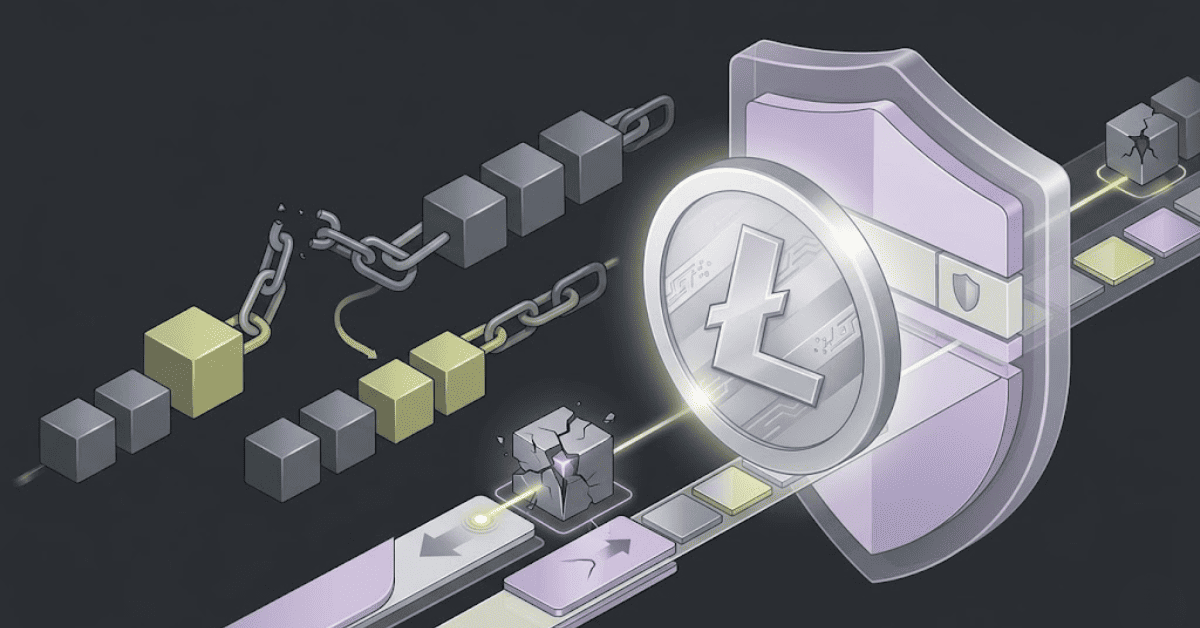
Litecoin suffered a 13-block chain reorganization after attackers exploited a bug tied to its Mimblewimble Extension Block privacy layer, forcing the network to roll back a short-lived invalid chain and return to the valid one.
The incident affected roughly 32 minutes of block activity, according to CoinDesk, and centered on invalid MWEB transactions that were accepted by some outdated mining nodes. Litecoin’s team said valid transactions from the affected window remained intact, while the invalid transactions were removed from the main chain.


The episode did not permanently break Litecoin, but it did expose a difficult truth for older proof-of-work networks. When privacy extensions, mining infrastructure and software upgrades fall out of sync, even a mature blockchain can face a sudden coordination crisis.
What Happened During the Reorg
Invalid MWEB Transactions Reached Outdated Nodes
MWEB is Litecoin’s optional privacy feature, designed to make LTC transfers more confidential by obscuring transaction amounts and improving scalability through Mimblewimble-based extension blocks. Litecoin describes MWEB as an optional upgrade that improves privacy and efficient pruning on the network.
According to reports based on Litecoin Foundation updates, the exploit involved invalid MWEB transactions that were accepted by older nodes that had not upgraded. Attackers also reportedly used a denial-of-service attack against major mining pools, which helped give unpatched miners room to build a temporary chain containing the invalid transactions.
That chain was eventually rejected. Litecoin reorganized 13 blocks back to the valid chain, removing the malicious MWEB activity and restoring the network’s correct state.
Why the “Zero-Day” Label Is Complicated
Litecoin’s public messaging initially framed the incident as a zero-day bug. CoinDesk, however, reported that the underlying consensus fix had already been committed privately to GitHub weeks earlier, meaning some pools had the patch while others did not.
That distinction matters. If a bug is unknown to developers and defenders until it is exploited, it is normally considered a true zero-day. If a fix already exists but has not been broadly deployed, the problem shifts toward patch coordination and disclosure timing.
For users, the practical impact is similar either way. The network entered a dangerous window where some participants were protected and others were not.
Litecoin Core 0.21.5.4 Ships the Fix
Litecoin has now released Litecoin Core 0.21.5.4, which includes an MWEB consensus fix addressing an input validation issue. The release also includes additional safeguards and is being presented as an important security update for node operators and miners.
That upgrade is now the most important short-term step for the network. The reorg has already happened, but Litecoin’s resilience depends on miners, pools, exchanges and infrastructure providers moving quickly to updated software.
A patch only protects the network if enough economically important participants install it.
Why MWEB Made the Incident More Sensitive
Privacy Features Add Complexity
MWEB is one of Litecoin’s most important differentiators. It gives users an optional privacy layer while keeping Litecoin’s base chain familiar to exchanges, wallets and payment processors.
That design is useful, but it also adds technical complexity. Extension blocks must interact cleanly with the main chain. Peg-ins and peg-outs must be validated correctly. Wallets, miners and node operators must all understand the rules well enough to reject invalid activity.
The exploit appears to have targeted that boundary. Attackers tried to use invalid MWEB transactions to peg out coins and move value into decentralized exchange or swap systems. Crypto.news reported that attackers used the fork window to attempt double-spends against several cross-chain swap protocols.
Cross-Chain Protocols Face the Hardest Questions
The most vulnerable services during short reorgs are often cross-chain swap platforms and bridges. These systems must decide how many confirmations are enough before treating a Litecoin transaction as final.
A 13-block reorg is rare enough to surprise users, but not impossible enough for infrastructure providers to ignore. After this incident, swap protocols that processed LTC during the affected window will likely review confirmation thresholds, monitoring systems and MWEB-specific validation rules.
That is especially important if any attempted double-spends reached external markets before the invalid chain was erased.
What This Means for Litecoin Users
For ordinary Litecoin users, the key point is that the valid chain survived. Litecoin’s team said invalid transactions were removed, while legitimate transactions during the affected period were not wiped out.
Still, the incident creates reputational damage. Litecoin has spent years presenting itself as one of crypto’s most reliable payment networks. A deep reorg tied to its privacy layer does not destroy that reputation, but it does give critics a clear example of how upgrade complexity can create risk.
Users who run their own nodes should upgrade to Litecoin Core 0.21.5.4. Exchanges and payment processors may also take a more cautious approach to LTC confirmations until they are satisfied the network is fully patched and stable.
What Comes Next
The next thing to watch is a full post-mortem from the Litecoin Foundation explaining the patch timeline, the disclosure process and why some miners were still exposed when the exploit happened.
The second issue is whether cross-chain swap protocols report losses or change Litecoin confirmation requirements after reviewing the fork window. If services accepted invalid deposits before the reorg, the financial impact could extend beyond Litecoin’s base chain.
For now, Litecoin has contained the immediate threat. The longer-term test is whether the network can show that MWEB remains safe, that miners are fully upgraded and that future consensus fixes can be rolled out without creating another uneven security window.
Disclaimer: This article is for informational purposes only and does not constitute financial, investment, or legal advice. Always conduct your own research before making any investment decisions.