
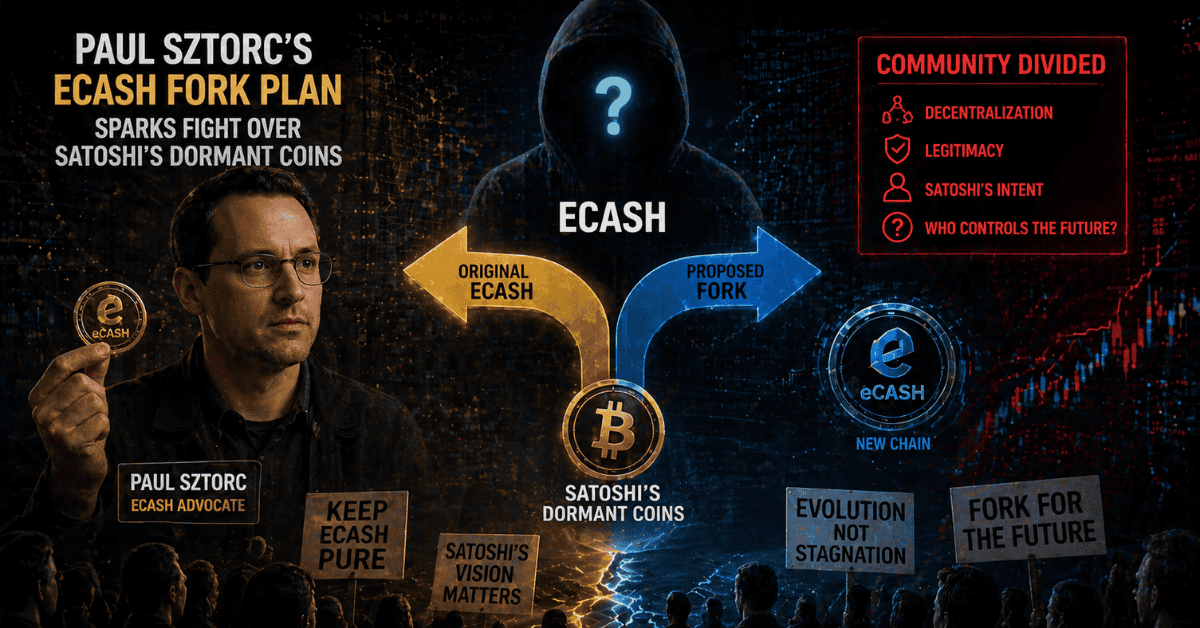
Long-time Bitcoin developer Paul Sztorc is planning a new Bitcoin hard fork called eCash, scheduled for August 2026 at block height 964,000.
The proposed chain would copy Bitcoin’s code and ledger history, then split into a separate network with its own rules. BTC holders would receive an equivalent amount of eCash on the new chain, similar to past Bitcoin forks that created new assets without changing Bitcoin itself.


The controversial part is not the fork alone. It is Sztorc’s plan to manually reallocate some eCash mapped to Satoshi Nakamoto’s long-dormant coins to early investors or contributors. Bitcoin’s existing ledger would remain untouched, but critics say the idea still violates one of Bitcoin’s strongest social norms: nobody else’s coins should be reassigned, even on a fork.
What eCash Is Supposed to Add
Drivechains Are the Technical Core
The eCash fork is built around Drivechains, Sztorc’s long-running proposal for expanding Bitcoin through sidechains. Drivechains are tied to BIP-300 and BIP-301, which Sztorc has advocated for years as a way to let Bitcoin support more experimental Layer 2 systems without changing the base chain too aggressively.
The basic idea is that users could move value between Bitcoin-style base-layer coins and sidechains that support different features. Those sidechains could experiment with new privacy tools, scaling systems, token designs or application logic while still being connected to the broader Bitcoin economy.
Supporters see Drivechains as a way to keep Bitcoin competitive with more programmable networks. Critics argue they add complexity, miner risk and governance problems that Bitcoin has deliberately avoided.
eCash Is a Fork Because Bitcoin Did Not Adopt Drivechains
Sztorc’s proposals have been discussed for years but have not been merged into Bitcoin Core. That is why eCash is being presented as a separate chain rather than a direct Bitcoin upgrade.
This matters because Bitcoin itself would not change. Existing BTC would remain on the current Bitcoin network, and no dormant Bitcoin would be moved on Bitcoin’s main ledger. The reallocation controversy applies to the new eCash chain’s version of those coins, not to BTC itself.
That distinction is important, but it has not calmed the backlash.
Why Satoshi’s Coins Are the Flashpoint
The Proposal Touches Bitcoin’s Most Symbolic Wallets
Satoshi Nakamoto’s coins are among the most sensitive assets in crypto. They have not moved in more than a decade, and many market participants treat them almost like a symbolic reserve rather than ordinary dormant wallets.
Reports estimate Satoshi-linked holdings at around 1.1 million BTC. Under the eCash plan, some of the eCash corresponding to those unmoved coins would reportedly be reassigned to fund early backers or contributors.
To supporters, this could be framed as a funding mechanism for the new chain. Since Satoshi is not known to be participating, they argue that the fork’s new asset can distribute those mapped coins differently without affecting real BTC.
To critics, that argument misses the point. They say a fork that begins by deciding someone else’s mapped balance can be redirected is sending the wrong message about property rights, even if the original Bitcoin chain remains untouched.
Critics Call It Theft, Supporters Call It Funding
The Ethical Fight Is Bigger Than eCash
The backlash has been immediate because Bitcoin’s culture is built around rules that are predictable, neutral and difficult to change. If a valid key controls coins, the network does not ask whether the owner is active, famous, missing or dead.
That is why critics are using words like “theft,” even though the proposal affects a new forked chain rather than Bitcoin itself. Their concern is about precedent. If a fork can reassign Satoshi’s mapped coins today, could another fork reassign exchange balances, dormant whale wallets or politically disliked addresses tomorrow?
Supporters may counter that every fork defines its own rules. If users dislike the distribution, they can ignore the chain. In that view, eCash is a new experiment, not a change to Bitcoin’s existing property system.
Both views can be true in a technical sense, but the market will likely judge the proposal through culture as much as code.
Development Funding Remains Bitcoin’s Unsolved Problem
The controversy also points to a real issue: how to fund long-term Bitcoin-related development.
Bitcoin does not have a foundation treasury, block reward tax or protocol-level development fund. That has helped preserve neutrality, but it also makes large technical efforts harder to finance. Sztorc’s eCash approach appears to solve funding by reallocating coins on the new chain, but that solution comes with a heavy reputational cost.
Many Bitcoiners would rather accept slower development than introduce any system that looks like discretionary coin reassignment.
What Miners and Exchanges Will Decide
A hard fork only matters if infrastructure supports it. For eCash to gain traction, miners would need to direct hash power to the new chain, exchanges would need to list it, wallets would need to support claiming and custody, and users would need to see value in holding or trading the new token.
Without that support, eCash could become another niche Bitcoin fork with limited liquidity and little long-term relevance.
The timing also matters. A fork at block height 964,000 gives Sztorc time to publish more details, attract contributors and explain how the controversial allocation would work. It also gives critics time to organize opposition and warn exchanges or custodians against supporting the asset.
Why This Matters for Bitcoin
The eCash proposal does not threaten Bitcoin’s current ledger directly. BTC holders do not lose Bitcoin if a separate chain launches with different rules.
But the debate matters because it touches three of Bitcoin’s deepest questions: how to scale, how to fund development and how strictly to protect the principle that coins belong only to their private-key holders.
Drivechains address the scaling question. The Satoshi reallocation addresses the funding question. The backlash addresses the ownership question.
That is why the debate is likely to remain intense even if eCash never becomes a major asset.
What Comes Next
The next thing to watch is whether Sztorc publishes a detailed allocation plan for the Satoshi-linked eCash coins. The exact mechanics will matter, including how much is reassigned, who receives it and what governance process is used.
The second signal is miner and exchange response. If major mining pools and trading venues ignore eCash, the fork may struggle to build credibility. If even a few support it, the controversy could become much louder.
The third signal is whether Drivechain supporters rally behind the project. eCash may become a real-world test of ideas that Bitcoin Core has declined to adopt.
For now, Sztorc has turned a long-running technical debate into a live market experiment. Whether eCash becomes a serious Bitcoin-adjacent chain or a cautionary tale may depend less on its code than on whether users accept a fork that begins by rewriting the fate of Satoshi’s dormant coins.
Disclaimer: This article is for informational purposes only and does not constitute financial, investment, or legal advice. Always conduct your own research before making any investment decisions.