
When the company behind the S&P 500, the most famous stock index in the world, builds a new benchmark for cryptocurrency, you’d expect Bitcoin to sit at the center of it. Bitcoin is the largest, most recognizable, and most institutionally embraced digital asset on earth. It has spot ETFs holding tens of billions of dollars. It’s the coin Wall Street actually knows.
And it’s not in the index.

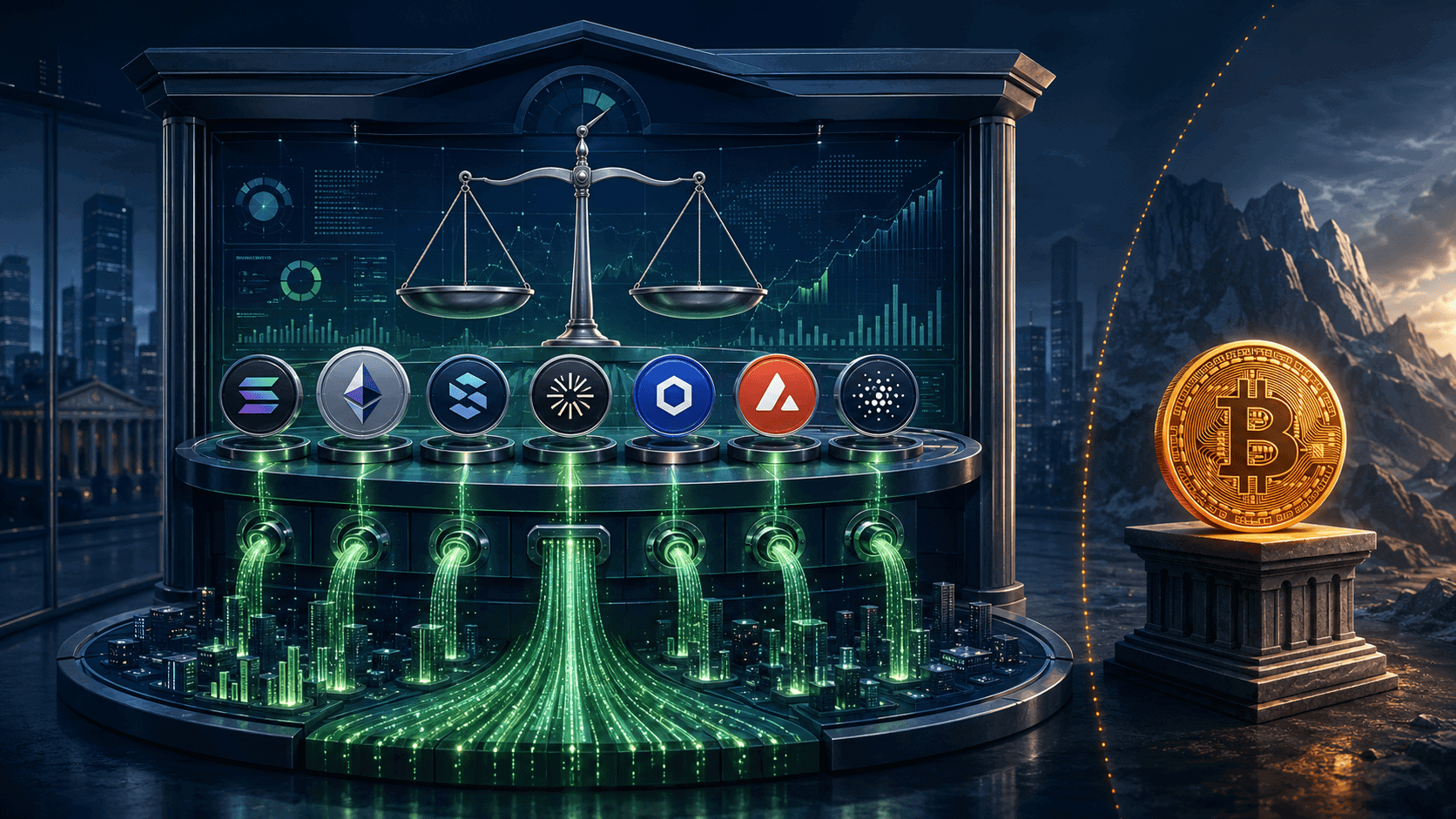
On July 21, S&P Dow Jones Indices and crypto investment firm Pantera Capital launched the S&P Pantera Digital Asset Index, an 18-token benchmark designed for institutional investors who want a disciplined, structured way to allocate to crypto. Its defining feature is what it leaves out. Bitcoin, the elephant in the crypto universe, doesn’t make the cut. Neither does XRP, another top-five asset by market value. The top five constituents are instead Ethereum, BNB, Solana, TRON, and Hyperliquid.
This isn’t an oversight or a snub in the petty sense. It’s a deliberate design choice that reveals a genuinely interesting and deepening divide in how the financial world is starting to define crypto value. The index asks a simple, almost heretical question: not “which coins are biggest?” but “which blockchains actually make money?” And by that measure, the king of crypto doesn’t belong.
How the Index Actually Works
To understand why Bitcoin was excluded, you have to understand what the index is measuring, because it’s fundamentally different from every popular crypto benchmark before it.
Most crypto indexes rank assets by market capitalization, essentially by size and price. The S&P Pantera index throws that approach out. Instead, it uses a rules-based framework borrowed from traditional finance, one that resembles how the S&P 500 screens companies by earnings. To qualify, an asset’s underlying blockchain must generate actual protocol revenue, meaning real economic activity from the trading, apps, and transfers running across the network.
The selection process is methodical. Assets start from the broader S&P Cryptocurrency Broad Digital Asset Index, then must clear minimum thresholds: at least $500 million in market cap, sufficient liquidity, and, crucially, demonstrable protocol revenue over the two most recent quarters. Assets that pass are ranked by their total protocol revenue, then weighted by adjusted market capitalization, with concentration caps mirroring S&P’s equity rules: no single token above 35%, no other above 20%. The index rebalances quarterly and trades under the ticker SPPDA, with revenue data supplied by analytics firm Artemis.
The numbers behind the qualifying tokens are substantial. Together, the 18 constituents generate more than $3 billion in annualized revenue. Solana alone booked roughly $1.3 billion in 2025 from network activity, while Ethereum, the largest holding, earned around $524 million. These are real, measurable cash flows, the crypto equivalent of a company’s earnings.
Why Bitcoin Doesn’t Qualify
Here’s the part that requires honesty, because “Bitcoin excluded” makes a dramatic headline that can mislead. Bitcoin’s absence is not a judgment that it’s low quality or a bad investment. It’s simply that Bitcoin isn’t the kind of thing the index measures.
S&P Dow Jones Indices CEO Cathy Clay put it plainly: Bitcoin is not one of those revenue-generating protocols the index was built for. Bitcoin’s blockchain doesn’t generate meaningful protocol revenue in the way a busy smart-contract platform does. It processes transactions and pays miners, but it isn’t a business with recurring economic activity flowing back to the network in the sense the methodology requires.
Pantera framed this without insult: Bitcoin is a monetary asset, more like digital gold than a business. And gold doesn’t generate revenue either. Nobody excludes gold from a value judgment because it doesn’t produce earnings; it’s simply a different category of asset. Bitcoin’s entire investment thesis, digital gold, a scarce non-sovereign store of value, never depended on generating revenue in the first place. So measuring it by a revenue test is like grading a poem on its arithmetic. The two things aren’t in conflict; they’re just different.
Pantera even made the point explicitly: investors who want Bitcoin can simply buy it directly, as the returning wave of Bitcoin ETF inflows shows. The index isn’t trying to replace Bitcoin exposure. It’s trying to capture something Bitcoin-heavy products miss.
The XRP Exclusion Is the Stranger One
If Bitcoin’s absence makes conceptual sense, XRP’s is more surprising and reveals the strictness of the index’s rules.
XRP actually does one of the things on S&P’s list. Every transaction on the XRP Ledger burns a small fee, permanently destroying that XRP and shrinking supply, which is a form of the value-accrual mechanism the index counts. So why exclude it? The answer is scale. XRP’s entire cumulative burn since 2012 totals only about $16 million, which is less than 1% of the $3 billion the 18 qualifying coins generate every single year. The mechanism exists, but the economic activity behind it is a rounding error by comparison.
The exclusion arguably stings XRP more than Bitcoin. Bitcoin never claimed to be a revenue-generating protocol; its digital gold narrative is intact regardless. But utility and real-world use are central to XRP’s entire value pitch. Being left out of a utility-and-revenue index cuts closer to XRP’s core story. It’s a reminder that in this framework, a mechanism existing isn’t enough; it has to produce meaningful, sustained revenue.
Why This Matters
The launch is significant for reasons that go well beyond which coins are in or out, because it signals how institutional money is starting to think.
The index reflects a widening split in how the financial world defines crypto value. On one side is the market-cap and narrative view, where Bitcoin reigns as digital gold. On the other is an emerging fundamentals view, where what matters is verifiable economic activity, blockchains that function like businesses generating real cash flow. S&P and Pantera are planting a flag firmly in the second camp, applying the same discipline to crypto that equity investors apply to stocks. As one analysis put it, by this measure, revenue beats Bitcoin’s dominant narrative.
The practical stakes are real. Because S&P is the premier index provider, funds that eventually track this benchmark would have to buy the qualifying coins, potentially channeling institutional capital toward revenue-generating tokens like Solana, TRON, and Hyperliquid rather than Bitcoin. Pantera is already in talks with asset managers about building ETFs on the index. The prize is enormous: Pantera cited research suggesting 89% of family offices still hold no crypto at all, partly because existing products mix serious businesses with meme coins and speculation. A clean, fundamentals-based benchmark is designed to bring that hesitant capital in.
There are honest caveats. The full list of 18 constituents hasn’t been publicly disclosed, only the top holdings. Investors can’t invest directly in an index, and any products built on it would be issued separately. The composition can shift at quarterly rebalances as revenue and market values change, so today’s constituents aren’t permanent. And the whole approach reflects one particular philosophy of crypto value, one that a Bitcoin maximalist would reasonably reject as missing the entire point of a monetary asset.
The deeper takeaway is that crypto is maturing to the point where Wall Street is building genuinely different tools to measure it, tools that ask harder questions than “what’s the biggest coin?” Whether the revenue lens or the digital-gold lens ultimately wins more institutional dollars is unsettled. But the fact that the company behind the S&P 500 just built a serious crypto benchmark and concluded Bitcoin didn’t fit it is, however you read it, a milestone worth noticing. The industry has grown up enough to disagree, in structured, institutional ways, about what its own assets are actually worth.
Disclaimer: This article is for informational purposes only and does not constitute financial advice. Cryptocurrency investments carry significant risk. Always conduct your own research before making any investment decisions.