
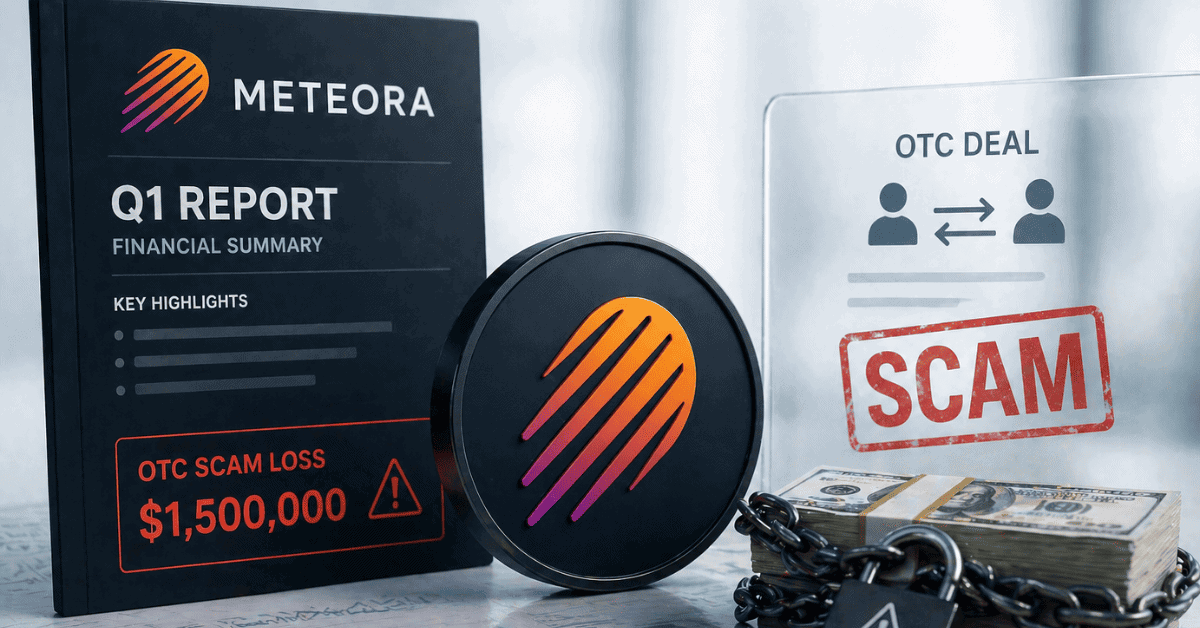
Meteora has disclosed a $1.5 million loss tied to an over-the-counter scam during its first-quarter MET token buyback activity.
The Solana-based DeFi protocol revealed the loss in its Q1 2026 Token Holders’ Report, according to crypto.news. The incident happened while the team was attempting to buy back MET tokens through an OTC transaction. Meteora said it filed a police report with local authorities, but the alleged scammer was not named and the report did not give further details on whether any funds could be recovered.


That makes the disclosure notable for two reasons. First, it shows that even protocol teams with public reporting, treasury controls and on-chain operations can still be exposed to old-fashioned counterparty risk. Second, Meteora chose to include the loss in a quarterly report rather than bury it, a move that gives token holders more visibility into how treasury money was used.
The Loss Came During MET Buybacks
Meteora reported $2.5 million in MET-related outflows during Q1. That included $1 million spent on MET buybacks and the $1.5 million lost to the OTC scammer.
Buybacks are usually meant to support token economics by using protocol funds to purchase tokens from the market or private sellers. In Meteora’s case, the team said it spent $1 million to acquire 7 million MET at an average price of $0.1427. Cumulative buybacks now stand at $13.7 million, covering 3.97% of total supply.
The scam loss therefore sits awkwardly beside a broader capital allocation strategy. The protocol was not hacked through a smart contract exploit, at least based on the public reporting. Instead, the loss appears to have come from a failed OTC deal, where trust, verification and execution controls matter as much as code.
Why OTC Deals Can Be Risky in Crypto
OTC transactions are common in crypto because they allow large buyers and sellers to move size without immediately affecting public markets. For teams conducting buybacks, OTC desks or private counterparties can offer liquidity, discretion and better pricing.
But they also introduce risks that do not always exist on transparent exchange order books. Counterparties may misrepresent inventory, settlement terms can be unclear and funds can be transferred before token delivery is properly secured. Without strong escrow, legal agreements and identity verification, an OTC transaction can become a serious operational weakness.
That is the broader lesson from Meteora’s disclosure. DeFi teams often focus heavily on smart contract risk, audits and on-chain security. Those are essential, but treasury management can fail through off-chain processes too.
Meteora Still Reported Positive Q1 Cash Flow
The scam disclosure came inside a wider quarterly report that showed Meteora remained financially active despite weaker market conditions.
According to crypto.news, Meteora reported $18.3 million in net cash flow for Q1, even as volumes and fees declined from the previous quarter. The protocol closed the quarter with $32.8 million in treasury funds and said it had more than two years of runway.
Meteora’s own investor relations page shows total Q1 inflows of about $25.4 million and total outflows of about $7 million. That compares with Q4 2025 outflows of about $30.8 million, reflecting a sharp reduction after a heavier token-generation-event quarter.
That context matters. A $1.5 million loss is material, but it did not erase Meteora’s positive quarterly cash flow. The larger question is whether the incident leads to tighter treasury controls around future token buybacks and private market transactions.
Volumes and Fees Fell as Market Activity Cooled
The report also showed that Meteora faced a softer operating environment in Q1.
Trading volume fell to $19.5 billion, down 36% from the previous quarter. Total fees dropped 51% to $105.9 million, while revenue declined 35% quarter over quarter to $11.4 million. Meteora said revenue held up better than fees as overall market activity cooled.
The protocol’s DLMM product remained the main driver, handling 86% of volume and 54% of fees. DAMM and DBC pool fees, however, rose 18% from Q4, suggesting some areas of the platform continued to grow even as headline activity slowed.
For a Solana DeFi protocol, that mixed picture is important. Meteora is still generating meaningful activity, but lower volumes and falling fees show how quickly revenue can move when trading demand cools.
Token Holders Will Want Better Controls
The key issue now is governance and operational discipline.
Meteora’s decision to disclose the OTC scam loss may help build trust with token holders, but transparency is only the first step. Investors will likely want to know what controls are being added to prevent similar incidents, especially if buybacks remain part of the protocol’s token strategy.
That could mean stricter counterparty checks, third-party escrow, staged settlement, better internal approval processes and more detailed post-trade reporting. In crypto, a treasury mistake can become a reputational issue quickly, even when the underlying protocol continues to function normally.
Meteora’s Q1 report shows a protocol with real revenue, a sizable treasury and ongoing buybacks. It also shows that DeFi teams are not only exposed to code risk. They are exposed to human risk, process risk and the same fraud tactics that affect traditional finance.
For MET holders, the takeaway is balanced. The $1.5 million OTC scam is a red flag, but the protocol’s broader financial position remains intact. What matters next is whether Meteora turns the mistake into stronger controls before the next round of treasury activity.
Disclaimer: This article is for informational purposes only and does not constitute financial, investment, or legal advice. Always conduct your own research before making any investment decisions.