
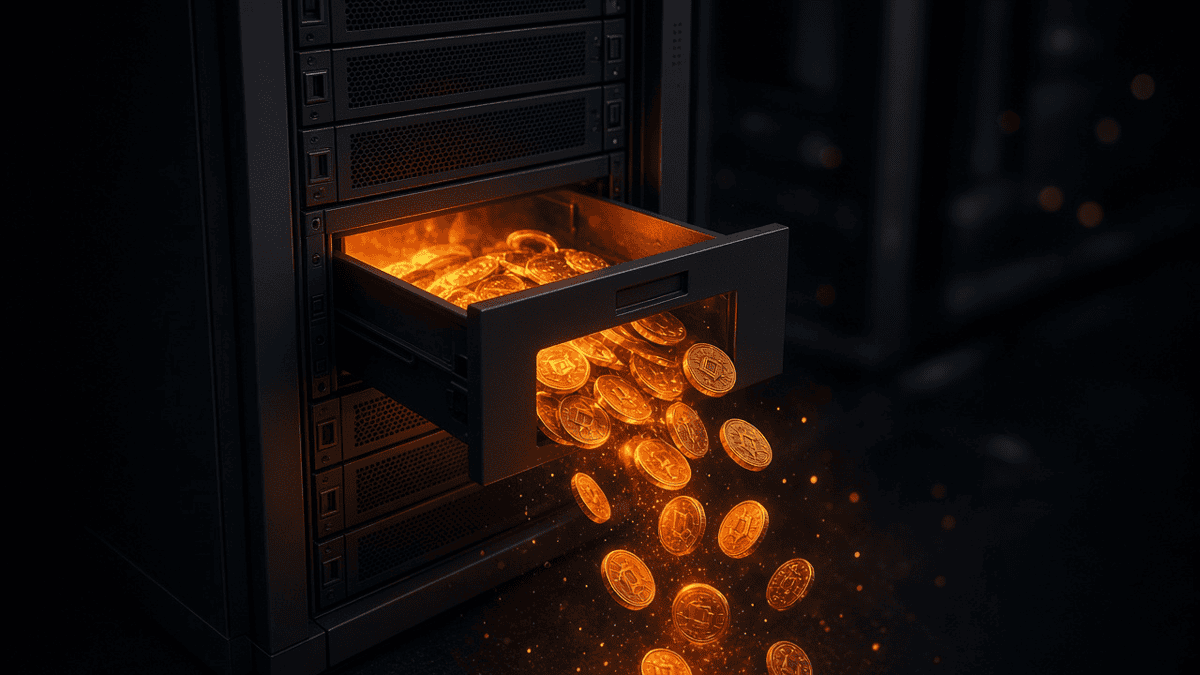
XMR1, the token that Monero swap service Wagyu issues to represent XMR on Hyperliquid, lost more than 99% of its value on Friday after an attacker took 5.2 million tokens from its deployer account and sold part of them into the order book for about $13.5 million. Wagyu’s pseudonymous founder, PerpetualCow, blamed a breach at the Icelandic web host 1984.hosting and promised to refund everyone who lost money out of his own pocket. Native Monero was not affected.
How the drain unfolded
According to an on-chain investigation by Bitquery, the attacker’s address received 0.098 ETH from the Tornado Cash mixer at 03:30 UTC and set up a Hyperliquid account eight minutes later. Between 04:46 and 05:16 UTC, the XMR1 deployer account sent it three transfers: 100,000 tokens, another 100,000, then 5 million. Before the drain, the deployer held about 93% of the token’s supply.


The selling began at 04:49 UTC. XMR1 had traded near $500 all week and was worth about $1 within half an hour. Bitquery counted 369,623 tokens sold to 420 buyers for $13.51 million, with about 76% of that raised before 05:00 UTC. The Block reported a low of $0.65. On Hyperliquid’s spot market, XMR1 was marked near $0.82 later on Friday, against a prior-day price of about $491.
The proceeds went to Arbitrum, were swapped for ETH and mostly bridged to Ethereum. Bitquery’s last check found 7,348 ETH spread across three wallets, with 4,836 ETH in a wallet that has never sent a transaction. The attacker had sold only about 7% of the tokens it received, leaving millions of XMR1 in its account.
Who paid for the dump
The money came from buyers on the way down, and most of it from a small group. Bitquery found that 75% of the $13.51 million came from buy orders already resting on the book, the way market makers usually trade. The single largest buyer had orders sitting near the old price and was filled for $3.56 million. The 27 accounts that paid $100,000 or more covered 77% of the total, while 243 accounts paid under $1,000 each.
That fits what PerpetualCow said in his first post at 09:36 UTC, when he wrote that he was not yet sure what had happened but that it seemed market makers “got hit primarily as they kept buying the endless amount of XMR1 being dumped on the market,” while users who only swapped “suffered no loss.” He also wrote that he was open to negotiating with whoever was responsible. Two hours later he said anyone who lost money making markets in XMR1 “will be refunded fully.”
The web host explanation
PerpetualCow’s post-mortem put the blame on infrastructure, not code. “The XMR1 deployer key was held on an OLD server on there that I DELETED, but somehow the logs/files were still kept,” he wrote, adding that Wagyu would relaunch “at a later stage” without giving a date.
A breach at the host has been reported. Decrypt, citing Icelandic outlet DV, reported that 1984 ehf and CERT-IS, Iceland’s national cyber incident team, issued a joint statement describing an extensive and serious attack on the company’s IT systems, after which it temporarily shut down all services. That statement did not mention Wagyu. The Block noted that the outage alone does not confirm that keys were taken from retained files, and that Wagyu’s website showed a “temporarily unavailable” notice.
Bitquery made a similar point. On Hyperliquid a token transfer is signed by the account’s own key, not an API trading wallet, so whoever moved the tokens most likely had the deployer’s main key. How that key was obtained cannot be seen on-chain.
What is still unclear
Three things remain open. First, refunds: by 13:16 UTC none of the ten largest buyers had received a transfer from another Hyperliquid account since 06:00 UTC, Bitquery said. Second, backing: the Monero side of Wagyu’s bridge is not visible on-chain, so it is not known how much XMR stands behind the XMR1 still in circulation. Third, exposure elsewhere: the same deployer account still holds 99.97% of ZEC1, Wagyu’s Zcash token, which means the key that moved the dumped XMR1 also controls that supply.
Wagyu has drawn attention before. Decrypt noted the service disclosed a separate data leak in October, saying funds were not affected, and AltcoinReporter reported earlier this month that some funds from a suspected $106 million theft were converted to Monero through Wagyu, according to ZachXBT’s tracing. The hack also landed on a weak day for the wider market, with XMR down about 9% over 24 hours on CoinGecko as Bitcoin fell below $60,000.
FAQ
Was Monero itself hacked? No. The attack hit XMR1, a token Wagyu issues on Hyperliquid to represent Monero. The Monero network and native XMR were not involved, although XMR’s price fell with the broader market.
Who lost money? Mainly buyers who bought XMR1 as it was dumped, most of them accounts with resting buy orders. PerpetualCow said swap users were not affected and promised personal refunds, with no timetable.
Is the web host breach confirmed as the cause? Not independently. 1984.hosting and CERT-IS confirmed a cyberattack, but the link to the XMR1 key rests on PerpetualCow’s account.
Disclaimer: This article is for informational purposes only and does not constitute financial advice.