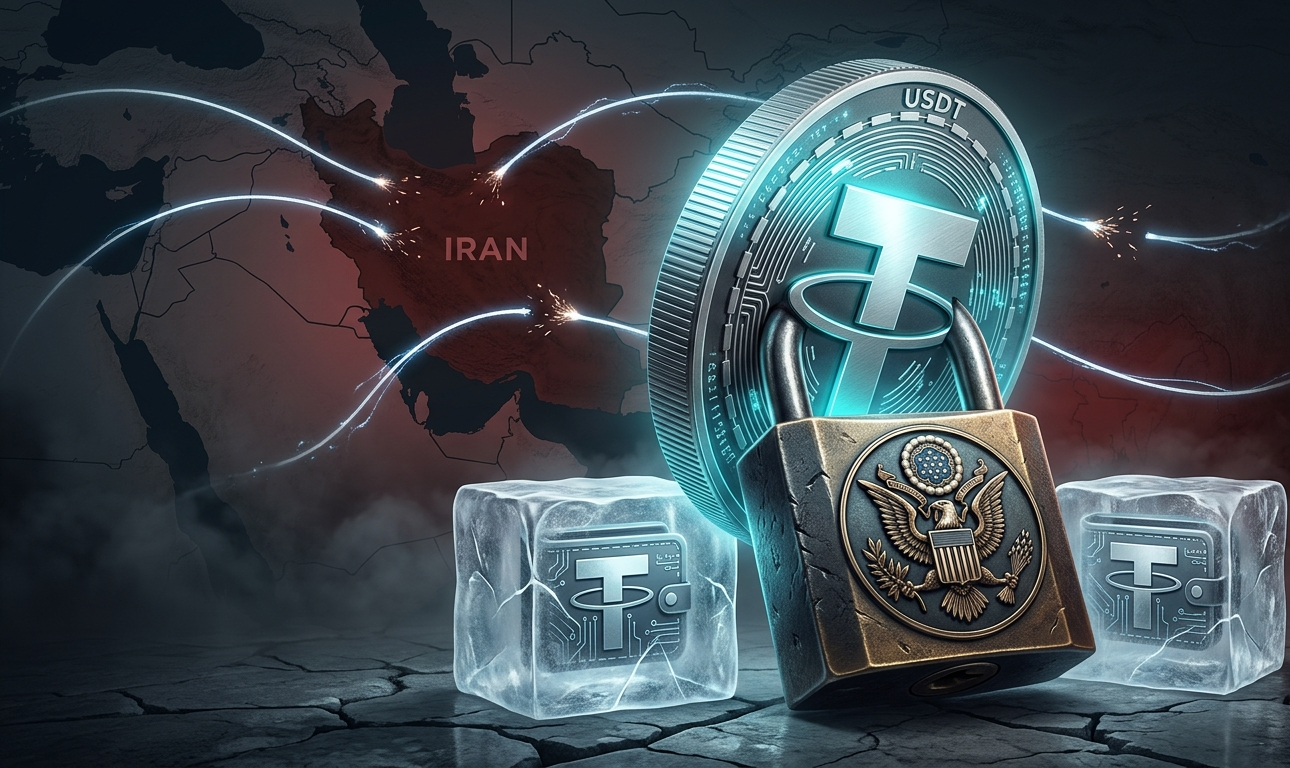
The US government just showed exactly how much power it has over the world’s most popular stablecoin. On Thursday, Tether froze $344 million in USDT across two wallets on the Tron blockchain after being flagged by US authorities. On Friday, Treasury Secretary Scott Bessent confirmed the wallets were linked to Iran’s Islamic Revolutionary Guard Corps (IRGC) and Hezbollah.
It is the largest single crypto freeze tied to Iran’s war economy and the most aggressive digital asset enforcement action since the conflict began in February.


Bessent called it part of “Operation Economic Fury,” the administration’s campaign to choke off every financial channel Tehran is using to fund the war. His words were direct: “We will follow the money that Tehran is desperately attempting to move outside of the country and target all financial lifelines tied to the regime.”
How Did the US Find and Freeze the Wallets?
The two frozen Tron wallets held $213 million and $131 million in USDT respectively. US officials said they tracked confirmed transactions with Iranian exchanges and a series of transfers routed through intermediary addresses that interacted with wallets tied to Iran’s Central Bank.
Chainalysis matched the frozen wallets to known IRGC transaction patterns. The firm told CNN the wallets had previously made “frequent, large transfers of up to tens of millions of dollars, largely with other private wallets.” Those patterns are consistent with how other known IRGC addresses move funds on-chain.
Tether then executed the freeze at the smart contract level. That means the tokens are still visible on the blockchain but cannot be moved, spent, or transferred. They are locked in place permanently unless Tether decides to unlock them.
How Big Is Iran’s Crypto Operation?
Bigger than most people realise. Chainalysis estimated that Iran’s crypto ecosystem reached $7.8 billion in 2025, growing faster than in 2024 for most of the year. The IRGC alone accounted for roughly half of all on-chain holdings by Q4 2025.
The Central Bank of Iran has been using stablecoins to stabilise the rial and settle international trade. Earlier research by Elliptic found that the CBI had acquired about $507 million in USDT specifically for these purposes. Tehran is not dabbling in crypto. It is running a parallel financial system through it.
This is not the first crypto action under Economic Fury either. In January, OFAC designated two UK-registered crypto exchanges for processing IRGC transactions. One of those exchanges had handled over $94 billion in transactions since 2022. Earlier this month, Treasury sanctioned more than two dozen individuals and companies tied to Iranian oil smuggling. Bessent has also warned banks in China, Hong Kong, the UAE, and Oman that facilitating Iranian trade could trigger secondary sanctions.
What Does This Mean for Stablecoin Users?
This is where the story gets uncomfortable for the crypto world. Tether froze $344 million with a single action. No court order was made public. No trial happened first. Tether received a request from US authorities and executed the freeze immediately.
That capability is built into the USDT smart contract. Tether can blacklist any address at any time if it receives a request from law enforcement. The company says it has now supported over 2,300 cases across 340 agencies in 65 countries and helped freeze over $4.4 billion in total assets.
For sanctions enforcement, this is a feature. It gives the US government surgical precision over stablecoin flows that it could never achieve with traditional banking. Real-time blockchain analysis combined with issuer-level controls means Washington can identify, track, and freeze Iranian funds faster than through any bank.
For regular users, it is a reminder. Your USDT is not fully yours in the way that Bitcoin is. If your wallet gets flagged, rightly or wrongly, Tether can lock your funds at the contract level. The tokens do not move. There is no appeal process on the blockchain.
Bitcoin does not have this feature. Nobody can freeze BTC at the protocol level. That fundamental difference is why some in the crypto community see the Tether freeze as proof that stablecoins are not really decentralised at all. As one Bitcoin publication put it bluntly: “Tether froze $344M with a keystroke. Your stablecoins are not your stablecoins.”
Will This Actually Hurt Iran?
That depends on who you ask. Daniel Tannebaum, a senior fellow at the Atlantic Council, told CNN the freeze is “meaningful” but said that given how heavily sanctioned Iran already is, “I don’t think it necessarily moves the needle for thwarting Iran’s attempts to continue operating.”
Iran has been adapting to sanctions for decades. It will find new wallets, new chains, new intermediaries. The $344 million freeze hurts, but Iran’s crypto ecosystem processed $7.8 billion last year. Losing $344 million is painful, not fatal.
The bigger impact may be psychological. Every crypto user in a sanctioned country just watched Tether lock $344 million overnight. That sends a message about the risks of holding large amounts of USDT in any jurisdiction that might attract US attention. It also pushes sanctioned actors further toward privacy coins, decentralised exchanges, and chains where issuer-level freezes are not possible.
For the rest of the crypto market, the Tether freeze reinforces a growing reality. Stablecoins are becoming the financial front line of geopolitical conflicts. They are tools of sanctions enforcement as much as they are tools of payments and trading. And the company that issues 60% of the world’s stablecoin supply just proved it will act as Washington’s enforcement arm when asked.