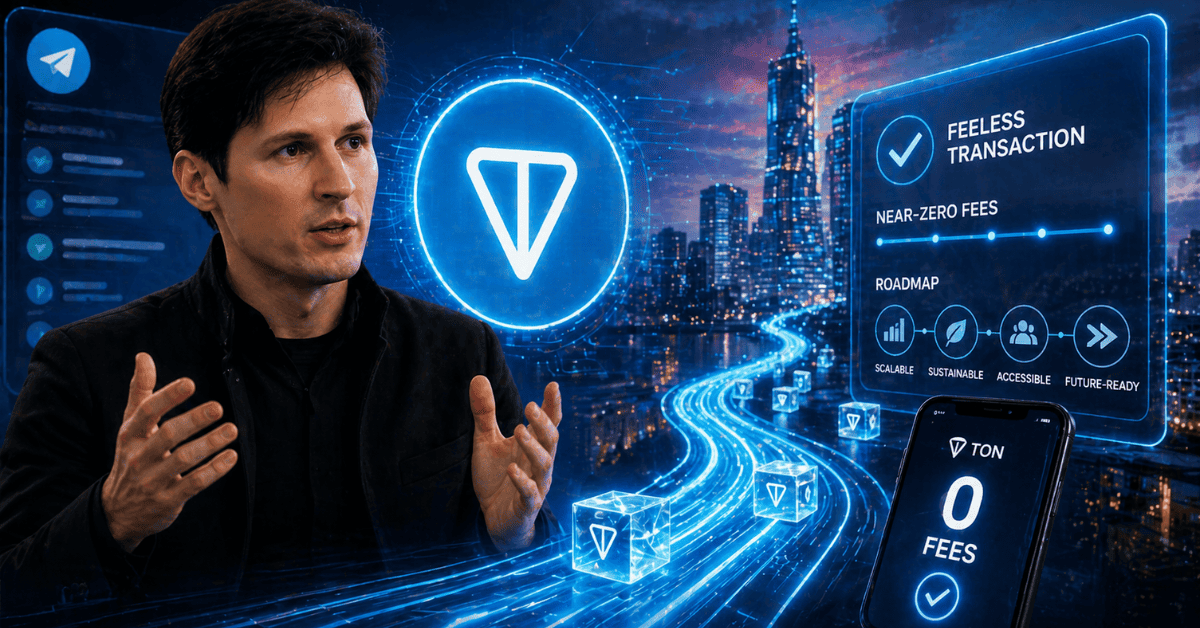
Pavel Durov says transaction fees on The Open Network will be cut sixfold, bringing standard network costs down to a fixed 0.00039 TON per transaction within about a week.
The Telegram founder also said most TON transactions are expected to become fully feeless soon after, with zero commission as part of the broader “Make TON Great Again” roadmap. The announcement gives TON a clear new pitch: faster settlement, lower fees and a user experience designed for everyday transfers rather than occasional crypto transactions.


That matters because TON’s biggest opportunity is not only serving crypto traders. Its real advantage is distribution through Telegram’s massive user base, where mini-apps, wallets, payments and on-chain activity can reach users who may never interact with a traditional crypto exchange.
Why the Fee Cut Matters
A Fixed Fee Makes Costs Easier to Understand
TON’s planned 0.00039 TON fee is not just lower. It is also meant to stay fixed regardless of network load.
That is important for consumer payments and app developers. Users do not want to calculate variable gas fees before sending small transfers, buying digital goods or interacting with mini-apps. Developers also need predictable costs when building products for millions of users.
Ethereum has improved significantly through scaling networks, and Solana remains one of crypto’s low-cost leaders. Still, TON’s fee-cut strategy is aimed at a different audience: people using crypto inside familiar messaging and app environments.
If fees become almost invisible, TON could become more practical for microtransactions, gaming rewards, creator payments, in-app purchases and cross-border transfers.
Feeless Transactions Could Change User Behavior
The bigger promise is feeless activity. If most TON transactions eventually carry zero commission, the network could remove one of the biggest friction points in crypto.
Even tiny fees can discourage casual users when they are making small payments. A zero-fee model could make blockchain interactions feel closer to normal app activity, where users tap, send and move on without thinking about transaction costs.
The challenge is sustainability. Someone still needs to pay for network security, validators, infrastructure and spam protection. TON will need to show how feeless transactions can work without opening the door to abuse or shifting costs in ways that hurt developers, validators or users later.
Catchain 2.0 Set the Stage
TON Recently Became Much Faster
The fee announcement follows TON’s Catchain 2.0 upgrade, which went live earlier in April and sharply improved network speed. TON’s documentation says mainnet block intervals dropped to roughly 400 milliseconds, compared with about 2.5 seconds before the upgrade, while target finalization lag fell from about 10 seconds to around 1 second.
That speed improvement is central to Durov’s roadmap. Lower fees are more useful when the network also feels fast enough for ordinary app interactions. For Telegram mini-apps, payment confirmations need to feel almost instant or users will compare them unfavorably with normal digital payment systems.
Catchain 2.0 gives TON a stronger technical foundation for that pitch. The fee cut is the next step in making the network cheaper as well as faster.
Payments Need Both Speed and Cost Certainty
A blockchain can be fast but still awkward if fees spike or transactions feel unpredictable. It can also be cheap but frustrating if confirmations take too long.
TON is trying to solve both sides at once. The network wants near-instant finality, low fixed fees and eventually feeless transactions. That combination is designed to make crypto payments feel less like crypto and more like regular digital infrastructure.
This is especially relevant for Telegram, where users may be interacting through bots, games, channels and mini-apps. In that environment, even a few seconds of delay or a confusing fee screen can reduce adoption.
Why Telegram Mini-Apps Are the Key Market
TON’s most important test is not whether crypto-native users appreciate lower fees. They probably will. The bigger test is whether Telegram mini-app developers can use cheaper transactions to build products that attract mainstream users.
Mini-apps could use TON for rewards, tipping, digital collectibles, subscriptions, game items or peer-to-peer payments. Lower fees make those use cases easier because small transactions no longer feel uneconomic.
But cheaper fees alone will not guarantee adoption. Developers still need strong tooling, safe wallet flows, clear compliance paths and enough liquidity for users to move in and out of TON-based assets easily.
If those pieces come together, TON could become one of the most important blockchain payment networks tied to a mainstream consumer platform.
The Risks Behind Near-Zero Fees
There are still open questions. Feeless transactions can invite spam if there are not strong rate limits, identity tools or other anti-abuse protections. Validators also need economic incentives to keep the network secure and responsive.
There is also execution risk. Durov’s announcement sets a clear expectation, but the market will want to see the lower fixed fee implemented on schedule and feeless transactions rolled out in a way that works under real traffic.
Finally, TON’s connection to Telegram is both a strength and a regulatory consideration. If the network becomes a major payments rail for mini-apps and cross-border transfers, regulators may pay closer attention to consumer protection, illicit finance controls and stablecoin-style use cases.
What Comes Next
The first milestone is whether TON implements the sixfold fee cut on schedule, bringing standard transaction costs down to 0.00039 TON.
The second is how quickly feeless transactions appear in practice. The key detail will be what “most transactions” means, which users qualify, and how the network prevents abuse when costs drop to zero.
The third signal is on-chain activity. If lower fees drive more wallet usage, mini-app transactions and payment volume, TON’s fee cut may become more than a marketing moment. It could become the next step in turning Telegram’s crypto ecosystem into everyday payment infrastructure.
For now, Durov has given TON a simple message: the network is getting faster, cheaper and closer to feeless use. The next test is whether users and developers show up.
Disclaimer: This article is for informational purposes only and does not constitute financial, investment, or legal advice. Always conduct your own research before making any investment decisions.