
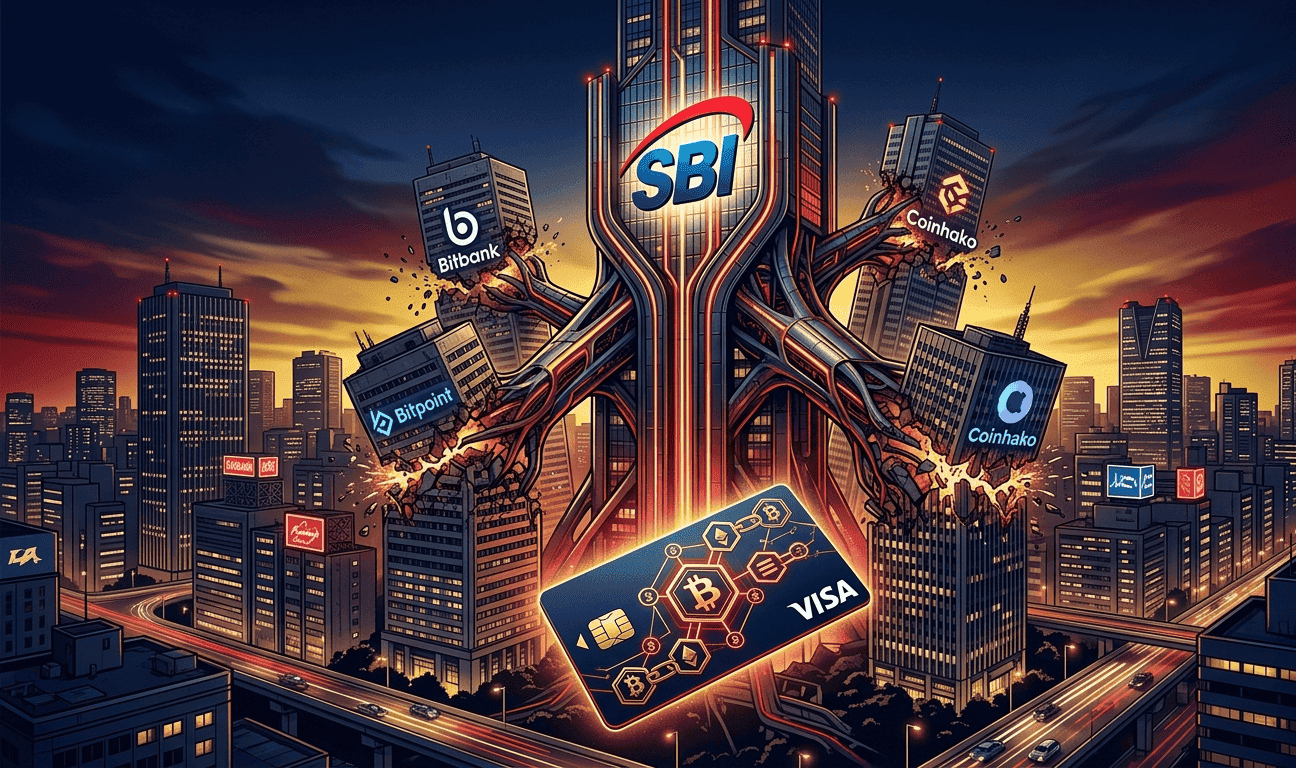
Japan’s biggest financial conglomerate is buying up every crypto exchange it can get its hands on. SBI Holdings confirmed on May 1 that it has submitted a letter of intent to acquire Bitbank, one of Japan’s largest and most trusted crypto exchanges. The goal is to make Bitbank a consolidated subsidiary, giving SBI control over three major exchanges under one roof.
This is not an isolated deal. It is the third crypto acquisition SBI has made in six months. The company absorbed Bitpoint Japan in April. It is buying a majority stake in Singapore’s Coinhako. And last week it launched a Visa credit card that converts spending rewards into Bitcoin, Ethereum, and XRP.


SBI Chairman Yoshitaka Kitao said bringing Bitbank into the group will help establish a “dominant position” in Japan’s crypto market. He is not exaggerating. If this deal closes, SBI will operate the largest crypto platform group in the country by a wide margin.
Why Does SBI Want Bitbank?
Bitbank is one of the strongest exchange brands in Japan. It has been running since 2014 and has never been hacked. Zero security breaches in 12 years. In an industry where exchanges lose hundreds of millions to exploits regularly, that track record is rare and valuable.
The exchange has strong retail recognition, solid daily trading volumes averaging around $50 million, and a growing product suite. Just days ago, Bitbank launched Japan’s first crypto-linked credit card in partnership with EPOS Card and Visa. The card lets users pay everyday bills from their exchange balance and earn 0.5% cashback in crypto on monthly spending.
Bitbank also raised 7 billion yen (roughly $47 million) from gaming company Mixi in 2021, giving Mixi a 26.2% stake. The exchange had been preparing for a Tokyo Stock Exchange IPO since mid-2025. Those IPO plans now look uncertain. Analysts believe SBI’s deep pockets and strategic integration make the acquisition more attractive to Bitbank’s shareholders than going public independently.
What Has SBI Already Built?
In April 2026, SBI completed the merger of Bitpoint Japan into SBI VC Trade, streamlining its domestic exchange operations. Bitpoint offered spot trading and had launched Japan’s first on-chain bond with XRP-based rewards. Rolling it into SBI VC Trade consolidated those capabilities under one platform.
In February 2026, SBI disclosed plans to acquire a majority stake in Coinhako, a licensed crypto exchange in Singapore regulated by the Monetary Authority of Singapore. That deal extends SBI’s reach beyond Japan into Southeast Asia, one of the fastest-growing crypto markets in the world.
In 2025, SBI acquired the customer accounts of DMM Bitcoin after the exchange suffered a major hack. Rather than let those users disappear, SBI absorbed them into its own platform.
And last week, SBI launched a Visa partnership offering credit cards that automatically convert spending rewards into Bitcoin, Ethereum, or XRP. That gives retail customers a way to accumulate crypto through everyday purchases without ever opening an exchange account.
Add Bitbank to the group and SBI controls: SBI VC Trade, Bitpoint (merged), Bitbank (pending), Coinhako (Singapore), a Visa crypto rewards card, and the remnants of DMM Bitcoin’s customer base. That is not a crypto strategy. That is a crypto empire.
Why Is This Happening Now?
Japan’s cabinet approved a draft amendment last month that would classify cryptocurrencies as financial products under the Financial Instruments and Exchange Act, the same framework used for stocks and securities. If passed during the current parliament session, the law could take effect as early as fiscal 2027.
That change would raise compliance requirements, increase capital thresholds, and make it harder for smaller exchanges to operate. SBI is positioning itself before those rules arrive. By consolidating multiple exchanges now, it builds the scale needed to absorb higher regulatory costs while smaller competitors struggle or get squeezed out.
This is the same playbook that played out in traditional finance. When banking regulations tightened after 2008, the largest institutions got larger by acquiring smaller ones that could not afford compliance alone. Japan’s crypto market is entering that phase now, and SBI is leading the consolidation.
What Does This Mean for the Japanese Crypto Market?
Japan is the world’s fourth-largest economy and home to one of the most active retail crypto trading populations globally. The Nomura survey we covered earlier this month showed 80% of Japanese institutional investors plan to buy crypto within three years. The market is growing.
SBI’s consolidation play means that growth will increasingly flow through one company. If the Bitbank deal closes, SBI will control exchanges that collectively serve the majority of Japan’s retail crypto users. That concentration raises questions about competition and pricing power, but it also creates a platform with the scale to compete internationally against Binance, Coinbase, and other global players.
For Bitbank users, the transition should be smooth. SBI has said it plans to maintain Bitbank’s brand and operations while integrating back-end systems. But the exchange’s independent IPO plans are likely dead. Bitbank was going to be a publicly traded, standalone crypto company. It is now going to be a subsidiary of a financial conglomerate.
The deal is still in early stages. Due diligence and regulatory approvals could take three to six months. If everything goes smoothly, the acquisition could close by late 2026, just in time for the new regulatory framework to take effect.