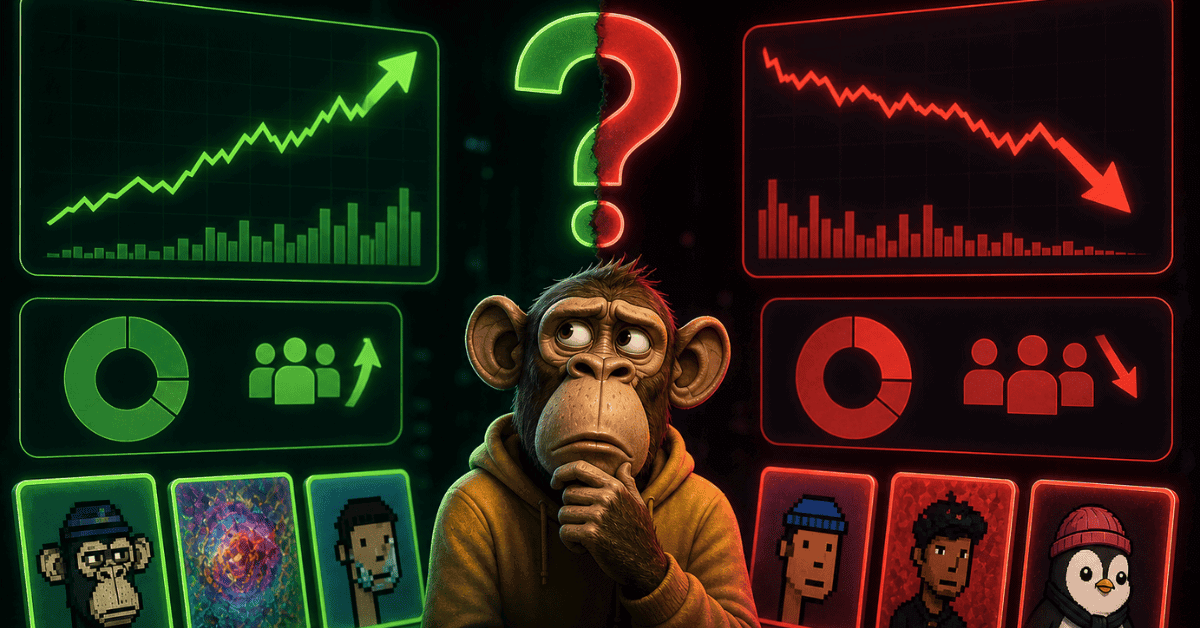
NFT marketplace data now tells two opposite stories at once.
Blue-chip NFTs can pump while NFT marketplaces still look like a ghost town. That is the strange state of the market in 2026: some well-known collections are seeing renewed price action, while the infrastructure built for the last NFT boom keeps shutting down, shrinking or reinventing itself.


CoinDesk recently reported that Pudgy Penguins and Bored Ape Yacht Club rallied with double-digit gains, even as global NFT sales volume fell and user participation hit multi-year lows. In other words, some elite collections are moving higher, but the broader market is not obviously back.
That is the real story. NFTs are not simply dead, but the old NFT marketplace model clearly is not healthy either.
Blue-Chip NFTs Can Rally Without a Broad Recovery
The recent blue-chip rally is real, but it is narrow.
Pudgy Penguins and Bored Ape Yacht Club have both attracted renewed attention, helped by stronger brand identity, deeper communities and a smaller group of high-conviction buyers. These collections are still recognizable names in crypto culture, which gives them an advantage over thousands of forgotten projects from the 2021 and 2022 boom.
But a few premium collections rising does not mean the whole market is recovering.
A thin market can produce sharp moves. If fewer people are trading, but the remaining buyers are willing to pay up for established collections, floor prices can rise even while total users and volumes remain weak. That creates a confusing picture: price charts look better than the underlying marketplace health.
This is why NFT data can feel contradictory. The top end can be active while the long tail is dead.
Marketplace Closures Tell the Other Side
The other side of the story is much harsher.
Nifty Gateway, one of the earliest and most prominent NFT platforms, announced it would shut down after years of declining activity. Artnet reported that the Gemini-owned marketplace said it would close effective February 23, 2026, after already entering withdrawal-only mode.
JPG Store, the leading Cardano NFT marketplace, also announced that it would permanently shut down on May 23, 2026, alongside its Comet platform. Yahoo Finance reported that JPG Store had been the dominant Cardano NFT marketplace since 2021, making the closure especially significant for that ecosystem.
Recent commentary has also pointed to Immutable closing its own marketplace as another sign that NFT trading infrastructure is changing. The pattern is hard to ignore: marketplaces that once looked like critical Web3 infrastructure are finding that the economics no longer work the way they did during the boom.
The Old NFT Marketplace Model Is Broken
The old model was simple: attract collections, list NFTs, take fees and ride the volume.
That worked when speculative demand was everywhere. In a hot market, buyers came for mints, flips, profile pictures, gaming assets and digital art. Marketplaces could compete on brand, user experience, royalties, fees and liquidity.
But when volume falls, the model becomes harder. Marketplaces need enough trading activity to justify engineering, support, compliance, infrastructure and creator tools. If users disappear, the business can shrink quickly.
That is what the closures suggest. The problem is not that NFTs have zero value. The problem is that running a standalone marketplace around low-volume trading may no longer be enough.
OpenSea’s Pivot Makes More Sense Now
This is why OpenSea’s OS2 pivot looks less like feature expansion and more like survival logic.
OpenSea has been moving beyond a pure NFT marketplace model by adding fungible-token swaps, cross-chain buying and aggregated listings. That strategy makes sense in a world where NFT-only trading is too narrow. If users are already connecting wallets, the platform wants to capture more of their broader on-chain activity.
That tells us something about the direction of the sector. The next successful NFT platforms may not look like NFT platforms at all. They may look like multichain trading hubs, wallet interfaces, gaming asset rails, loyalty platforms, creator commerce tools or brand infrastructure.
NFTs may survive, but the marketplace wrapper around them is changing.
Collectibles Are Becoming More Like Luxury Markets
The blue-chip rally also suggests NFTs may be behaving more like a luxury or art market.
In weak environments, the middle and lower end often suffer most. The strongest brands, rarest assets and most culturally durable collections can still attract capital, while everything else struggles for bids.
That is not unique to crypto. Art, watches, sneakers and collectibles all show similar patterns. The best-known names retain attention while weaker categories fade.
For NFTs, that means CryptoPunks, Pudgy Penguins, Bored Ape Yacht Club and a handful of other collections can move differently from the wider market. Their price action may say more about status, scarcity and community than about general NFT adoption.
This is why looking only at blue-chip floors can mislead readers. It is like judging the entire art market by a few major auction sales.
The Real Question Is What Marketplaces Become Next
The NFT marketplace of the future may need to do more than list tokens.
It may need to handle cross-chain liquidity, token swaps, gaming inventory, digital identity, loyalty rewards, physical redemption, creator royalties and community access. It may need to integrate with wallets, social platforms and brand commerce instead of relying only on floor-price speculation.
That is a very different business from the old marketplace model.
The old model assumed NFTs were the main event. The new model may treat NFTs as one asset type inside a wider digital ownership stack.
That shift is less flashy than a bull-market floor-price rally, but it may be more important.
The Bottom Line
NFT marketplace data now tells two opposite stories at once.
Blue-chip collections can rally, and that does matter. It shows that some NFT brands still have loyal buyers and cultural value. But marketplace closures and shrinking participation show that the broader NFT economy has not simply returned to its old form.
The right takeaway is not “NFTs are back” or “NFTs are dead.”
The better answer is that NFTs are becoming more selective, more fragmented and more dependent on real utility, brand strength or collector conviction. The old marketplace boom is gone. Whatever comes next will not look like 2021 with lower prices.
Blue-chip NFTs can still pump, but the marketplace model around them has to become something more durable.
Disclaimer: This article is for informational purposes only and does not constitute financial, investment, or legal advice. Always conduct your own research before making any investment decisions.