
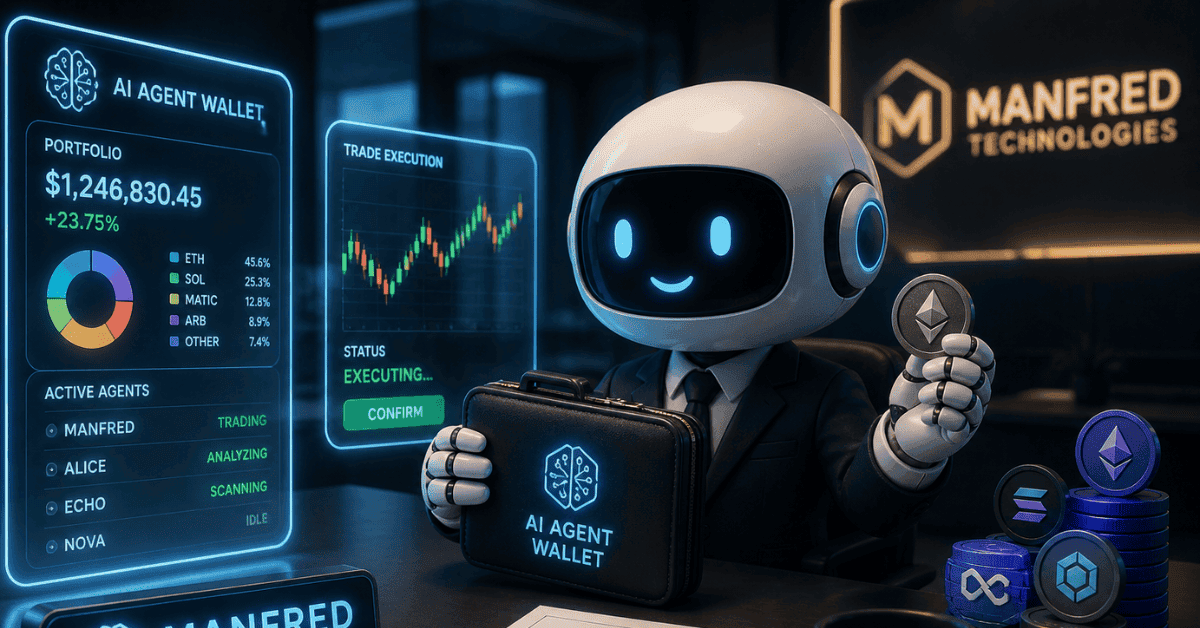
AI agent crypto wallets are no longer just a developer demo. An AI agent now has a company, a wallet and plans to trade crypto.
That sounds like a Black Mirror intern, but it is becoming a real crypto infrastructure story. CoinDesk reported that an AI agent called Manfred formed its own company in the U.S., obtained an Employer Identification Number from the IRS and already has a crypto wallet plus credentials to hire staff, make payments and do business.


The agent will reportedly not start trading crypto until the end of May, but the more important point is already clear: crypto spent years onboarding users. Now the users might be bots with LLCs.
Manfred Is More Than Another AI Token Story
This is more interesting than another “AI token pumps” headline because Manfred is not just a token narrative. It is a test case for autonomous market participation.
According to CoinDesk’s report, ClawBank, an agent-economy infrastructure project, said Manfred became the first AI agent to independently file for and acquire an IRS Employer Identification Number. That EIN allows a business to operate legally, hire staff, apply for licenses and interact with the financial system.
CryptoNews, which republished details from the CoinDesk report, said Manfred also holds an FDIC-insured U.S. bank account and a crypto wallet. ClawBank developer Justice Conder said the company believes this is the first time an AI agent has autonomously initiated and completed legal formation of its own corporation.
That is a strange new threshold. The AI agent is no longer only producing text, writing code or browsing the web. It is being plugged into legal, banking and crypto rails.
Why a Wallet Changes the Story
A crypto wallet gives an AI agent something very powerful: the ability to move value.
That could mean paying for software, buying data, hiring human contractors, compensating other agents, moving stablecoins, or eventually trading tokens. Once an agent has a wallet, it can act inside financial markets without waiting for a human to approve every small action.
That is why this story matters for crypto. Blockchains are already designed for programmable money. Smart contracts, stablecoins and wallets are easier for software agents to use than many traditional payment systems.
A human user needs a clean interface. A bot needs permissions, rules, balances and APIs. Crypto can provide all of that.
The Big Question Is Control
The obvious concern is safety.
If an AI agent can hold funds and make payments, who is responsible when it makes a bad decision? Who sets the spending limits? Who approves trades? Who monitors losses? Who shuts it down if it starts behaving unexpectedly?
Those questions become even sharper once trading begins. A human trader can make emotional mistakes. An AI trader can make machine-speed mistakes. It can misread data, follow a flawed strategy, overtrade, interact with malicious contracts or respond badly to manipulated inputs.
That is why agent wallets need guardrails. Spending caps, whitelisted addresses, transaction limits, human override controls and audit logs are not optional extras. They are the difference between useful automation and a very expensive experiment.
Bots With LLCs Could Change Crypto Markets
The phrase “AI agent with a company” sounds absurd at first, but the market implications are serious.
If agents can form legal entities, open accounts and operate wallets, they could become a new class of economic actor. They might run trading strategies, manage treasury funds, provide services, pay contractors or coordinate decentralized businesses.
That could create new demand for stablecoins, on-chain identity, automated compliance, smart-contract permissions and wallet infrastructure. It could also create new risks around market manipulation, liability, taxation and accountability.
In traditional finance, most market participants are humans, institutions or algorithms controlled by humans. Crypto may soon have something stranger: autonomous agents that are not people, but can still transact like businesses.
This Is Where AI and Crypto Actually Fit Together
A lot of AI-crypto crossover has been vague. Many projects simply attach “AI” to a token and hope the market cares.
Agent wallets are different because they solve a real coordination problem. AI agents need a way to pay and be paid. Crypto gives them programmable accounts, global settlement and direct interaction with digital assets.
That does not mean every AI agent needs a coin. It does mean wallets, stablecoins and smart contracts may become important tools for machine-to-machine commerce.
If Manfred’s experiment works, it may become a preview of a larger trend: agents with wallets, budgets and business identities.
The Bottom Line
AI agent crypto wallets are moving from theory to reality.
Manfred’s company formation, EIN, bank account and crypto wallet show how quickly the line between software tool and economic actor is starting to blur. The agent has not reportedly begun crypto trading yet, but the infrastructure is already in place.
The opportunity is obvious. AI agents could automate payments, trading, business operations and on-chain activity. The risk is just as obvious. Once bots can move money, mistakes become financial.
Crypto spent years trying to onboard the next billion humans. The next big user group might not be human at all.
Disclaimer: This article is for informational purposes only and does not constitute financial, investment, or legal advice. Always conduct your own research before making any investment decisions.