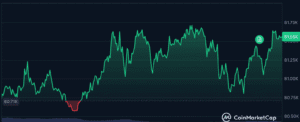
BTC climbed to $81,500 on Tuesday, its strongest level since January. That alone would be a story. But what made the rally different is where the energy came from. It was not a short squeeze. It was not a Saylor purchase. It was tokenisation.
At Consensus Miami, the crypto industry’s biggest annual conference, every major company on stage said the same thing: the future is putting real-world assets on the blockchain. Stocks. Bonds. Real estate. Commodities. The whole economy. And the market reacted like it believed them.


What Happened at Consensus That Moved Markets?
First, Bullish acquired Equiniti for $4.2 billion. Equiniti is a transfer agent, the company that keeps track of who owns shares in publicly traded companies. Buying it transforms Bullish from a crypto exchange into a capital markets infrastructure company. Bullish shares jumped 12%. Analyst Owen Lau said the acquisition signals Bullish is positioning to lead the tokenisation trend rather than just trade around it.
Second, Coinbase invested in Centrifuge and made it the default tokenisation infrastructure for its entire ecosystem, including Base. The first wave of institutional tokenised assets is expected to launch on Base within weeks. Centrifuge’s token CFG jumped 15% on the news. Coinbase is not just offering crypto trading anymore. It is building the rails for tokenised finance.
Third, Galaxy Digital and State Street unveiled a tokenised cash management fund for large institutional investors. Galaxy shares rose 3.6%. State Street manages over $4.3 trillion in assets. When a firm that size launches a tokenised product, it tells every other asset manager that the technology is ready.
Why Is Tokenisation Suddenly Driving Bitcoin’s Price?
Because it gives the rally something to stand on besides “number go up.”
Short squeezes fade. ETF inflows slow down. Saylor pauses buying. All of those catalysts are temporary. But tokenisation is a structural story. It changes what crypto is used for, not just how much people want to buy it.
Consensys founder Joseph Lubin said it directly at Consensus: “We’re moving into a world where essentially the entire economy is going to be tokenized.” He traced the concept back to Ethereum’s original design, which let anyone issue tokens without building a new blockchain. That design choice, made over a decade ago, is now paying off as banks and asset managers build on top of it.
Ripple and Boston Consulting Group project that tokenised assets could reach $18.9 trillion by 2033. That is not a crypto prediction. That is a consulting firm telling traditional finance how big this gets.
Rallies last longer when they have a narrative behind them. “ETF inflows” is a number. “The entire global economy moving onto blockchain” is a story. Stories hold attention. Attention holds prices.
What Are the Banks Actually Doing?
Citigroup’s tokenised deposit system went from processing millions to processing billions in the past year. Ryan Rugg, Citi’s digital asset lead, said the demand comes from corporate clients who want to move money around the clock, not just during banking hours.
JPMorgan’s blockchain platform Kinexys has processed over $1 trillion in tokenised transactions. Kara Kennedy, who leads market development for JPMorgan’s digital assets unit, described the growth as driven by genuine client demand, not experiments.
DTCC, the company that clears most US stock trades, is building blockchain integration into its settlement infrastructure. If DTCC moves onto blockchain rails, every stock trade in America eventually touches the technology.
The message from all three was the same: tokenisation is not replacing the financial system. It is upgrading the plumbing underneath it. The banks are not fighting crypto anymore. They are absorbing it.
What Pushed Bitcoin Specifically?
The ETF machine. Over $500 million flowed into spot Bitcoin ETFs on Monday alone, led by BlackRock and Fidelity. Paul Howard of Wincent told CoinDesk that ETF inflows are acting as “an increasingly important source of consistent buying pressure.”
Bitcoin is now up over 35% from its early February lows. The $80,000 breakout from Sunday is holding. The next resistance sits at $82,500, then $83,400, then $84,400. Analysts say a daily close above $82,500 would confirm the move and open a path toward $85,000.
Polymarket is pricing strong expectations for Bitcoin to reach $85,000 this month. The market is starting to treat this move not as a bounce but as the beginning of something bigger.
Can the Tokenisation Rally Last?
It depends on whether the deals translate into real products with real users.
Bullish buying Equiniti is meaningful only if tokenised securities actually trade on Bullish’s platform. Coinbase investing in Centrifuge matters only if institutional assets actually launch on Base. Galaxy and State Street’s fund matters only if large investors actually allocate capital to it.
The history of tokenisation is full of announcements that led to nothing. “Proof of concept” projects that stayed in pilot mode forever. The difference in 2026 is that the companies making the announcements are not startups. They are Citigroup, JPMorgan, Coinbase, BlackRock, and State Street. When firms this large commit resources, they tend to follow through.
One risk remains. If the Iran situation escalates again, or oil spikes back above $110, the tokenisation narrative will not matter in the short term. Geopolitics still drives Bitcoin’s biggest moves. But for the first time in months, the rally has something under it besides hope and leverage. It has Wall Street building real products on blockchain rails. That is harder to shake than a short squeeze.
Disclaimer: This article is for informational purposes only and does not constitute financial, investment, or legal advice. Always conduct your own research before making any investment decisions.