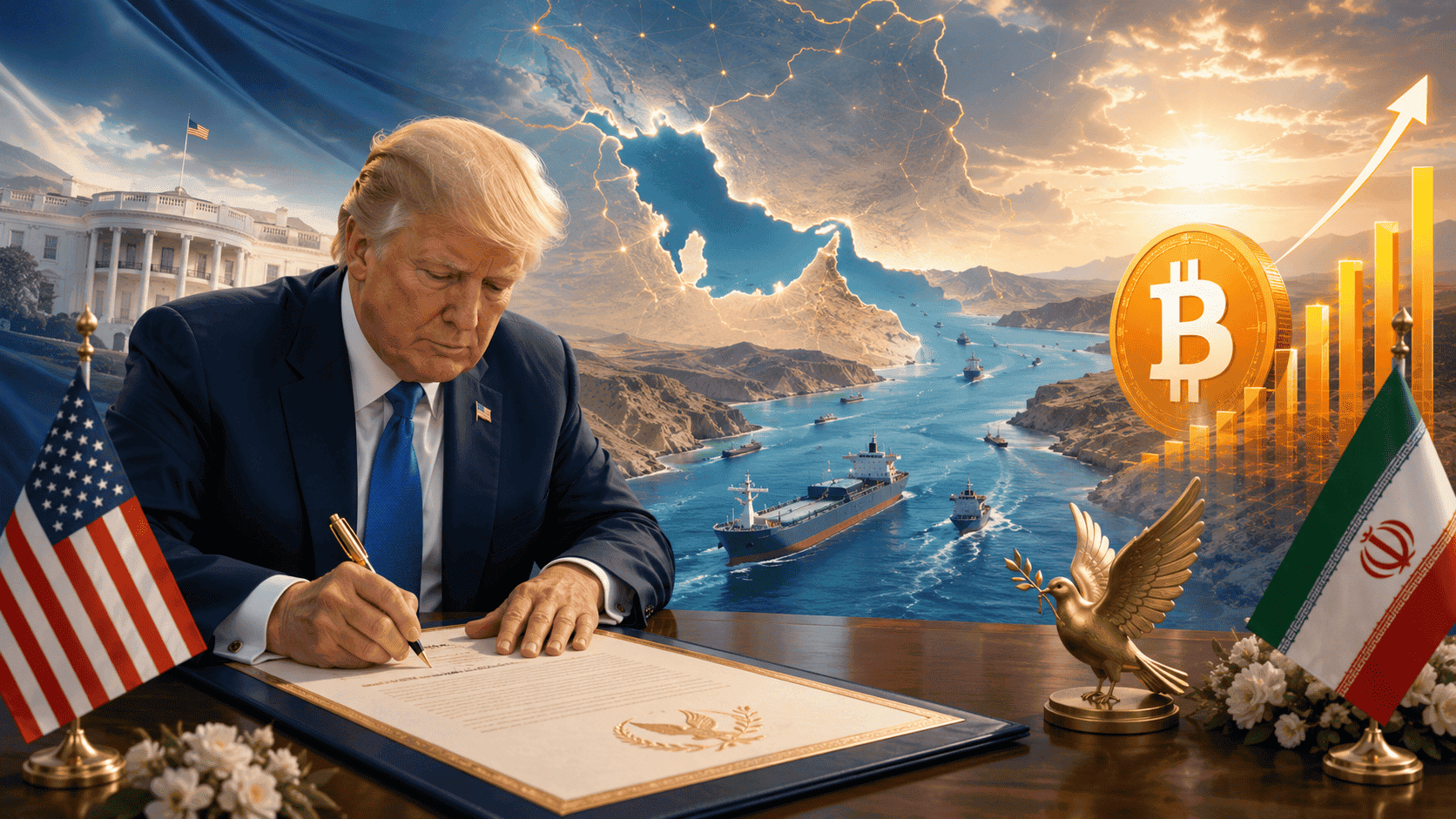
Donald Trump posted four words on Truth Social on Saturday that Bitcoin traders had been hoping to see for months. “The Deal is scheduled to get signed tomorrow.” A few sentences later, he added the line that captured the entire macro thesis driving crypto sentiment heading into Sunday: “and immediately after it is signed, the Hormuz Strait is OPEN TO ALL.”
If Trump is correct, the US-Iran memorandum of understanding gets signed today. The naval blockade lifts. The Strait of Hormuz, the chokepoint through which roughly 20% of global oil flows daily, reopens to unrestricted shipping. The conflict that has crushed risk assets and inflated oil prices since February’s escalation effectively ends.


Bitcoin moved immediately. The price climbed to approximately $64,252 by Sunday morning, up 1.14% in 24 hours. Ethereum followed to $1,677. Solana rallied 2.10% to $68.14. The crypto market was already pricing in a relief rally before the deal was technically signed, betting that Trump’s announcement carries enough credibility to mark a meaningful turning point.
The complication, as always with the Iran situation, is that Iran disagrees. Foreign Ministry spokesperson Esmaeil Baghaei told state media that the memorandum would not actually be signed on Sunday, though it could still move forward later. Pakistan’s Prime Minister Shehbaz Sharif said an electronic signing could happen within 24 hours. The actual signing timeline remains genuinely uncertain.
What’s clear is that the market has decided to position for relief. The next 48 hours will reveal whether that positioning gets validated by an actual signed agreement or whether traders have once again priced in a peace deal that fails to materialise as advertised.
What the Deal Actually Includes
The memorandum of understanding that Trump described includes specific provisions that go beyond a simple ceasefire. The framework, according to Trump’s public statements and reporting from sources close to the negotiations, extends the current ceasefire between the US and Iran for 60 days while addressing the most immediate economic flashpoint: the Strait of Hormuz.
The Strait is the most consequential element. Roughly 20% of global oil consumption flows through the narrow waterway between Iran and Oman. Any disruption to shipping pushes oil prices higher within hours, feeding directly into US inflation data through gasoline costs and freight expenses. Iran’s intermittent blockade threats and the US naval response have kept the Strait’s status in question since February, contributing to oil prices staying above $90 throughout the period.
A signed agreement that reopens the Strait “to all” immediately would crash oil prices. Brent crude, currently near $98, could fall toward $80 within days as the geopolitical premium evaporates. Lower oil flows directly through to lower headline inflation. The Fed’s rate decision on Tuesday would happen in a meaningfully different macro environment than the one priced into current markets.
The deal also reportedly addresses Iran’s frozen assets, with approximately $24 billion potentially being released. The asset release was a key Iranian demand throughout the negotiations and would represent the largest unfreezing of Iranian funds in years. Combined with sanctions relief on specific sectors, the financial provisions provide Iran with the economic incentive to maintain the agreement.
For crypto specifically, the deal carries an interesting subplot. The US Treasury has been sanctioning Iran-linked crypto wallets aggressively throughout 2026, freezing approximately $344 million in assets with cooperation from Tether on stablecoin transfers. Any normalisation of US-Iran economic relations could affect the pace and scope of these sanctions, with potential implications for stablecoin regulation and crypto compliance frameworks.
The Skepticism That Refuses to Go Away
Trump has announced an imminent Iran peace deal multiple times throughout 2026. Each previous announcement has been followed by either renewed escalation, technical complications that delayed signing, or Iranian denials that broke the agreement before it could be implemented.
The pattern is so consistent that one analysis tracker noted Trump has effectively called peace 37 times since February’s escalation. The ceasefire has been declared, broken, renewed, broken again, and currently exists in a state of fragile maintenance with regular violations from both sides. The skepticism around Trump’s Sunday claim isn’t cynicism. It’s pattern recognition.
Iran’s public position contradicts Trump’s timeline. The Foreign Ministry’s statement that the deal would not be signed Sunday is particularly significant because it came directly from Iranian official media rather than as background commentary. Whether the position reflects actual policy or last-minute negotiating posture is unclear, but it creates the possibility that the signing gets delayed even as Trump publicly commits to the timeline.
The indirect nature of the negotiations adds another layer of fragility. Talks have been mediated through Oman and Pakistan, meaning there’s no direct US-Iran channel for resolving last-minute disputes. Pakistan’s Prime Minister Sharif’s confirmation that the final text had been reached suggests progress, but mediated agreements face higher implementation risks than directly negotiated ones.
The realistic base case is that something gets signed within the next week, even if the exact Sunday timeline slips. The bigger question is whether the deal that ultimately gets signed contains the specific provisions Trump described, particularly the immediate reopening of the Strait of Hormuz. A deal that takes effect over weeks rather than immediately would still be positive for markets but would deliver the benefits more gradually than current pricing implies.
What This Means for Bitcoin’s Setup
The Iran deal arrives at a precise moment in Bitcoin’s macro setup that amplifies its potential impact.
The asset is currently sitting at $64,252 with Tuesday’s FOMC meeting four days away. The Fed will deliver Warsh’s first rate decision and a dot plot that the market is expecting to lean hawkish. The combination of an Iran deal and a less-than-feared FOMC outcome could trigger a sharp relief rally as the two biggest macro headwinds simultaneously ease.
The mechanics work through inflation expectations. Lower oil prices from a reopened Strait reduce headline inflation directly. Lower inflation gives the Fed more room to either stay neutral or signal eventual cuts rather than hikes. A neutral-to-dovish Fed in a falling-inflation environment removes the macro pressure that has crushed Bitcoin since the rate cut narrative collapsed in May.
If the deal signs Sunday and the Fed delivers anything but a hawkish surprise, Bitcoin could push toward $68,000 to $70,000 within the week. The catalysts would compound. ETF flows that have been deeply negative for weeks could turn positive. Long-term holders sitting at record accumulation levels would see validation of their positioning. The Fear and Greed Index in extreme territory would reset rapidly.
If the deal slips past Sunday but signs within the week, the relief rally still occurs but with less intensity. Bitcoin could reach $66,000 to $68,000 by month-end as the gradual easing of geopolitical tension provides ongoing tailwinds.
If the deal fails to sign at all and another escalation occurs, Bitcoin faces immediate selling pressure. The $63,000 to $64,000 support zone would face its biggest test of June. A break below $60,000 would target the liquidity gap toward $55,000 that traders have been watching since the SpaceX week.
The asymmetry of the setup favors positioning for the deal, even with the credibility concerns about Trump’s specific Sunday timeline. The downside if the deal fails is bounded by existing support levels. The upside if the deal succeeds combined with a non-hawkish FOMC is significantly larger than current prices reflect.
The Broader Crypto Implications
Beyond Bitcoin’s immediate price response, an Iran peace deal carries longer-term implications for the crypto industry.
The sanctions framework on Iran has been a major catalyst for crypto compliance development throughout 2026. Tether’s cooperation with US Treasury on freezing Iran-linked wallets demonstrated how stablecoin issuers can be integrated into geopolitical financial enforcement. The CLARITY Act and related legislation include provisions that affect how digital assets can be used for sanctions evasion. A normalisation of US-Iran relations could reduce the urgency around some of these frameworks while accelerating others.
Oil-dependent emerging markets that have been pressured by high energy costs would benefit from a Strait reopening. Countries like Turkey, India, and several African nations have seen growing crypto adoption partly as a hedge against currency depreciation linked to energy import costs. A return to lower oil prices could ease that specific driver of crypto demand in those markets, though the underlying adoption trends would likely continue regardless.
Russia’s position in the geopolitical landscape would also shift. The Iran-Russia partnership has been a central feature of the 2024-2026 international landscape, with both countries cooperating on sanctions evasion, military equipment, and energy infrastructure. A US-Iran deal that addresses Iran’s economic isolation could create distance between Tehran and Moscow, with implications for the broader sanctions environment that affects crypto markets.
For now, all of these longer-term implications are secondary to the immediate price action. Bitcoin at $64,252 is positioning for a relief rally that depends on Trump’s claim about Sunday actually proving accurate. The next 24 hours will reveal whether the deal signs as scheduled or whether the cycle of announcements and disappointments continues.
The market is betting on relief. The world is waiting to see whether that bet is justified.
FAQ
What does the Iran peace deal include?
The memorandum of understanding extends the US-Iran ceasefire for 60 days and reopens the Strait of Hormuz to unrestricted shipping immediately after signing. The deal reportedly includes the release of approximately $24 billion in frozen Iranian assets and various sanctions relief provisions. The lifting of the US naval blockade is the most immediate economic impact.
Why does an Iran deal matter for Bitcoin?
The Strait of Hormuz carries roughly 20% of global oil consumption. A signed deal reopening the Strait would crash oil prices, reducing headline inflation and giving the Federal Reserve more room to ease monetary policy. Lower inflation and dovish Fed expectations historically support Bitcoin and other risk assets. The deal also removes the geopolitical premium that has weighed on crypto markets since February.
Is the deal actually going to be signed?
Trump announced the deal will be signed Sunday, with the Strait reopening immediately. Iran’s Foreign Ministry has publicly disputed the Sunday timeline. Pakistan’s Prime Minister confirmed that the final text had been reached and electronic signing could happen within 24 hours. The exact timing remains uncertain, but progress toward eventual signing appears genuine even if Sunday specifically doesn’t hold.
Disclaimer: This article is for informational purposes only and does not constitute financial advice. Cryptocurrency investments carry significant risk. Always conduct your own research before making any investment decisions.