

Bitcoin spent the past two weeks executing one of the cleanest recoveries of the cycle. From the June 4 low at $59,770, the price climbed methodically through $62,000, $64,000, and $66,000, reclaiming each level with sustained buying rather than relief-rally spikes. By Tuesday afternoon, BTC touched $67,236, its highest level since the SpaceX IPO week. Standard Chartered’s Geoffrey Kendrick had publicly declared “crypto winter is over.” The on-chain data showed 125,000 BTC of long-term holder accumulation in June, one of the largest monthly events of the cycle. Every condition for sustained recovery was in place.
Then Kevin Warsh’s first FOMC meeting happened.


Wednesday’s rate decision delivered exactly the outcome bulls had feared. The Federal Reserve held rates at 3.50%-3.75% as expected, but the accompanying dot plot was the most hawkish in years. Nine of 18 Fed officials now project at least one rate hike in 2026. Six project two. Just one official penciled in a cut. The March dot plot had shown zero officials projecting hikes and the committee as a whole forecasting one cut. The reversal between meetings was unanimous.
Warsh himself declined to submit a dot plot projection at all, breaking 14 years of forward guidance tradition. He removed easing bias from the policy statement entirely. He launched five new task forces to restructure how the Fed communicates. His message to markets was direct: the era of forward guidance and dovish telegraphing is over, and getting inflation back to 2% is the priority.
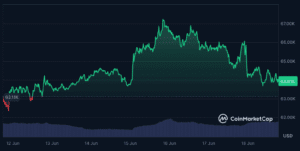
Bitcoin fell from $66,315 pre-FOMC to $63,908 on Thursday, breaking the $64,350 support that had held through the pre-decision session. The 2.4% decline doesn’t capture the structural significance. The recovery thesis that drove the climb from $59,770 to $67,236 just hit its first real macro test, and the test came back hostile. The next several days will determine whether the recovery holds the line or whether it gets unwound.
The levels that matter are specific. Understanding them clarifies what to watch as Bitcoin trades through the post-FOMC volatility.
The Critical Support Levels
The first line of defence sits at $63,000-$63,558. This is the immediate floor that Bitcoin tested in the hours following the FOMC release. If this zone holds on subsequent retests, the post-FOMC selloff likely qualifies as a positioning move rather than a directional breakdown. Long-term holders who absorbed 125,000 BTC in June have demonstrated willingness to defend prices at this level, providing structural buying that should reinforce the support.
Below $63,000, the next significant support sits at $61,250. This level represents the consolidation zone Bitcoin traversed during the climb from $59,770 to $66,000. Buyers who entered positions in this range have profit cushion to defend the level, but the cushion narrows significantly if BTC retests it. A break through $61,250 would suggest that the recovery’s structural buying has been exhausted and that additional supply needs to be absorbed before another recovery attempt can begin.
The structural defence line is the $59,130 May cycle low. This is the price that Standard Chartered’s Kendrick declared the cycle bottom. The 200-week SMA sits in this vicinity. The Fear and Greed Index hit 12 when Bitcoin reached this level previously. If $59,130 breaks, the entire “crypto winter is over” thesis gets invalidated, and the analytical framework that supported the recent recovery needs to be reconstructed. This is the level that matters for the broader market structure rather than just short-term trading.
Below $59,130, the volume profile reveals a liquidity gap stretching toward $55,000. Bitcoin has spent relatively little time in this zone historically, meaning there’s limited structural support to slow a decline through it. If $59,130 breaks decisively, the technical setup opens to a sharp move toward $55,000 with limited intermediate stops.
Below $55,000, the 200-week SMA itself sits near $54,000-$56,000 depending on the specific calculation. This is the indicator that has marked the exact bottom of every major Bitcoin bear market since 2018. December 2018 saw it at $3,100. March 2020 at $4,000. November 2022 at $16,000. Each test produced multi-hundred-percent rallies. Whether the indicator holds for a fourth time would be the most important Bitcoin technical event of the cycle.
The Critical Resistance Levels
On the upside, the first level to reclaim is $66,000. Bitcoin lost this level on the FOMC decision after holding it through the pre-decision period. Reclaiming $66,000 with sustained buying would confirm that the post-FOMC selloff was a positioning move rather than a directional reversal. The level represents the immediate technical proof that the recovery thesis remains intact despite the hawkish Fed positioning.
Above $66,000, the next test is $67,236, Tuesday’s pre-FOMC high. Pushing through this level would signal that buyers are willing to commit at levels above pre-FOMC pricing, indicating genuine bullish conviction rather than mean reversion. Sustained trading above $67,500 would confirm a structural recovery extending beyond simple FOMC mean reversion.
Beyond $67,500, the $70,000 level represents the next significant resistance. Bitcoin spent meaningful time in this zone during the May decline, creating overhead supply from traders who bought near these levels and are looking to exit at break-even or modest profits. Clearing $70,000 would require absorbing this supply, which would represent meaningful bullish conviction.
Above $70,000, the path to $75,000 opens with relatively less resistance until reaching the area where Bitcoin previously consolidated during the broader cycle high. The longer-term targets above $75,000 require either macro improvement (rate cuts returning to the Fed outlook) or sustained institutional buying that can drive prices independently of macro conditions.
What the Hawkish Pivot Actually Means
The structural change from Warsh’s first FOMC matters beyond the immediate price impact.
The removal of forward guidance changes how markets price future Fed policy. Previously, traders could anchor expectations to the dot plot, the policy statement language, and Fed speakers’ public communications. Each of these provided signals about likely future moves. Warsh’s deliberate elimination of forward guidance removes these anchors entirely, making future Fed policy more genuinely uncertain.
The hawkish dot plot signals that the inflation fight is the Fed’s priority for the foreseeable future. PCE inflation forecasts were raised to 3.6% for year-end 2026, up sharply from the 2.7% March projection. The Fed’s own models now confirm inflation is running hotter than previously expected. Until inflation shows sustained deceleration, the hawkish bias likely persists.
The dot plot showing 9 of 18 officials projecting hikes represents a complete reversal from March when zero officials projected hikes. The unanimous direction of the shift suggests that the entire Fed has updated its outlook in response to the hot inflation data, not just hawkish minority voices. The implication is that any hint of accelerating inflation could push the actual policy rate higher rather than just maintaining current levels.
Rate hike odds on Polymarket surged to 66% for at least one hike by year-end. The 2-year Treasury yield jumped 16 basis points to 4.22%. Markets are repricing the rate path significantly upward. For risk assets including Bitcoin, the implication is that the macro backdrop has fundamentally shifted from “potentially supportive” to “actively challenging.”
The Iran peace deal signing scheduled for June 19 provides one near-term counterweight. Lower oil prices following sustained Strait of Hormuz reopening would feed into lower headline inflation, which could push back on the hawkish dot plot in subsequent meetings. The sequence to watch is sustained lower oil prices, then cooler July CPI in mid-July, then potentially revised dot plots at the September FOMC meeting. The window for the hawkish narrative to reverse is roughly 60-90 days.
The On-Chain Reality That Contradicts the Price
Despite the hawkish macro environment and the Bitcoin price decline, on-chain data continues telling a story that’s diametrically opposed to the bearish positioning.
Long-term holders absorbed 125,000 BTC during June, one of the largest monthly accumulation events of the current cycle. These wallets have held BTC for at least 155 days and are statistically unlikely to sell into short-term volatility. The pattern indicates that sophisticated long-term participants are buying weakness systematically. Strategy added 1,587 BTC for $100 million between June 8-14, lifting holdings to 846,842 BTC. BitMine, the Tom Lee-led firm, continues accumulating across multiple major crypto assets.
Whale wallets with at least 1,000 BTC have rebounded to 7.17 million BTC, controlling 35.82% of available supply. This level hasn’t been seen in several months. The concentration of supply in stronger hands typically precedes sustained recoveries because it removes weak-handed sellers from the market.
The Bitcoin ETF flow data is mixed but turning. After 13 consecutive days of outflows totalling $3.58 billion in late May and early June, the flow direction has been turning. Bitcoin and Ethereum ETFs combined lost $111 million on June 17 as the FOMC pricing took effect, but the magnitude was much smaller than the May-June outflows. Whether institutional buyers return aggressively after the hawkish FOMC reality sets in will be one of the key signals for the recovery’s durability.
The disconnect between on-chain accumulation and price action reflects the structural reality of crypto markets. Long-term holders operate on multi-year timeframes. Short-term traders respond to macro news. The hawkish FOMC produced short-term selling but doesn’t change the multi-year accumulation thesis. As the FOMC repricing absorbs, the underlying accumulation pattern will reassert itself in price action.
Three Scenarios for the Coming Days
Scenario 1 (Bull Case): Bitcoin holds $63,000-$63,558 support and reclaims $66,000 within the next 5-7 days. The Iran peace deal signs on June 19 with sustained oil price decline. Long-term holders continue accumulating. ETF flows turn positive. The recovery from $59,770 extends to $70,000 and beyond by month-end.
Scenario 2 (Base Case): Bitcoin oscillates between $61,250-$66,000 over the coming weeks as the market digests the hawkish Fed positioning. The June 19 Iran signing provides modest support. ETF flows stabilise without strong directional bias. The recovery resumes more gradually with intermediate retests as conviction builds.
Scenario 3 (Bear Case): Bitcoin breaks $63,000 support within days, tests $61,250, and continues lower toward $59,130. The Iran signing disappoints or gets delayed. Hawkish Fed positioning produces sustained ETF outflows. The cycle bottom thesis gets retested, with the 200-week SMA at $54,000-$56,000 becoming the next major support to defend.
The probability weights favor Scenario 2 (Base Case) followed by Scenario 3 (Bear Case) given the hawkish FOMC backdrop. Scenario 1 (Bull Case) requires the Iran deal to deliver and the Fed to provide softening signals in subsequent communications, neither of which is guaranteed.
What Investors Should Do
The current setup favors patient capital over aggressive trading. The macro backdrop has genuinely shifted, but the structural Bitcoin accumulation pattern remains intact.
For long-term investors with multi-year horizons, the current weakness provides better accumulation opportunities than the recovery near $67,000 offered. The same Bitcoin that traded at $67,236 on Tuesday is now available at $63,908. The same long-term thesis applies. The price simply offers a better entry point.
For traders with shorter horizons, the binary nature of the next major support test (will $63,000 hold or not) argues for waiting for confirmation rather than predicting the outcome. Trading the bounce off $63,000 if it holds carries better risk-reward than positioning for either continuation lower or recovery higher without confirmation.
For investors who reduced exposure during the recent rally to lock in gains, the FOMC-induced weakness provides re-entry opportunities at meaningfully better prices. The question is whether to deploy now at $63,908 or wait for potential retests of $61,250 or lower. The patient approach typically produces better entries but risks missing the recovery if it resumes quickly.
For investors who haven’t been in Bitcoin and are considering entry, the current environment provides educational examples of how macro events affect crypto prices. The recovery from $59,770 to $67,236 demonstrated bullish institutional conviction. The decline back to $63,908 demonstrated that conviction is conditional on macro support. The honest assessment is that Bitcoin remains a volatile asset whose returns depend on factors beyond crypto-specific catalysts.
The next major test sits at $63,000. Whether Bitcoin holds that line or breaks through it will signal which scenario plays out from here. The Iran signing on Thursday and the subsequent ETF flow data over the coming days will provide the next confirmations. Until then, the recovery is on probation. The hawkish Fed just put it there.
FAQ
Why did Bitcoin fall after the FOMC decision?
The Federal Reserve held rates at 3.50%-3.75% as expected, but the accompanying dot plot delivered the most hawkish economic projections in years. Nine of 18 Fed officials now project at least one rate hike in 2026, with six projecting two hikes. The March dot plot had shown zero officials projecting hikes. PCE inflation forecasts were raised to 3.6% from 2.7% in March. Chair Kevin Warsh removed forward guidance entirely from the policy statement. The combination eliminated the rate cut narrative that had supported Bitcoin’s recovery from $59,770.
What are the key support and resistance levels for Bitcoin?
Immediate support sits at $63,000-$63,558. Below that, $61,250 is the next floor, then the structural defence line at the May cycle low of $59,130. Below $59,130, the 200-week SMA at $54,000-$56,000 becomes critical. On the upside, $66,000 is the immediate level to reclaim, followed by $67,236 (Tuesday’s high), then $70,000 as the next significant resistance zone.
What’s the next major catalyst?
The US-Iran peace deal signing scheduled for June 19 in Switzerland could provide near-term support if successful, with sustained lower oil prices feeding into lower headline inflation. Beyond that, the July CPI release in mid-July is the next inflation data point. The September FOMC meeting represents the next opportunity for Fed policy reassessment. ETF flow patterns and on-chain holder behaviour over the coming days will signal whether institutional conviction supports the recovery thesis through the hawkish macro environment.
Disclaimer: This article is for informational purposes only and does not constitute financial advice. Cryptocurrency investments carry significant risk. Always conduct your own research before making any investment decisions.