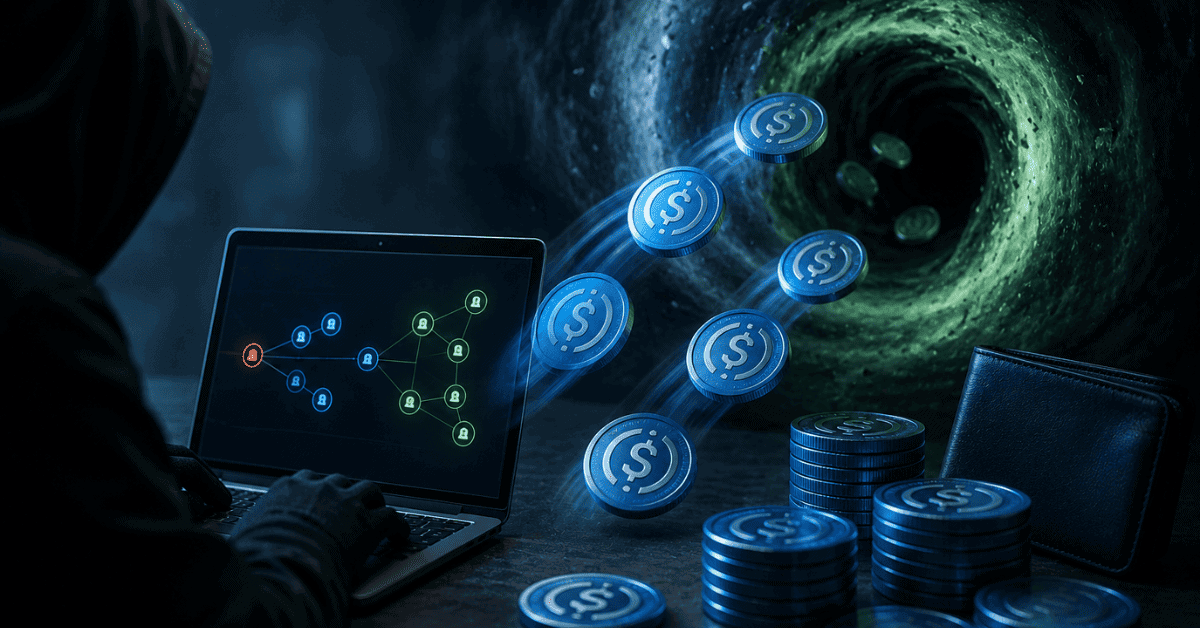
Hinkal exploit concerns are spreading across DeFi after the privacy protocol reportedly lost about $820,000 in USDC, with attacker-linked funds quickly moving through Tornado Cash and THORChain.
The incident is especially awkward because Hinkal is built around confidential stablecoin transfers. It is not a random meme token contract or a forgotten DeFi farm. Hinkal positions itself as privacy infrastructure for users and institutions that want to move stablecoins without exposing sender, receiver and amount details on public blockchains.


That makes the exploit more than another security headline. It is a reminder that privacy protocols face two problems at once: keeping user activity confidential and keeping their own smart contracts safe.
What Happened to Hinkal
According to blockchain security alerts and crypto market reports, the attacker drained Hinkal through a suspicious sequence of USDC withdrawals from its Ethereum contracts.
The reported exploit involved a “proofless deposit” interaction followed by repeated transaction calls that allowed the attacker to pull funds from the protocol. The wallet linked to the attack reportedly received multiple 25,000 USDC transfers in quick succession, suggesting an automated or highly prepared exploit rather than a slow manual drain.
The stolen funds were then swapped into ETH, making them easier to move through common laundering routes. Reports said about 410 ETH, worth roughly $700,000 at the time, was deposited into Tornado Cash. Another 44.7 ETH was reportedly moved through THORChain from Ethereum toward Bitcoin.
That speed matters. In DeFi exploits, the first hour often determines whether any funds can be frozen, intercepted or traced before they scatter across mixers, bridges and cross-chain liquidity.
Why Tornado Cash Appears Again
Tornado Cash remains one of the most familiar names in crypto laundering stories because it is designed to break the visible link between deposits and withdrawals.
That does not mean every Tornado Cash user is a criminal. Privacy tools can have legitimate use cases, especially on public blockchains where every payment can expose a user’s balances, counterparties and habits. But Tornado Cash has also repeatedly appeared in exploit flows because it gives attackers a fast way to make tracing harder.
In this case, the use of Tornado Cash was predictable. Once funds were converted into ETH, the attacker could use fixed-size deposits to make the trail more difficult to follow. Moving part of the funds through THORChain adds another layer because cross-chain swaps can shift value from Ethereum into Bitcoin without relying on a centralized exchange.
For investigators, that does not end the trail. It just makes the recovery window much shorter.
A Privacy Protocol Getting Exploited Is Especially Sensitive
The Hinkal incident is uncomfortable because the protocol exists to solve a real problem.
Public blockchain payments are transparent by default. A company paying contractors in stablecoins can accidentally reveal its payroll structure. A treasury wallet can expose vendor relationships. A fund can leak trading patterns. Even ordinary users can have their financial history mapped by anyone with a block explorer.
Hinkal’s model tries to solve this with zero-knowledge proofs and shielded stablecoin transfers. Polygon recently integrated Hinkal into private payment flows, allowing users to send stablecoins without publicly revealing the sender, receiver or amount.
That use case is serious. Institutional stablecoin adoption probably needs some form of confidentiality if businesses are expected to move meaningful payment volume on-chain.
But the exploit shows the trust problem clearly. If privacy rails are going to handle institutional flows, users need confidence not only in the cryptography, but also in the implementation, contract logic, monitoring systems and emergency response procedures.
The Difference Between Privacy and Safety
Privacy is not the same thing as safety.
A protocol can hide transaction details from public view while still having a bug in its smart contracts. It can be non-custodial while still routing funds through contracts that need to behave exactly as designed. It can use zero-knowledge proofs while still depending on surrounding code, integrations and assumptions that may fail.
That is why privacy infrastructure needs especially strong security standards. When something goes wrong, the same features that protect legitimate users can also make attacker recovery harder.
This is the trade-off the industry keeps running into. Crypto users want privacy. Regulators want traceability. Institutions want confidentiality but also compliance. Builders want neutral infrastructure, but victims want stolen assets frozen fast.
The Hinkal exploit sits directly in the middle of that conflict.
What Users Should Watch Next
The immediate questions are whether Hinkal publishes a full post-mortem, whether any contracts remain paused or restricted, and whether affected users can recover funds.
Security teams will also want to know exactly where the failure happened. Was the issue caused by a proof verification flaw, a contract logic bug, a misconfigured deposit path, or something in surrounding infrastructure? The answer matters because other privacy protocols may need to check whether they share similar assumptions.
Users should be careful with any Hinkal-related contracts until the team provides clear guidance. They should also avoid interacting with suspicious recovery links, fake compensation forms or impersonator accounts that often appear after exploits.
The worst moment to rush is immediately after a hack, when confusion is high and scammers know users are looking for answers.
A Warning for the Next Wave of Private Stablecoin Payments
The Hinkal exploit does not mean private stablecoin payments are dead. If anything, the demand for confidential settlement is likely to keep growing as more businesses experiment with on-chain finance.
But the incident does show that privacy infrastructure will be judged more harshly than ordinary DeFi apps. When a lending protocol is exploited, the market sees a security failure. When a privacy protocol is exploited and funds move into Tornado Cash, the market sees a security failure and a laundering problem at the same time.
That reputational risk is serious.
For Hinkal, the next step is transparency. Users need a detailed explanation, a clear recovery plan and evidence that the affected contracts have been reviewed. For the wider DeFi market, the lesson is broader: privacy cannot be treated as a feature alone. It has to be backed by security, monitoring, compliance design and fast incident response.
The future of private stablecoin payments may still be bright, but this exploit shows how fragile trust can be when privacy rails become attack targets.
Disclaimer: This article is for informational purposes only and does not constitute financial, investment, or legal advice. Always conduct your own research before making any investment decisions.