Tether’s USDT is the giant of the stablecoin world. With roughly $187 billion in circulation, it’s the third-largest cryptocurrency by market value and the dollar-pegged token most of the crypto economy runs on. For traders across the globe, USDT is the default way to move value, settle trades, and park funds. Its dominance has felt close to permanent.
A regulatory clock is now ticking that could change USDT’s relationship with the United States.


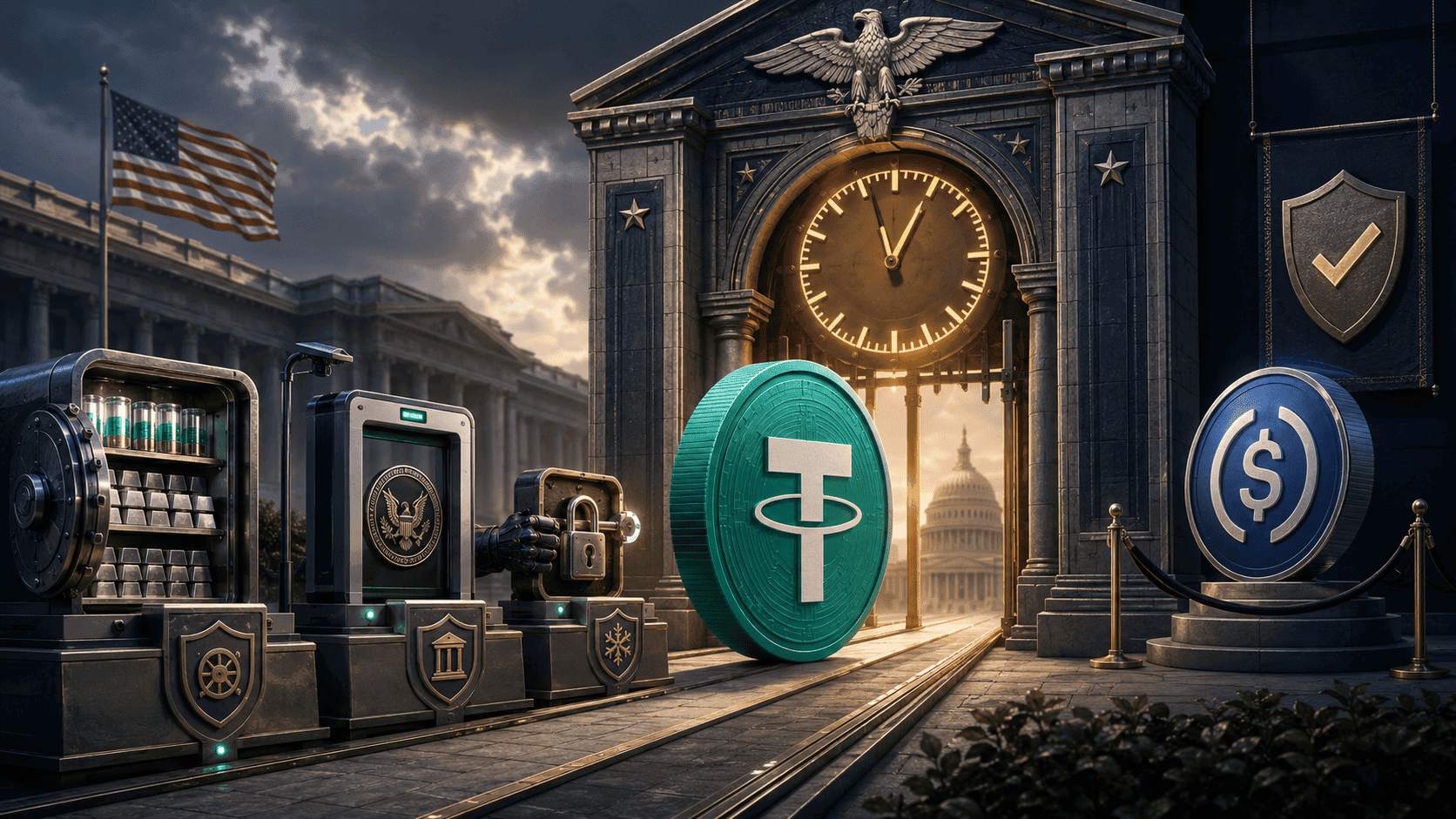
Saturday, July 18, marked the one-year anniversary of the GENIUS Act, the first major US federal law regulating stablecoins. And as analysts marked the milestone, attention turned to a looming deadline built into the law. The GENIUS Act included a three-year grace period for compliance. Two years now remain. After that window closes, US crypto platforms won’t be able to offer stablecoins whose issuers haven’t met the law’s regulatory requirements, and it’s not yet clear that Tether will clear that bar.
This isn’t a doomsday scenario, and the “two-year countdown” framing compresses a genuinely complicated picture into something more dramatic than it is. But the underlying tension is real. The world’s dominant stablecoin, issued by a foreign company that has historically operated outside US oversight, now faces a choice about whether and how to bring itself inside America’s regulatory perimeter.
What the GENIUS Act Requires
To understand the pressure on Tether, you need to understand what the law actually demands.
The GENIUS Act, signed into law on July 18, 2025, sets clear standards for any stablecoin issuer that wants to serve US customers. Issuers must be permitted entities holding 1:1 reserves in US dollars or equivalent liquid assets like short-term Treasuries. They must publish monthly disclosures detailing those reserves. And crucially for a foreign issuer, they must demonstrate the technical ability and formal commitment to follow lawful US orders, including freezing and seizing coins held by illicit actors.
For USDT specifically, the reserve requirements are the thorniest part. Tether’s reserves have historically included assets beyond pure cash and Treasuries, reportedly including precious metals, Bitcoin, and lending exposure. The GENIUS Act’s focus on cash and Treasury-backed assets raises a genuine question about whether Tether’s current reserve structure would satisfy the new rules without significant changes. Restructuring reserves at Tether’s scale is not a trivial undertaking.
To qualify as a compliant foreign issuer, Tether would likely need to register with the OCC, submit to US oversight and examinations, and secure recognition from the US Treasury that its home jurisdiction operates a stablecoin regime comparable to America’s. That’s a substantial compliance lift for a company that has long prized operating on its own terms.
The Deadline Is Murkier Than It Looks
Here’s where honesty matters, because the headlines have oversimplified a genuinely ambiguous situation.
The widely cited “hard” deadline is July 18, 2028, three years after the law was signed. On that date, it generally becomes unlawful for a US digital asset service provider to offer a non-qualifying stablecoin to a US person. That’s the date most analysts point to as the real cutoff.
But there’s disagreement among lawyers about whether foreign issuers get the full grace period. Some finance attorneys assume Tether has until July 2028 to comply. Others suggest foreign issuers would face certain requirements the moment GENIUS officially goes live, likely around January 2027. The OCC, the national bank regulator that will supervise some stablecoin issuers, added to the confusion with a footnote in a rulemaking proposal, noting the drop-dead date was generally 2028 but that it gets triggered earlier for foreign issuers that don’t meet “certain requirements.”
Those earlier requirements probably refer to the shorter-term obligations, chiefly the ability to freeze and seize bad actors’ assets on lawful order, rather than the full reserve overhaul. In practical terms, this means there are really several dates in play: January 2027 activates the compliance framework and the immediate freeze-and-seize demands, while July 2028 is the hard prohibition. The two 2027 milestones don’t ban USDT; they turn on the machinery that leads to the 2028 cutoff. Compressing all of this into a single “two-year countdown” obscures the staged reality.
Complicating matters further, the one-year anniversary was also supposed to be the deadline for federal regulators to finish writing the rules implementing GENIUS. They’ve fallen short. Several essential regulations remain unfinished, leaving the compliance path itself incomplete even as the deadline approaches.
Tether’s Options, and Its Head Start
Tether isn’t without a plan, and it’s important to note the company has already hedged its position.
In January 2026, Tether launched a separate, US-domestic stablecoin called USA₮ through Anchorage Digital Bank, a federally regulated, dollar-backed token designed specifically for the GENIUS Act framework. This gives Tether a compliant American product without having to force USDT itself through the full foreign-issuer process. However, USA₮ saw only low usage as of mid-2026, and its launch doesn’t automatically preserve USDT’s listings on US exchanges. Platforms would still need assurance that USDT’s foreign issuer meets every final legal condition before 2028.
That leaves Tether with roughly two years and a menu of choices: register USDT as a compliant foreign issuer, restructure its reserves toward cash and Treasuries, aggressively expand USA₮ as the US-facing product, or some combination of all three. When asked repeatedly about its compliance stance in recent days, the El Salvador-based company didn’t respond, and it hasn’t revealed a decisive strategy despite CEO Paolo Ardoino’s assurances last year that USDT would achieve US compliance.
What It Means for the Market
The stakes here extend well beyond Tether itself, touching the competitive balance of the entire stablecoin sector.
The clearest beneficiary of Tether’s uncertainty is Circle, whose USDC stablecoin is widely regarded as further along on GENIUS Act compliance. If USDT’s US access becomes doubtful, USDC becomes the natural default for American platforms, potentially accelerating a shift in market share that has long favored Tether globally. The broader stablecoin sector has seen a surge in issuance and a wave of firms, including traditional financial players and even Sony, pursuing US trust bank charters to smooth their regulatory pathways. The regulatory clarity GENIUS provides is reshaping who leads.
For US-based USDT holders, though, the practical advice is measured, not panicked. The law restricts regulated providers like exchanges, not private wallets. Nothing forces holders to liquidate USDT today, and self-custody remains unaffected. The sensible approach is to treat the period before July 2028 as a staged decision window: audit which platforms hold your USDT and whether they’ve published compliance plans, watch whether Tether clears the foreign-issuer bar, and keep a self-custody fallback. The cost of waiting rises only as the window narrows.
There’s also a wildcard. The GENIUS Act was meant to work alongside the broader CLARITY Act, which is still stalled in Congress. If CLARITY passes, it could overhaul some of GENIUS’s language, potentially reshaping these very deadlines. The regulatory picture isn’t fully settled.
The bigger story is that stablecoins are being pulled decisively into the traditional financial system. For years, USDT thrived precisely because it operated outside that system, offering fast, borderless dollars with minimal oversight. The GENIUS Act represents the moment that era starts closing in the US market. Whether Tether adapts, leans on USA₮, or cedes American ground to compliant rivals like Circle will be one of the defining stablecoin storylines of the next two years. The countdown has started. How Tether responds will determine whether the giant of the stablecoin world keeps its throne on American soil.
Disclaimer: This article is for informational purposes only and does not constitute financial or legal advice. Cryptocurrency investments carry significant risk. Always conduct your own research before making any investment decisions.