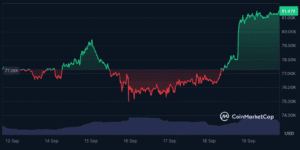
Bitcoin trades around $81,055 on Saturday after a Friday rally carried it roughly 4.1% higher from $77,900, reclaiming $80,000 and peaking between $81,700 and $81,750 before consolidating.
That is a notable place to end a week that delivered two events the market did not want.


The Senate blocked the CLARITY Act on Tuesday, with the measure attracting just 49 supporters against the 60 needed. The Federal Reserve raised its target range by 25 basis points to 3.75% to 4.00% on Wednesday, its first increase since 2023.
Bitcoin briefly fell below $74,887 on Tuesday and touched a monthly low near $75,900. It has since recovered roughly 8%.
Two headwinds, contained damage
The more interesting data point is what did not happen.
Bitcoin is down just 1.5% across September. The month has delivered an average loss of roughly 3% since 2013, so the asset is currently outperforming its own seasonal record during a week that produced a rate hike and a legislative defeat.
QCP Capital noted the 25 basis point move was fully priced before the decision, with odds sitting at 92% going in. A scheduled event is not a shock, and the pattern through 2026 has been that surprises move price rather than direction itself.
The CLARITY vote was procedural rather than final, though the practical effect is the same. Senate Democrats blocked advancement over government ethics provisions and presidential conflict of interest concerns, with community bank lobbying over stablecoin reward rules and Republican defections weakening momentum further.
The immediate damage was real. The vote triggered roughly $570 million in long liquidations, and XRP took the worst of it among large caps, which is consistent with how much of its thesis rests on regulatory resolution.
ETF flows tell the sequence
Institutional positioning through the week maps the recovery precisely.
US spot bitcoin ETFs shed $450 million on 15 September, the largest single-day outflow since June, followed by $296 million on the 16th. Flows turned positive on the 17th with $159.5 million, led by BlackRock’s IBIT at $184 million. Thursday added $159.5 million and Friday brought $433 million.
That gives $592.5 million of capital entry across two sessions, reversing the midweek redemptions.
Friday’s intake concentrated unusually. Fidelity’s FBTC captured $310.7 million, roughly 72% of the day’s total, lifting its lifetime net inflows to $10.36 billion. IBIT added $108.4 million, taking its lifetime figure to $64.13 billion. Bitwise took $9.7 million and VanEck $2.3 million.
Fidelity leading a session by that margin is unusual, since IBIT normally dominates the category.
What supported Friday
Three things converged.
The CFTC moved forward with its own crypto market structure proposal, effectively pursuing through rulemaking what the Senate declined to legislate. That reframed the CLARITY defeat as a delay rather than a dead end.
Treasury yields declined after the Fed decision, suggesting markets read the accompanying guidance as implying fewer increases ahead despite Chair Kevin Warsh’s hawkish framing on inflation. The Fed’s own projections point to limited further tightening.
Bitcoin’s mining difficulty adjusted upward to a record, indicating hashrate committed to the network at current prices.
Bitcoin decoupled from macro headwinds during Friday trading even as Treasury yields pushed back toward 5.00%.
The bear case has not gone away
Several readings argue the recovery is structural weakness rather than a turn.
Analyst VoidOnChain noted on Friday that bitcoin had completed another falling wedge beneath previously rejected $82,000 resistance, with liquidity concentrated near $61,000. A similar structure earlier this year preceded a slide toward $60,000. The same account described the current phase as re-accumulation and put $100,000 as a 2027 target rather than a 2026 one.
Glassnode-linked analysis flagged bitcoin slipping below the $76,700 True Market Mean for active holders as corporate buying slowed.
On-chain trackers also reported substantial exchange-bound transfers during the 15 September decline, with flows into Coinbase, OKX, Kraken and MAX Exchange while bitcoin traded near $76,115.
Bitcoin remains roughly 38% below its October 2025 peak near $126,200.
The levels that matter
Resistance sits at $82,000, the level that rejected price previously and caps the current wedge.
Above that, the psychological $85,000 zone is the next reference point. Below, $77,900 marks Friday’s floor, with $75,900 the monthly low and $74,887 Tuesday’s spike low.
The deeper structural level is $61,000, where liquidity is concentrated, and it becomes relevant only on a break well below the current range.
Sunday’s weekly close is the near-term confirmation. A close that holds above $80,000 would establish the first weekly reclaim of that level in the current move and support the argument that the market absorbed two significant negatives without breaking structure.
The October Fed meeting is the next scheduled risk. Goldman Sachs is already forecasting another 25 basis point increase, citing the Fed’s own near-term projections. Japan’s central bank also raised rates to a 31-year high on Friday.
Bitcoin has held better than the calendar or the news flow suggested it should. Whether that reflects genuine seller exhaustion or simply a market that has not yet repriced the tightening cycle is what the next fortnight resolves.
FAQ
What happened this week?
The Senate blocked the CLARITY Act on Tuesday with only 49 of 60 required votes, and the Federal Reserve raised rates 25 basis points to 3.75% to 4.00% on Wednesday, its first hike since 2023. Bitcoin fell below $74,887 before recovering above $81,000 by Saturday.
Why did bitcoin recover?
The CFTC advanced its own market structure proposal, Treasury yields declined on expectations of limited further tightening, and spot ETFs took $592.5 million across Thursday and Friday. Mining difficulty also hit a record.
What are the key levels?
Resistance at $82,000, which has rejected price previously. Support at $77,900, then $75,900 and $74,887. Sunday’s weekly close above $80,000 would be the first confirmation of a reclaim.
Disclaimer: This article is for informational purposes only and does not constitute financial advice. Cryptocurrency investments carry significant risk. Always conduct your own research before making any investment decisions.