For years, Solana carried a reputation it desperately wanted to shake. It was fast and cheap, but it also went down, suffering a string of network outages that made critics question whether a high-performance blockchain could ever be reliable. In 2026, Solana has spent the year methodically answering that question by rebuilding its infrastructure piece by piece. The centerpiece of that effort is now approaching its most important milestone.
It’s called Alpenglow, and it’s the largest change to how Solana works since the network launched in 2020.


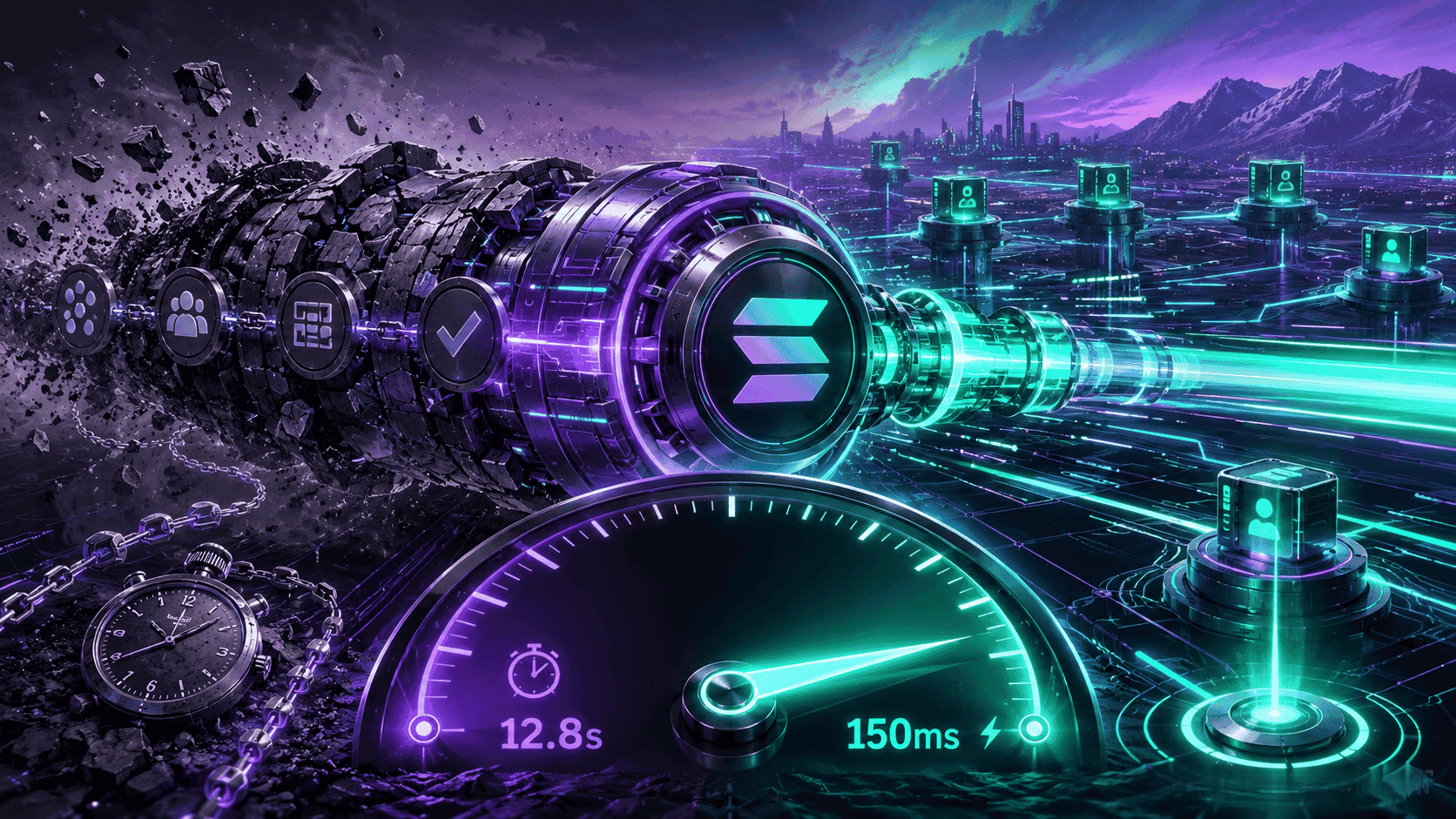
Solana validators are actively preparing for the rollout of Alpenglow, formalized under a proposal called SIMD-0326. The upgrade’s headline promise is dramatic: cutting transaction finality from roughly 12.8 seconds down to as little as 100 to 150 milliseconds, a nearly 100-fold improvement. Finality is the point at which a transaction becomes irreversible, essentially settled for good. Bringing that down to the blink of an eye would give Solana settlement speeds that rival the responsiveness of traditional internet applications.
To achieve this, Alpenglow doesn’t tweak Solana’s existing machinery. It replaces the two core mechanisms the network has relied on since day one: Proof of History and Tower BFT. Ripping out and rebuilding a blockchain’s consensus layer while it continues to run billions of dollars in value is a genuinely ambitious engineering feat. Understanding what’s changing, and where the project actually stands, reveals both the promise and the honest uncertainties of Solana’s most consequential upgrade.
What Alpenglow Actually Changes
At its heart, Alpenglow is about how validators, the computers that run the network, agree on the state of the blockchain. That agreement process is what “consensus” means, and it’s what determines how fast transactions finalize.
Solana’s current system uses a combination of Proof of History and Tower BFT. It’s highly performant by blockchain standards, but it requires a multi-step process where validator votes climb through layers of confirmation, taking nearly 13 seconds to reach deterministic finality. Alpenglow throws out this complex, layered architecture and replaces it with a streamlined, direct-voting structure built around two new components.
The first is called Votor, the new voting and finalization engine that replaces Tower BFT. Votor collapses the current multi-step confirmation process into just one or two rounds of voting. When 80% or more of validator stake participates, a block finalizes on a “fast path” in about 100 milliseconds. When participation is lower, around 60%, it finalizes on a “slow path” in roughly 150 milliseconds across two rounds. Crucially, Votor also moves validator votes off-chain, recording only a compact summary on the blockchain itself.
That off-chain move solves a hidden problem. Currently, vote transactions consume roughly 75% of Solana’s block space. By removing them from the chain, Alpenglow frees up that enormous capacity for actual user transactions, effectively expanding the network’s usable throughput as a side benefit of the speed improvement.
The second component is called Rotor, a redesigned system for sharing data across the network. However, an important detail often gets lost: Rotor is being deferred to a separate proposal down the line. The initial Alpenglow activation covers only the Votor consensus changes. Solana’s existing data-propagation system, Turbine, stays in place at launch. This means the breaking changes on day one are confined entirely to the consensus layer, a deliberate choice to reduce risk.
Where It Actually Stands
Here’s where honesty matters, because “nearing the finish line” needs precise context.
The governance mandate is exceptionally strong. When Solana validators voted on SIMD-0326 in September 2025, it passed with 98.27% approval. That’s an unusually clean result for a change of this structural depth, and it meaningfully reduces the coordination risk that has derailed other major protocol rewrites elsewhere. The proposal’s academic origins trace to distributed-systems research at ETH Zurich, lending it serious technical credibility.
The rollout has been methodically phased. Anza, the core development firm behind the upgrade, activated Alpenglow on a live community test cluster in May 2026, successfully validating the “Alpenswitch” transition mechanics that let the network migrate from the old system to the new one. Since then, Solana has shipped validator client updates on a steady six-week cadence, with the Agave 4.1 and 4.2 releases laying essential groundwork like new key-management systems that validators need before Alpenglow can go live.
The near-term milestones are concrete. According to Solana’s own development updates, the Alpenswitch is expected on testnet in July and on mainnet in August, with only the Votor portion shipping first. But that mainnet appearance is the beginning of the transition, not its completion. Full mainnet activation of Alpenglow is currently anticipated for late 2026, following community testing and security audits through the fourth quarter. Solana co-founder Anatoly Yakovenko has said mainnet could arrive as early as the third quarter if testing holds, but the official target remains late 2026.
So the accurate picture is this: validators are actively preparing, the transition machinery begins appearing on mainnet in August, but the full activation that delivers 150-millisecond finality is still months away and gated on successful audits.
The Honest Caveats
Two important qualifications deserve emphasis, because the headline numbers can mislead.
First, the 100-to-150-millisecond finality target is a design goal based on protocol specifications and testing environments, not a confirmed result observed on Solana’s live mainnet. An announced capability and real-world network performance are different things. Actual finality will depend on factors like validator participation levels and geographic distribution once the system is running at full scale. The target is credible and well-engineered, but it remains a target until proven in production.
Second, there are economic changes for validators that come bundled with the upgrade. Alpenglow eliminates the roughly 2 SOL per epoch that validators currently pay in on-chain vote transaction fees. In its place, it introduces a new once-per-epoch “Validator Admission Ticket” fee, set at 1.6 SOL, which is burned. This preserves a comparable cost structure while preventing an uncontrolled expansion of the validator set at launch. It also lowers the minimum profitable stake needed to run a validator, which could improve decentralization over time. These are meaningful shifts that validators are actively adjusting for.
What It Means
For Solana, Alpenglow represents a defining bet on its core identity. While Ethereum has embraced a modular approach that pushes execution to separate layer-2 networks, Solana is doubling down on making its single base layer as fast as possible. If Alpenglow delivers even close to its targets, it would give Solana settlement speeds approaching those of Web2 infrastructure, unlocking use cases in high-frequency trading, payments, and real-time applications that slower blockchains struggle to support.
The competitive stakes are real. Faster finality directly strengthens Solana’s pitch to the payments companies, DeFi protocols, and institutional users increasingly evaluating which blockchain to build on. Sub-150-millisecond settlement would let Solana credibly challenge not just other blockchains but traditional financial infrastructure.
For SOL holders and the broader ecosystem, the upgrade is a genuine reason for optimism, tempered by patience. The strong governance mandate, the methodical rollout, and the clean separation of the risky consensus changes from other components all suggest a well-managed process. But the full payoff arrives in late 2026, not this summer, and the promised speeds remain unproven at mainnet scale until then.
The network once mocked for going down is quietly executing one of the most ambitious infrastructure rebuilds in blockchain history, on a predictable schedule. Whether Alpenglow lands its 150-millisecond target on live mainnet will be one of the defining technical stories of Solana’s year. The finish line is in sight. It just isn’t quite here yet.
FAQ
What is Solana’s Alpenglow upgrade?
Alpenglow (formalized as SIMD-0326) is Solana’s largest consensus overhaul since the network launched in 2020. It replaces the two core mechanisms Solana has used since day one, Proof of History and Tower BFT, with a new architecture centered on Votor, a direct-voting engine. The goal is to cut transaction finality (the point at which a transaction becomes irreversible) from roughly 12.8 seconds to as little as 100-150 milliseconds, a nearly 100-fold improvement. It also frees up the roughly 75% of block space currently consumed by on-chain vote transactions.
When will Alpenglow go live?
The rollout is phased. The “Alpenswitch” transition mechanism is expected on testnet in July 2026 and on mainnet in August, but that marks the start of the transition, not full activation. Only the Votor consensus changes ship first; the Rotor data-propagation component is deferred to a separate later proposal. Full mainnet activation delivering the target finality speeds is anticipated for late 2026, following community testing and security audits through the fourth quarter. The proposal passed governance with 98.27% validator approval in September 2025.
Is the 150ms finality guaranteed?
No. The 100-150 millisecond target is a design goal based on protocol specifications and testing environments, not a confirmed result observed on Solana’s live mainnet. Actual finality will depend on real-world factors like validator participation levels and geographic distribution once the upgrade runs at full scale. Under Votor, a block finalizes in about 100ms on a “fast path” when 80%+ of validator stake participates, or roughly 150ms on a “slow path” at 60% participation. The engineering is credible, but the speeds remain unproven in production until mainnet activation.
Disclaimer: This article is for informational purposes only and does not constitute financial advice. Cryptocurrency investments carry significant risk. Always conduct your own research before making any investment decisions.