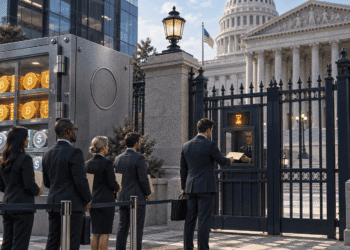
For over a year, the single biggest obstacle to America’s crypto market structure bill has been an ethics dispute. Democrats refused to advance legislation regulating an industry from which the sitting president personally profits, pointing to the roughly $1.4 billion in crypto earnings Trump’s 2025 financial disclosure listed as his largest income source. Republicans needed Democratic votes. The impasse held.
On July 22, Republicans finally produced an answer: a revised 616-page draft of the Digital Asset Market Clarity Act containing, for the first time, a full conflict-of-interest package covering the president and other senior officials.


Elizabeth Warren rejected it the same day.
“This bill should be dead on arrival,” said the Massachusetts senator, who serves as ranking Democrat on the Senate Banking Committee. Her staff simultaneously released an analysis arguing the new language is “riddled with massive loopholes” and “does nothing to prevent the President from making his next $1.4 billion in crypto profits.”
That reaction captures the problem now facing the most consequential crypto legislation in US history. The bill has nine legislative days before the Senate leaves for its August recess, widely regarded as the last realistic window to pass it in 2026. And by the current count, it remains nine votes short.
What the Revised Draft Actually Does
The new text merges language from the Senate Banking and Agriculture Committees and represents a genuine attempt at compromise, negotiated between the White House and Republican senators Cynthia Lummis and Bernie Moreno.
Its centerpiece is the ethics division. The bill would bar the president, vice president, members of Congress, federal judges and other covered officials, along with their spouses, from issuing or sponsoring a digital asset for compensation while in office. Covered officials would be required to divest crypto holdings or place them in blind trusts. The provisions carry a sunset clause, expiring on January 20, 2029 unless renewed.
The draft also adds a dedicated section strengthening law enforcement’s ability to investigate crypto crime through funding, training and tools. Lummis has pointed to more than 16 anti-illicit-finance safeguards in the text as a direct response to critics.
But the draft retained several disputed provisions rather than resolving them. The fight over stablecoin rewards, essentially a Coinbase-versus-major-banks dispute over yield revenue, remains unsettled. So does the contested language shielding software developers from money-laundering obligations, which federal prosecutors have warned could hamper criminal investigations.
Why Democrats Rejected It
The most contentious detail isn’t in the ethics rules themselves but in who enforces them.
Under the Republican draft, the Department of Justice would have sole authority to enforce the ethics provisions through civil proceedings. Democrats have objected that this concentrates enforcement in an agency the president controls, and they want state attorneys general to share that authority. Warren went further, arguing the structure “bars the next Department of Justice from ever holding Trump accountable.”
Democrats also had no input into the ethics language, which was negotiated between Republican senators and the White House and presented largely as finished. That process alone hardened opposition among senators who had spent a year demanding a seat at that table.
Crucially, the resistance extends well beyond Warren. Seven Democrats whose support is considered decisive, including Senators Angela Alsobrooks, Mark Warner, Catherine Cortez Masto and Ruben Gallego, have said the current draft falls short on ethics, illicit finance and consumer protection. Gallego and Alsobrooks both voted for the bill in committee in May but explicitly characterized those votes as conditional rather than floor commitments.
The Math Problem
The vote count is where the situation becomes genuinely difficult, and the numbers are unforgiving.
The bill needs 60 votes to clear a procedural filibuster. Republicans hold 53 seats, and their majority has thinned in practice, with Senator McConnell missing votes for a medical issue and the death of Senator Lindsey Graham. By one running tally circulating this week, 51 of 53 Republicans support the bill while zero of 47 Democrats have publicly committed. At least 12 Democrats are firm no votes. Roughly 25 have not declared either way, so nothing is final, but the bill sits about nine votes short with days to close the gap.
The crypto industry has mounted a final lobbying blitz. The Digital Chamber, Crypto Council for Innovation and Blockchain Association sent a joint letter urging Senate leaders to begin the floor process regardless, praising the draft’s illicit-finance improvements and consumer protection framework. “For the United States to maintain its position as the global leader of financial innovation, there is no substitute for the long-term certainty of durable market structure legislation,” the group CEOs wrote.
Senate Banking Chair Tim Scott has backed the push, and Majority Leader John Thune had committed to trying to bring the bill to the floor. Bipartisan negotiations are expected to continue through the weekend, with Republicans hoping to open the floor process next week. However, some reports on Friday indicated Thune has now acknowledged the bill will not pass before the recess, a signal that would effectively close the 2026 window. Prediction markets reflect the pessimism: Polymarket odds of 2026 enactment sit near 37-38%, down from over 80% earlier this year.
What Failure Would Cost
If the bill doesn’t advance before the August recess, the consequences extend well past a delayed vote.
The Senate calendar leaves roughly three weeks of productive session after September before lawmakers enter full midterm campaign mode. November’s elections could shift control of Congress, potentially sending the legislation back to the starting line. Senator Lummis has warned that missing this window could push market structure legislation to 2030 or kill it entirely when the 119th Congress ends in January 2027, forcing a complete restart.
The market consequences are already visible. Citi cited legislative uncertainty as a factor in its revised Bitcoin and Ether outlooks, and the stalled bill has been repeatedly flagged as a drag on institutional allocation. Asset managers exploring digital asset exposure have withheld capital commitments pending clear rules, meaning every month of delay keeps institutional money on the sidelines.
Even a successful Senate vote wouldn’t end the process. The bill would still need reconciliation with the House version, which passed 294-134 in July 2025, before reaching the president’s desk.
The deeper story here is that crypto’s legislative fate has become inseparable from a political fight that has little to do with market structure. The technical questions, which tokens are securities, which are commodities, who regulates what, have largely been settled through months of negotiation. What remains unresolved is whether Congress can regulate an industry while the president profits from it, and who gets to enforce the answer. Nine days remain to find one.
Disclaimer: This article is for informational purposes only and does not constitute financial or legal advice. Cryptocurrency investments carry significant risk. Always conduct your own research before making any investment decisions.