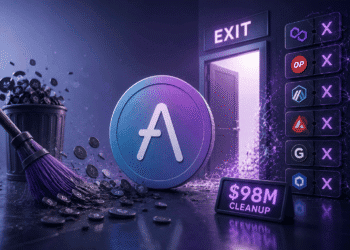
Two things happened at Aave this week that, taken together, tell a story about where decentralised finance is actually heading in 2026. On April 13, the Aave DAO passed a governance proposal called the “Aave Will Win” framework, which for the first time directs all future product revenue back into the DAO treasury rather than to Aave Labs. On April 14, a single unknown wallet deposited $350 million USDT directly into the Aave lending protocol in one of the largest single inflows to any DeFi protocol in months. The timing was not confirmed as connected, but the message it sent was hard to miss: someone with very deep pockets looked at Aave’s governance situation and decided to put serious money in.
What Aave Actually Is
For anyone not familiar, Aave is the largest decentralised lending protocol in the world. It works like a bank, except there are no bankers. Users deposit crypto assets and earn interest. Other users borrow against collateral and pay interest. The difference goes to the protocol. Aave holds about 30% of the total DeFi Total Value Locked as of April 2026, showing the concentration of capital into deeply liquid and audited platforms. The protocol recently crossed $1 trillion in cumulative lending volume, a milestone no traditional finance competitor has come close to matching on-chain.


The AAVE token gives holders the ability to vote on how the protocol is run: what assets are listed, what interest rates look like, how revenue is spent. That governance right has become valuable this year in ways it had not been before.
What “Aave Will Win” Actually Means
Aave has had a difficult few months internally. A $51 million funding proposal from Aave Labs sparked fierce debate within the community. Core developer BGD Labs announced it was leaving in April due to governance friction. The protocol’s founder was accused of using his voting power to dominate controversial proposals. It looked, for a moment, like DeFi’s biggest lending protocol might be tearing itself apart.
The Aave DAO approved the “Aave Will Win” framework on April 13, directing all future product revenue to the DAO treasury. The significance of this is easy to understate. Before this vote, revenue generated by Aave’s products could flow to various parties including Aave Labs. After it, every dollar the protocol earns goes into the shared treasury controlled by AAVE token holders. It is the DeFi equivalent of a company switching from paying management fees to returning all profits to shareholders.
Aave Labs also achieved SOC 2 compliance on April 11, an enterprise-grade security attestation that strengthens the protocol’s appeal to regulated institutions. SOC 2 is the standard that banks, insurance companies, and regulated funds require before they will touch a piece of software with real money. Getting it is not glamorous, but it matters enormously for institutional adoption.
The $350 Million Deposit
Blockchain tracker Whale Alert reported a single 350 million USDT transfer from an unknown wallet directly into the Aave lending protocol. This is one of the largest single inflows to a DeFi protocol in recent months, deposited primarily into Ethereum-based pools.
Nobody knows who made the deposit. That is the nature of DeFi. But the context matters. The deposit arrived one day after the governance vote that made Aave’s revenue model cleaner and more aligned with token holders. It arrived weeks after Aave achieved SOC 2 compliance. And it arrived as the broader institutional DeFi story was accelerating. Apollo Global Management has been acquiring governance tokens in Morpho, Aave’s closest competitor. BlackRock listed its tokenised Treasury fund through Uniswap. The message from traditional finance has been consistent: they want access to DeFi rails, and they are willing to put real capital behind that conviction.
Why Wall Street Is Suddenly Interested in DeFi Governance
The Apollo and BlackRock moves earlier this year explained something important about why institutions are buying governance tokens rather than just using protocols. When BlackRock puts BUIDL on Uniswap, it is moving a traditional product onto decentralised rails. When Apollo buys MORPHO governance tokens, it is buying a say in how the rails themselves are built. If you are routing hundreds of millions through a protocol, you cannot tolerate arbitrary parameter changes voted in by holders with different incentives.
That logic applies directly to Aave. A protocol processing hundreds of millions in deposits, now with SOC 2 compliance and a revenue model that returns money to token holders, starts to look less like a crypto experiment and more like infrastructure worth owning a stake in. Aave, Morpho, Uniswap, and Hyperliquid are becoming the new shared permissionless execution and credit venues that institutions route through rather than replicate.
The governance disputes of the past few months were painful for the Aave community but arguably necessary. A protocol that has worked through its internal funding arguments, established who controls the revenue, and achieved enterprise security certification is a more credible counterparty for a regulated institution than one still figuring out its power structure.
Whether the $350 million whale is an institution, a DAO treasury, or a private family office with strong conviction is unknown. What is clear is that the “Aave Will Win” vote and the deposit landed in the same 24-hour window, and whoever moved that money was not doing it by accident.