• About Us
  • Advertise
AltcoinReporter
  • Home
  • News
    • Bitcoin
    • Ethereum
    • Blockchain
    • Altcoins
    • DeFi
    • NFT
  • Press Releases
  • Reviews
    • Exchanges
    • NFT Marketplaces
    • Wallets
  • Market Analysis
  • Contact Us
No Result
View All Result
  • Home
  • News
    • Bitcoin
    • Ethereum
    • Blockchain
    • Altcoins
    • DeFi
    • NFT
  • Press Releases
  • Reviews
    • Exchanges
    • NFT Marketplaces
    • Wallets
  • Market Analysis
  • Contact Us
No Result
View All Result
AltcoinReporter
No Result
View All Result
Home DeFi

Aave Moves to Deprecate 50 Reserves and Exit Six Chains in $98M Cleanup

Aave plans to deprecate 50 low-adoption reserves and exit six chains in a $98M cleanup aimed at reducing protocol risk.

Dans Kramer by Dans Kramer
July 30, 2026
in DeFi
Aave Reserves

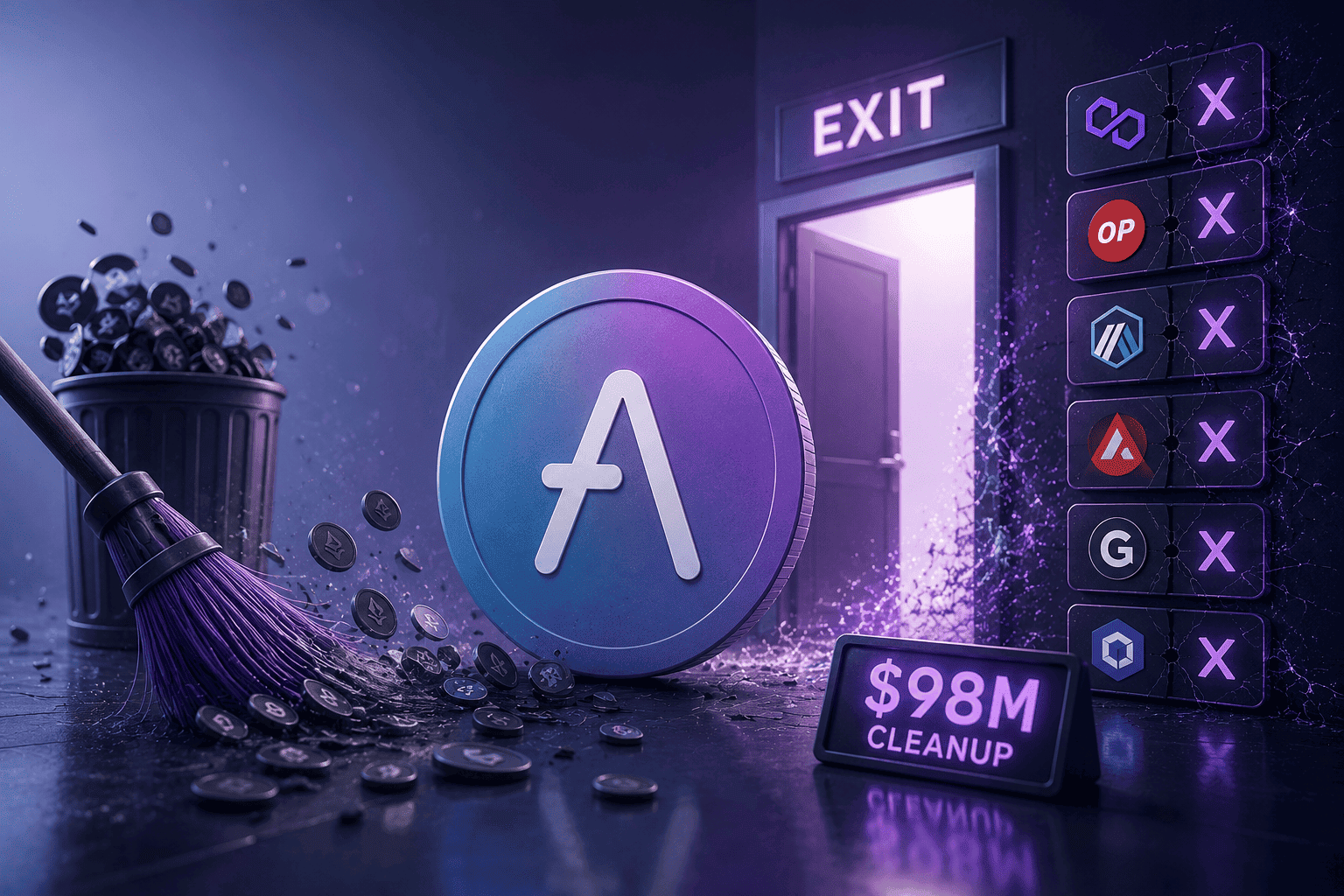
Aave is moving to deprecate 50 low-adoption reserves and wind down deployments on six blockchains in one of the DeFi lender’s biggest cleanup efforts to date.

The proposal, posted to Aave governance by risk provider LlamaRisk, targets underused markets across Aave V3 and affects about $98.1 million in supplied assets and $15.6 million in outstanding debt. The affected chains are Sonic, Scroll, zkSync, Metis, Soneium and Aptos.


Related articles

A $35 Million Wave of Bridge Hacks Shows Crypto’s Oldest Weakness Is Still Wide Open

A $35 Million Wave of Bridge Hacks Shows Crypto’s Oldest Weakness Is Still Wide Open

July 23, 2026
Uniswap’s Fee Switch Faces a Final Vote and a Memecoin Boom Is Fueling It

Uniswap’s Fee Switch Faces a Final Vote and a Memecoin Boom Is Fueling It

July 19, 2026

The plan is not yet live. It still needs to move through Aave’s governance process and pass an on-chain vote before the changes take effect. But the direction is clear: Aave is choosing a smaller, cleaner and more manageable risk footprint over keeping every low-usage market open.

Aave Is Cleaning Up Its Long Tail

Aave has grown into one of DeFi’s largest lending protocols by expanding across many assets and chains. That growth helped the protocol reach more users, but it also created a long tail of markets that now have limited activity.

LlamaRisk’s proposal splits the cleanup into two main parts.

The first part covers 50 individual reserves and 21 matured Pendle principal tokens across 11 Aave deployments. These markets hold about $85.3 million in supply and $11.5 million in debt.

The second part covers full wind-downs of six smaller deployments, Sonic, Scroll, zkSync, Metis, Soneium and Aptos. Those markets add another 25 reserves, with about $12.8 million in supply and $4.1 million in debt.

Together, the proposal touches 75 reserves, plus the matured Pendle tokens.

Why Aave Wants to Exit Six Chains

The reason is not only user activity. It is economics.

According to the proposal and follow-up reporting, each of the six deployments now generates less than $5,000 in quarterly protocol revenue. Metis, Soneium and Aptos reportedly generate less than $1,000 each.

That creates a simple problem. Every Aave deployment requires monitoring, risk management, oracle maintenance, liquidation paths, governance attention and technical support. If a market barely generates revenue, the cost of maintaining it can outweigh the benefit of keeping it live.

In DeFi, small markets can still create big risk. Thin liquidity can make liquidations harder. Weak demand can leave stale caps and inactive reserves. Low-volume assets can become expensive to monitor relative to their actual use.

Aave’s proposal is therefore less about shrinking for its own sake and more about removing operational drag.

What Happens to Users

The plan is designed as an orderly wind-down, not an abrupt shutdown.

For most affected reserves, Aave would freeze the markets, reduce supply and borrow caps to 1, and prevent new activity. Existing positions would remain open, giving users time to unwind rather than forcing an instant exit.

For reserves with active borrowing, the proposal also raises the reserve factor, which routes more interest to the protocol rather than suppliers. On the six full deployments being wound down, borrow-carrying reserves would see the reserve factor rise to 99% and the base variable rate move to 5%.

That structure is meant to nudge users out of the markets. Borrowing becomes unattractive, new deposits are blocked, and existing positions can be closed over time.

The Pendle PTs Are a Different Case

The proposal also includes 21 matured Pendle principal tokens.

These are fixed-maturity DeFi instruments. Once they mature, their original purpose is largely finished. Leaving them listed on Aave can create unnecessary maintenance work without meaningful ongoing benefit.

That makes the Pendle removals one of the cleaner parts of the proposal. They are not being retired because of a sudden failure. They are being retired because their lifecycle has ended.

This is the kind of housekeeping that becomes more important as DeFi protocols mature. Lending markets cannot keep every expired or inactive asset forever without increasing complexity.

Not a Judgment on the Chains

Aave founder Stani Kulechov said the move should not be read as a view on any specific layer 1 or layer 2 network.

That distinction matters. Exiting a deployment can sound like a public vote of no confidence in a chain. In this case, Aave’s stated goal is to reduce its operational, technical and economic risk surface so it can focus on higher-impact markets.

That is a more practical framing. Aave does not need to be everywhere to remain dominant. It needs to be reliable where activity, liquidity and revenue justify the risk.

For smaller chains, however, the signal still matters. Losing Aave can reduce lending depth, stablecoin utility and institutional confidence in a local DeFi ecosystem.

Aave Is Acting More Like a Mature Financial Network

The move shows how DeFi governance is changing.

In earlier cycles, expansion was the default. More chains, more assets and more integrations were seen as signs of growth. Now, large protocols are being judged more on efficiency, risk control and treasury discipline.

Aave’s cleanup fits that shift. It follows a broader pattern of tightening parameters, reviewing inactive markets and focusing liquidity around higher-value deployments.

That does not make the decision risk-free. Users may dislike losing access to certain markets, and affected chains may see the exit as a setback. But from Aave’s perspective, complexity has a cost.

A Smaller Aave Could Be a Stronger Aave

The proposal marks a turning point for cross-chain DeFi.

Aave is not abandoning growth. It is trying to separate growth that matters from growth that only adds maintenance. That is a more disciplined model than keeping every deployment alive for appearances.

If governance approves the plan, Aave will become a little less spread out, but potentially more resilient. Fewer low-use reserves mean fewer weak points, fewer oracle dependencies and less monitoring burden for the DAO.

For users, the lesson is clear. DeFi markets are not guaranteed to remain open forever just because they were once listed. As protocols mature, inactive assets and underperforming chains may be phased out.

Aave’s $98 million cleanup shows that the next phase of DeFi may be less about launching everywhere and more about choosing where the risk is actually worth it.

Disclaimer: This article is for informational purposes only and does not constitute financial, investment, or legal advice. Always conduct your own research before making any investment decisions.

Dans Kramer

Dans Kramer Verified AltcoinReporter Author

Dans is a cryptocurrency writer at AltcoinReporter, focused on market analysis, trading strategies, and exchange reviews. He entered the crypto space in 2022, just after the bull run peak, and...

Read More
Tags: AaveDAODeFiRisk Management

Related Posts

A $35 Million Wave of Bridge Hacks Shows Crypto’s Oldest Weakness Is Still Wide Open

A $35 Million Wave of Bridge Hacks Shows Crypto’s Oldest Weakness Is Still Wide Open

by Salar Salek
July 23, 2026
0

Crypto's cryptography is, by and large, unbreakable. The mathematical foundations securing Bitcoin and Ethereum have never been cracked. So when...

Uniswap’s Fee Switch Faces a Final Vote and a Memecoin Boom Is Fueling It

Uniswap’s Fee Switch Faces a Final Vote and a Memecoin Boom Is Fueling It

by Salar Salek
July 19, 2026
0

For most of its existence, Uniswap embodied one of crypto's most frustrating paradoxes. The protocol was a runaway success, processing...

AI Trading Agent Tricked Into Sending $174,000 via a Hidden Morse Code Instruction

AI Trading Agent Tricked Into Sending $174,000 via a Hidden Morse Code Instruction

by Salar Salek
July 14, 2026
0

Crypto has seen every kind of theft: stolen private keys, phishing sites, smart-contract exploits, bridge hacks. But in May 2026,...

Robinhood Built a Blockchain for Wall Street. The First Hit Was a $150 Million Cat Coin

Robinhood Built a Blockchain for Wall Street. The First Hit Was a $150 Million Cat Coin

by Salar Salek
July 10, 2026
0

On July 1, Robinhood flipped the switch on its own blockchain at a London keynote grandly titled "The World Is...

DeFi Barely Flinched While Bitcoin Crashed 22%. Bitwise Thinks Something Bigger Is Happening

DeFi Barely Flinched While Bitcoin Crashed 22%. Bitwise Thinks Something Bigger Is Happening

by Salar Salek
July 10, 2026
0

There's an old rule of thumb in crypto: when the market gets scared, DeFi bleeds worse than everything else. Decentralized...

Load More
  • Trending
  • Comments
  • Latest
Solana Alpenglow Upgrade 2026: Launch Date, Features, and What It Means for SOL

Solana Alpenglow Upgrade 2026: Launch Date, Features, and What It Means for SOL

April 18, 2026
Dogecoin and Meme Coins

Dogecoin and Meme Coins Face a Reality Check as Speculative Demand Fades

June 14, 2026
Solana’s Alpenglow Upgrade: The Biggest Change to SOL Since Launch

Solana’s Alpenglow Upgrade: The Biggest Change to SOL Since Launch

April 7, 2026
Justin Sun vs WLFI: “See You in Court” as Backdoor Token Freeze Row Explodes

Justin Sun vs WLFI: “See You in Court” as Backdoor Token Freeze Row Explodes

April 13, 2026
North Korea’s Six-Month Con: How Hackers Stole $286M from Solana’s Drift Protocol

North Korea’s Six-Month Con: How Hackers Stole $286M from Solana’s Drift Protocol

0
Ethereum’s Glamsterdam Upgrade: What It Is and Why It Matters in 2026

Ethereum’s Glamsterdam Upgrade: What It Is and Why It Matters in 2026

0
Bitcoin’s Worst Q1 Since 2018: Can April Turn the Tide?

Bitcoin’s Worst Q1 Since 2018: Can April Turn the Tide?

0
Former UK Chancellor Kwarteng Leads Bitcoin Firm as Farage Backs BTC

Former UK Chancellor Kwarteng Leads Bitcoin Firm as Farage Backs BTC

0
Aave Reserves

Aave Moves to Deprecate 50 Reserves and Exit Six Chains in $98M Cleanup

July 30, 2026
The Fed Held Rates, but Three Officials Voted to Hike. That’s the Signal Crypto Should Watch

The Fed Held Rates, but Three Officials Voted to Hike. That’s the Signal Crypto Should Watch

July 29, 2026
Bitcoin Holds

Bitcoin Holds Near $64K as Fed Pause Keeps September Rate Hike Risk Alive

July 29, 2026
Lummis Says the CLARITY Act Is the Key to Stopping North Korea’s Hackers

Lummis Says the CLARITY Act Is the Key to Stopping North Korea’s Hackers

July 28, 2026

About

AltcoinReporter

AltcoinReporter is an independent crypto news platform built to keep you ahead of the market. We cover everything from Bitcoin and altcoins to DeFi, NFTs, regulation, and emerging blockchain technology.


Our editorial team delivers accurate news, detailed market analysis, and expert insights, with every article written and reviewed by named contributors. We are committed to transparent, independent reporting our readers can trust.

News

  • Altcoins
  • Bitcoin
  • Blockchain
  • DeFi
  • Ethereum
  • NFT

Reviews

  • Exchanges
  • NFT Marketplaces
  • Wallets

Company

  • About Us
  • Advertise
  • Write for Us
  • Contact Us

Disclaimer: AltcoinReporter.com provides cryptocurrency news for informational purposes only, not financial, investment, or legal advice. Crypto markets carry significant risk. Always do your own research and consult a financial advisor before investing. We may earn compensation through affiliate links, ads, and sponsored content, which are clearly labelled. AltcoinReporter is not responsible for any financial losses resulting from information on this site.

  • Cookie Policy
  • Ethics
  • Corrections
  • Editorial Standards
  • Privacy Policy
  • Terms & Conditions

© 2026 AltcoinReporter. All rights reserved.

No Result
View All Result
  • Home
  • News
    • Altcoins
    • Bitcoin
    • Blockchain
    • DeFi
    • Ethereum
    • NFT
  • Press Releases
  • Reviews
    • Exchanges
    • NFT Marketplaces
    • Wallets
  • Market Analysis
  • Contact Us

© 2026 AltcoinReporter. All rights reserved.