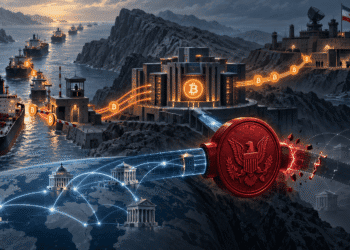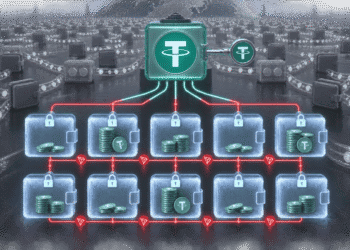
Arkham has identified wallets it says are linked to the Central Bank of Iran after a major $344 million USDT freeze on the Tron network, adding a new layer to one of the biggest stablecoin sanctions cases of 2026.
The freeze itself happened in April, when Tether worked with OFAC and U.S. law enforcement to freeze more than $344 million in USDT across two Tron addresses. Arkham’s fresh update says its investigators used those addresses as a starting point to trace a wider network and label the central state entity behind the flows as the Central Bank of Iran.


This is not just another wallet-labeling story. It shows how stablecoins, on-chain surveillance, sanctions enforcement, and public blockchain data now overlap in real time.
Why Arkham’s Iran Wallet Labels Matter
Crypto used to be described as hard for governments to track. That was never fully true, and cases like this make it even harder to believe.
Blockchains are public ledgers. If investigators can connect a wallet to a real-world person, company, or state entity, the rest of the transaction history becomes much easier to follow. Arkham’s business is built around exactly that kind of labeling.
In this case, the label matters because the Central Bank of Iran is already under heavy sanctions. If wallets tied to that institution are visible on a public intelligence platform, exchanges, compliance teams, and investigators can screen against them more easily.
That does not mean every related transaction is automatically criminal. But it does mean those wallets become much harder to use quietly.
What Happened in the $344 Million USDT Freeze?
The freeze involved two Tron addresses holding more than $344 million in USDT.
Tether said on April 23 that it supported the U.S. government in freezing the funds after the addresses were identified, preventing any further movement. The stablecoin issuer said the action was coordinated with OFAC and U.S. law enforcement.
TRM Labs later described the action as the largest on-chain freeze of Iranian sovereign crypto reserves on public record. The blockchain intelligence firm said OFAC designated two wallets as property of Iran’s Bank Markazi, also known as the Central Bank of Iran, with links to the IRGC-Qods Force and Hezbollah.
That is why the case drew attention beyond crypto circles. It was not only about stablecoins. It was about whether sanctioned state-linked actors can use public blockchains to move dollar-pegged assets, and whether issuers can stop them once addresses are identified.
Why Tron and USDT Keep Appearing in Enforcement Cases
USDT on Tron is popular because it is fast, cheap, and widely used.
Those same qualities make it useful for legitimate users and attractive to bad actors. A transfer can move across borders quickly, often at a lower cost than traditional payment rails. For people in difficult economies, that can be a lifeline. For sanctioned networks, it can become a way to move value outside the banking system.
That is the tension regulators now focus on. Stablecoins are useful because they feel like digital dollars. But when they circulate outside normal banking channels, governments want stronger monitoring.
Reuters reported earlier this year that U.S. authorities were intensifying scrutiny of Iran’s crypto activity, with blockchain firms giving different estimates of how much activity was retail and how much was state-linked. Chainalysis estimated that half of Iran’s crypto flows in 2025 were tied to the IRGC, while TRM Labs estimated most flows were retail but still identified thousands of IRGC-linked addresses.
Those differences matter. Iran has ordinary citizens using crypto as a hedge against inflation and sanctions pressure, while state-linked actors may also use crypto for sanctions evasion. Enforcement has to separate those groups, which is not always simple.
What This Means for Tether
The case also shows Tether’s unusual role in global crypto enforcement.
USDT moves on public blockchains, but Tether can freeze tokens at the smart contract level when it receives lawful requests tied to sanctions, crime, or other investigations. That power is controversial. Some crypto users see it as necessary for compliance. Others see it as proof that stablecoins are not censorship-resistant like Bitcoin.
In practical terms, it means USDT is not a safe hiding place for sanctioned wallets once they are identified.
Tether said the April freeze stopped more than $344 million from moving further. The company has also said it works with hundreds of law enforcement agencies worldwide and has frozen billions in assets tied to investigations.
Why On-Chain Intelligence Is Becoming More Powerful
Arkham’s update shows how a freeze can turn into a wider map.
Once two addresses are publicly tied to a sanctions action, analysts can look backward and sideways. They can study inflows, outflows, counterparties, timing, exchange links, and connected wallets. Over time, that builds a clearer picture of how a network moves money.
This is where public blockchains become a double-edged sword. They can help users send value quickly, but they also create permanent records. If a wallet is later identified, years of activity can become evidence.
That is why governments and compliance firms are investing heavily in blockchain analytics. Sanctions enforcement is no longer limited to bank accounts, shipping records, and shell companies. It now includes wallet clusters, token freezes, and stablecoin flows.
What Happens Next?
The next step is likely more scrutiny of wallets connected to Iranian exchanges, state-linked entities, and sanctioned networks.
OFAC’s April action already put specific Tron addresses into the sanctions perimeter. Arkham’s labeling could make it easier for the market to watch related activity, but it may also push bad actors toward new wallets, different chains, or less centralized assets.
That is the constant enforcement challenge. Freezing one set of wallets can stop funds that are already identified, but it does not end the search for new routes.
Stablecoins will stay at the center of this fight because they are useful, liquid, and dollar-linked. The more they become part of global payments, the more often they will appear in sanctions cases.
Key Takeaway
Arkham’s Iran wallet labels show how much crypto enforcement has changed.
A stablecoin freeze is no longer just a blocked address. It can become the starting point for mapping a wider financial network on-chain. For USDT users, the message is clear: stablecoins may move like crypto, but they are increasingly monitored like money.
Disclaimer: This article is for informational purposes only and does not constitute financial, investment, or legal advice. Always conduct your own research before making any investment decisions.