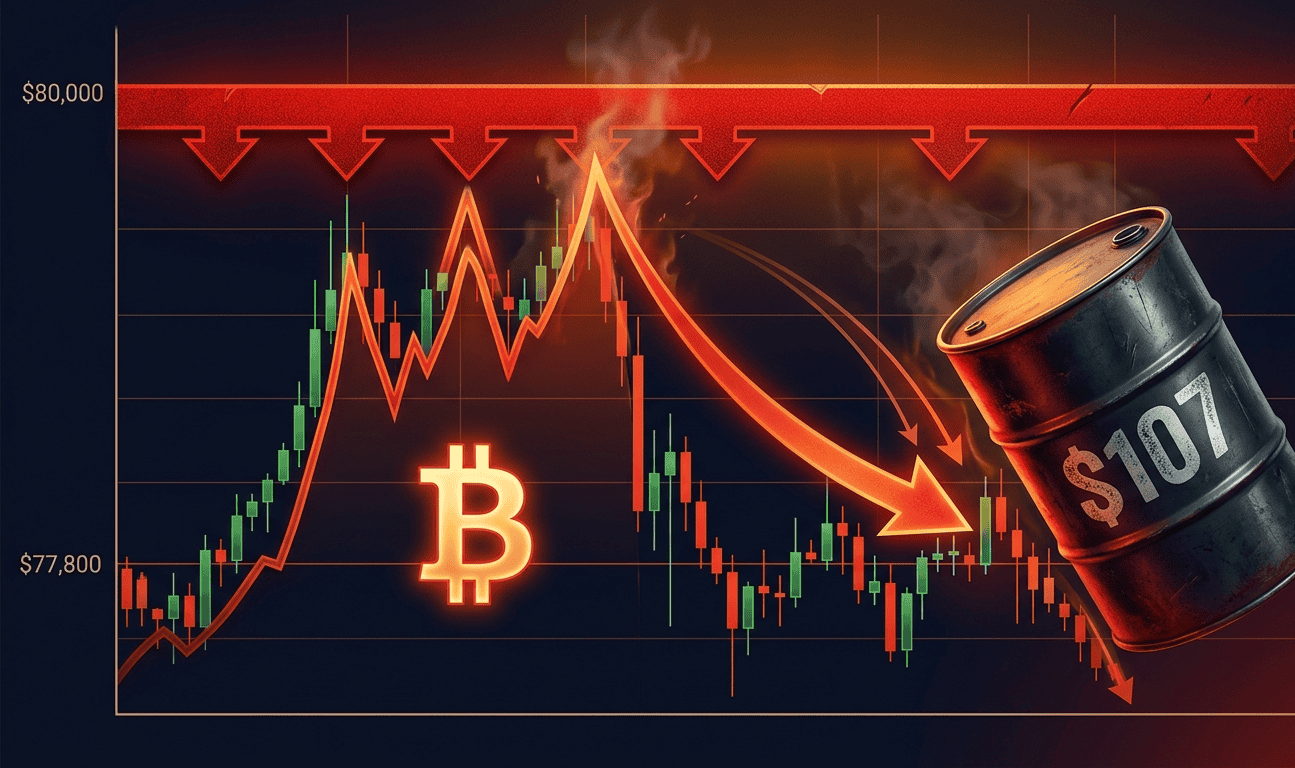
Monday started strong. Bitcoin touched $79,500 overnight as US equity futures and CME Bitcoin futures opened. For a few hours, $80,000 looked inevitable. Then oil happened.
Brent crude surged to $107 per barrel on reports of escalating US-Iran tensions, including the seizure of Iranian tankers in Asian waters. Bitcoin dropped 2% in an hour, sliding from $79,480 to $77,800. Altcoins got hit harder. LDO fell 17%. Major sector indexes dropped as much as 2.5%. About $300 million in futures positions were liquidated across the market.


This is the fourth time since February that Bitcoin has tried to break $80,000 and failed. Each rejection has followed the same pattern: rally on hope, reverse on oil.
Why Does $80,000 Keep Rejecting Bitcoin?
The number is not random. Two on-chain metrics sit right at this level, creating a wall of selling pressure that has blocked every breakout attempt.
The first is the True Market Mean at $78,200. This measures the average cost basis of all actively traded Bitcoin. When price reaches this level, the average active holder is at breakeven. Many of them sell rather than hold, especially after months of being underwater.
The second is the Short-Term Holder cost basis at $79,200. This is the average entry price of everyone who bought Bitcoin in the last few months. These are the people who bought during the ceasefire rally and watched their position go red almost immediately. When price reaches their entry, they sell to get their money back. That creates a predictable zone of supply between $79,000 and $80,000 that absorbs every rally.
For Bitcoin to break through cleanly, institutional demand needs to overwhelm those sellers. That has not happened yet, partly because oil keeps spiking at the worst possible moments.
What Is Oil Doing to the Crypto Market?
Oil is the invisible hand pulling Bitcoin’s strings in 2026. The relationship is simple. Higher oil pushes inflation expectations higher. Higher inflation makes the Fed less likely to cut rates. No rate cuts means tighter financial conditions, which is bad for risk assets. Bitcoin is a risk asset.
Every time Brent crude spikes above $100, Bitcoin stalls or reverses. When oil dropped from $103 to $85 in mid-April, Bitcoin rallied from $72,000 to $79,000. When oil rebounded to $107 today, Bitcoin gave back $2,000 in an hour.
The Iran peace talks collapsed over the weekend. Iran’s delegation left Pakistan without meeting US counterparts. Trump cancelled the American trip to Islamabad. Reports emerged that the US seized Iranian tankers in Asian waters. All of that pushed oil sharply higher on Monday morning and pulled Bitcoin sharply lower.
Until oil stabilises below $90 or a genuine peace deal reopens the Strait of Hormuz, the $80,000 ceiling will be very difficult to break. Bitcoin can rally all it wants on ETF flows and institutional buying. If oil spikes at the same time, the macro headwind overpowers the crypto tailwind.
Why Did Altcoins Get Hit So Much Harder?
This is the part that should worry altcoin holders. Bitcoin dropped 2%. Many altcoins dropped 5% to 17%. That gap tells you exactly where risk appetite stands right now.
LDO led the losses at 17%, making it the worst major performer of the session. LDO’s drop is likely connected to the broader DeFi fear following the Kelp DAO hack and Aave’s ongoing liquidity crisis. When the market sells off, the tokens most exposed to DeFi risk get hit first.
CoinMarketCap’s Altcoin Season index sits at 39 out of 100, firmly in neutral territory. It has not moved in a week. Last month’s high was 51. This is not altcoin season. It is not even close. Capital is concentrated in Bitcoin and to a lesser extent Ethereum. Everything else is struggling.
A few tokens bucked the trend. PENGU rose 9.1%, JUP gained 4%, and CHZ added 3.1%. But these were exceptions in a sea of red. When Bitcoin dumps 2% and the average altcoin dumps 5% to 10%, it means traders are fleeing to the exits and selling their riskiest positions first.
What Needs to Change for Bitcoin to Break $80,000?
Three things, and ideally all at the same time.
First, oil needs to drop below $95. That would ease inflation concerns and give the Fed room to signal future rate cuts. Every dollar oil falls makes the macro environment friendlier for Bitcoin.
Second, the Fed needs to sound dovish on Wednesday. If Powell’s final press conference leaves the door open for rate cuts later this year, risk appetite improves and institutional buyers have a reason to push harder through the $79,000 to $80,000 zone.
Third, ETF flows need to stay positive. The nine-day inflow streak brought in over $2 billion. If that pace continues through the FOMC meeting and the Big Tech earnings gauntlet, the cumulative buying pressure could eventually overwhelm the sellers sitting at $79,200.
Without at least two of those three, $80,000 will keep rejecting. And if oil spikes further or the Iran situation deteriorates, Bitcoin could fall back into the $74,000 to $76,000 range that held for most of March.
Today’s rejection was not a crash. It was a reality check. Bitcoin is in a genuine recovery from $60,000, and the institutional bid is real. But the macro environment is not cooperating yet. Until oil calms down and the Fed softens up, every push toward $80,000 will be a fight.
Disclaimer: This article is for informational purposes only and does not constitute financial, investment, or legal advice. Always conduct your own research before making any investment decisions.